


Curiosities
Why Greenwich Drops a Red Ball at One O'Clock
A ball above the Royal Observatory once helped ships check their chronometers. Its rising and falling still show how a clock can communicate without a dial.
By OnelROR Editorial Team · October 11, 2026 · Miami · 4 min read
A clock you watch move
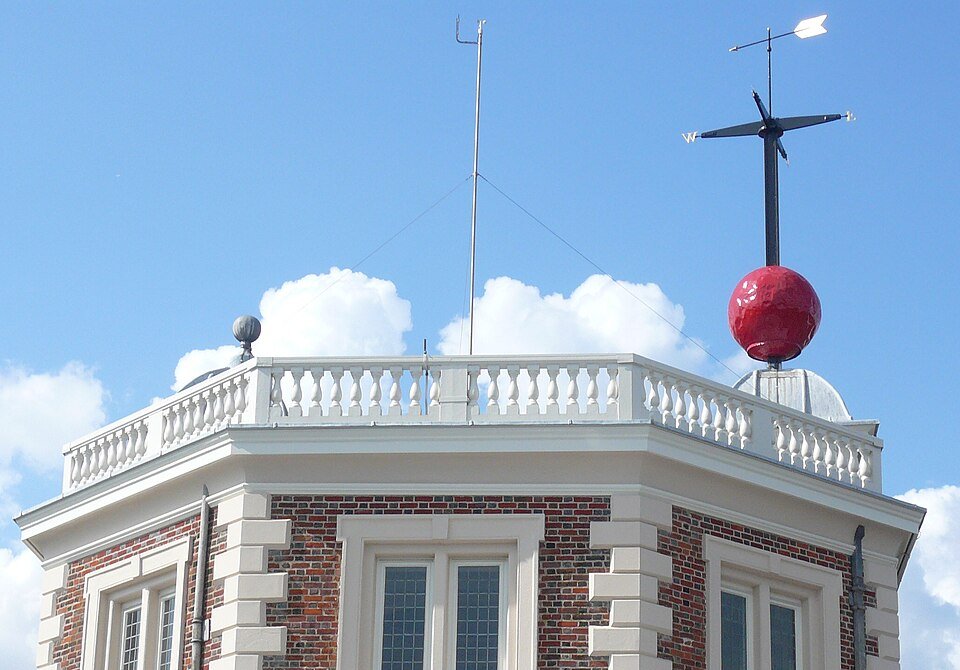
Above Flamsteed House at the Royal Observatory in Greenwich, a red ball travels along a mast. It has no hour hand and no numbered face. Its purpose is to make a particular moment visible: someone watching the movement can compare a separate timepiece with the signal.
Royal Museums Greenwich dates the first use of its time ball to 1833. Historian Graham Dolan's account explains its main audience: navigators on ships moored on the Thames and in the London Docks, checking their chronometers before departure. The ball distributed an observatory's time to people who could see it. It did not carry that time aboard a ship or measure the ship's position.
That distinction explains the object's unusual appearance. A large moving shape is a different way of communicating time from a small dial. The observer already knows what the scheduled event means; the movement supplies a reference against which another instrument can be checked.
The rise prepares you for the fall
The museum lists three stages: halfway up at 12:55 p.m., all the way up at 12:58 p.m., and a drop at 1 p.m. The earlier movements give an observer time to prepare for the signal.
The distinction between preparation and signal matters. Seeing the ball high on the mast is not the same observation as seeing it fall. A photograph can show the apparatus and one of its positions, but cannot establish when a particular day's signal occurred. The archive images here illustrate the objects, rather than document an October 2026 drop.
The published schedule uses 1 p.m. GMT in winter and 1 p.m. British Summer Time in summer. The museum says the ball will not run when it is too windy. Check current information before trying to watch.

Why a ship needed time from somewhere else
Longitude describes position east or west. A sea clock preserving a reference time let a navigator compare that time with local time and work out longitude. Royal Museums Greenwich explains this relationship in its account of marine chronometers. The useful instrument was therefore not simply a clock showing whatever time happened to be convenient aboard the ship.
Checking the chronometer before sailing addressed another problem: even a precision instrument could gain or lose time. In an October 31, 2024 collections essay, South Street Seaport Museum's Martina Caruso explains that captains rated their timepieces in port to account for their going-rate. A reference signal helped establish how the clock was behaving, rather than guaranteeing it would remain perfect throughout a voyage.
The ball and the chronometer performed separate jobs. One communicated a reference moment from shore; the other preserved time at sea. Confusing those roles makes the ball seem either magical or unnecessary. It was useful because a portable clock needed a reliable comparison before it was taken away from the reference.
Greenwich was part of a developing system
Greenwich's 1833 installation was not the beginning of every time-ball experiment. Both Dolan's history and the Seaport Museum's essay place Robert Wauchope's Portsmouth experiment in 1829. Caruso describes a design with one fixed ball and one movable ball: observers watched for daylight to reappear between them. That specific arrangement should not be mistaken for the appearance of the Greenwich apparatus in today's photographs.
Nor was a time ball useful to everyone. Dolan records a different service begun by John Henry Belville in 1836: he carried a pocket chronometer from the Observatory to subscribers who needed accurate time but could not use the ball. This makes the practical limit clear. A visible signal distributes time only to people able to observe it at the required moment.
A shared reference needs a delivery method. A mast, a transported timepiece and an electrical connection solve that delivery problem in different ways. Comparing them is more revealing than assuming the discovery of accurate time immediately made it available everywhere.

The dial beside the signal
The Shepherd Gate Clock offers a contrast. The museum describes a master clock installed in 1852 and connected to a dial at the Observatory gates. A dial can be read on arrival; the ball requires attention to a scheduled movement.
To understand the surviving ball, separate three questions: what is the reference time, how is the signal delivered, and what must the observer do to receive it? The red sphere answers the second question through motion. Its staged rise helps with the third. The chronometer photograph reminds us that receiving a signal was only one step in carrying useful time out to sea.
Watching the drop today offers a small, concrete lesson in how information travels. Knowing that a clock exists is different from receiving its time. Greenwich made that connection visible above a roof, and the surviving demonstration lets us read the logic of the system one movement at a time.