




The “False Dawn” Is Back: How to See Zodiacal Light This September
Science & Space | Skywatching guide
A faint pyramid of light can rise above the horizon before sunrise. A new NASA sky image puts this easily missed solar-system glow in focus—and September offers a useful reason to look for it yourself.
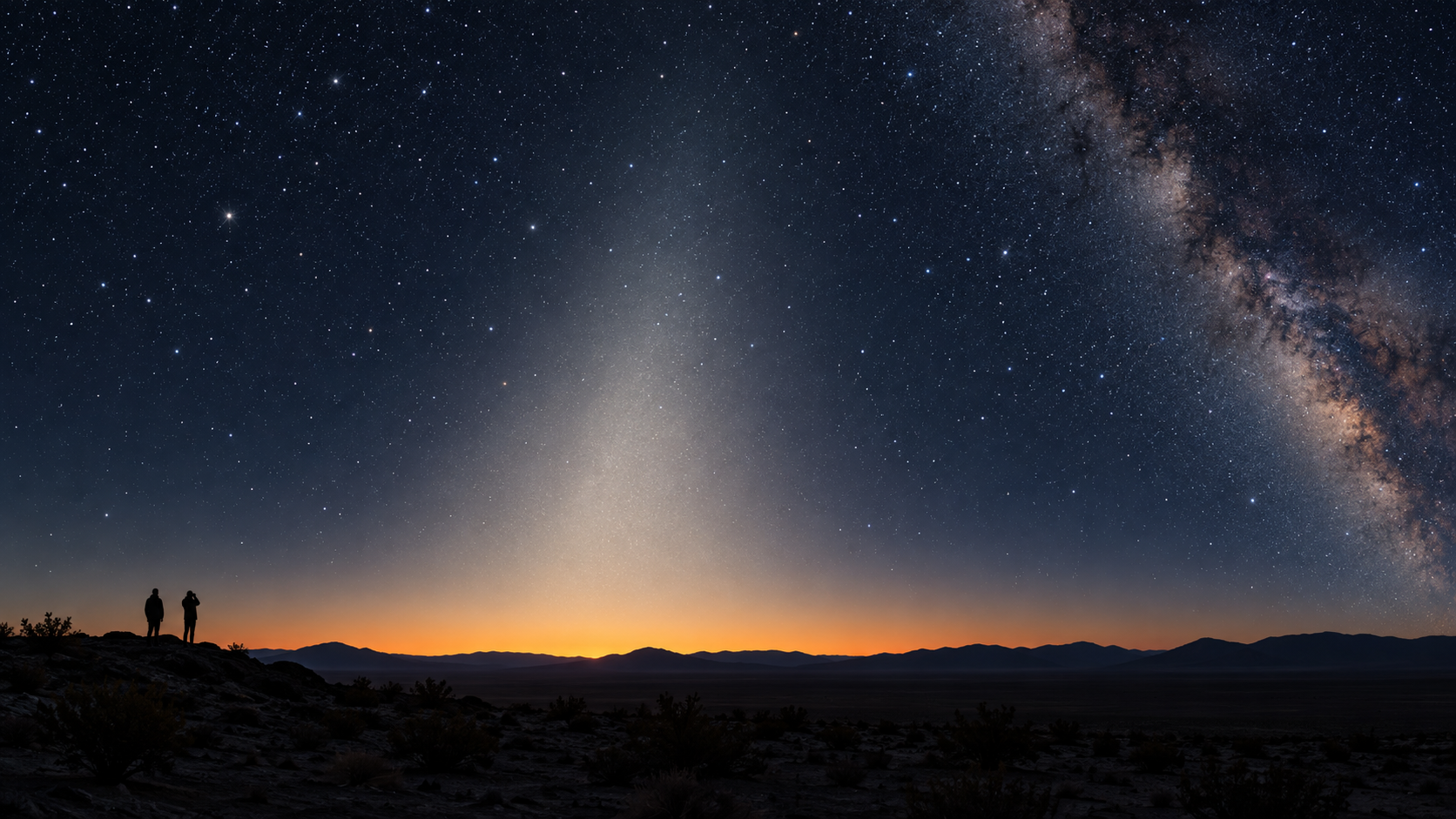
Featured image is an original conceptual illustration, not a photograph of the sky.
What appeared in the latest sky image
NASA’s Astronomy Picture of the Day for September 19 shows zodiacal light over India’s Hanle Dark Sky Reserve, photographed before astronomical twilight at a September star party. Jupiter, Mars and the Beehive star cluster appear in the scene, but the faint band is the main attraction. The date of NASA’s post is September 19, 2026; the image captures a skywatching scene, not a newly discovered celestial object.
The glow is sunlight scattered by tiny particles spread through the inner solar system. Because much of that dust lies near the plane of the planets, the light follows the ecliptic and can look like a tapered cone or wedge rising from the horizon. It is sometimes called the “false dawn,” but it is not the Sun coming up early and it is not the Milky Way.
Where and when to look
For a Northern Hemisphere observer near the September equinox, look toward the eastern horizon before morning twilight begins. NASA’s skywatching guidance describes the hour or so before twilight as a useful window. South of the equator, the corresponding opportunity is to look west after evening twilight. The precise timing and tilt depend on latitude and date; check your local astronomical-twilight time and the Moon’s schedule before leaving.
Choose a dark site with an unobstructed horizon, away from city lights. The glow is subtle: give your eyes time to adjust, keep phone screens dim, and avoid white flashlights. NASA’s dark-sky guide recommends considering the Moon and using red light to protect night vision. Never stop or stand in an unsafe roadside location for a view.
How to tell it from other light
Look for a broad, softly edged wedge that narrows as it extends upward along the planets’ path. Ordinary dawn tends to brighten the horizon more evenly and grows quickly as sunrise approaches. The Milky Way is a star-rich band that crosses much more of the sky; a distant town may make a stationary glow at the horizon without the zodiacal light’s taper. Thin clouds and light pollution can erase the effect altogether, so failing to see it on one outing is normal.
Why a little dust tells a larger story
Interplanetary dust is real material in our neighborhood, not an optical trick in Earth’s atmosphere. NASA notes that cometary and asteroidal material have been considered sources, while observations from Juno suggest Mars may contribute significantly. That finding is an interpretation of dust measurements, not proof that every visible particle came from Mars. Seeing the glow is a simple way to notice the disk of our solar system from the ground.
Sources: NASA APOD, September 19, 2026; NASA September skywatching guidance; NASA dark-sky guide.