


At the Hirshhorn, a Garden Becomes a Chamber-Music Program
ONELROR · CULTURE
At the Hirshhorn, a Garden Becomes a Chamber-Music Program
An Unsecret Garden’s announced October 3–4 program connects chamber music, birds and visual imagination. This expanded guide follows the repertoire after those dates, with practical ways to listen, look and plan a current museum visit.
OnelROR Editorial Team · Originally published October 2, 2026 · Updated October 10, 2026 · Miami · 25-minute read
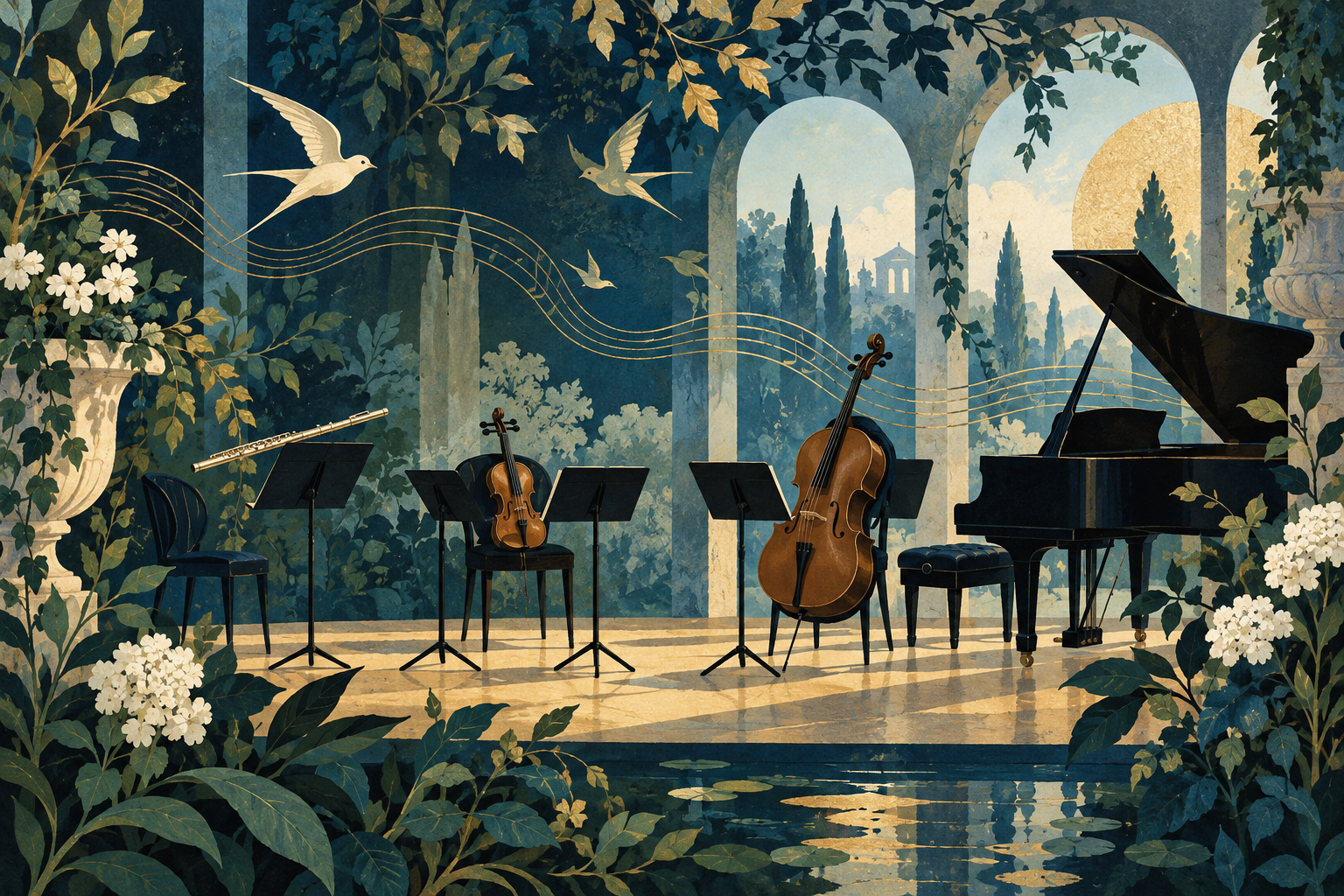
Opening image preserved: original conceptual illustration, not a photograph of the venue or performers.
An October program, read after its announced dates
An Unsecret Garden was advertised by the 21st Century Consort for October 3 and 4, 2026 at the Hirshhorn Museum’s Ring Auditorium. This article was first published on October 2 as an advance guide. Updated on October 10, it now treats those dates as past announced dates and develops the repertoire as a way to explore connections between music, visual art and imagined landscapes. It is not a concert review: we do not claim to have attended, heard the performances or verified how they unfolded.
The ensemble’s 2026–2027 season page lists the October program and identifies the instrumental combinations. Its published plan provides a sound basis for discussing what was proposed. It does not establish the atmosphere in the room, the interpretation of a particular passage or an audience’s response. Keeping that boundary visible lets the program remain useful after the dates have passed without turning an invitation into an invented report. The linked season page also states that programs are subject to change.
The garden in the title is an imaginative connection, not a claim that this concert took place outdoors. The announced October venue was the auditorium. The Smithsonian’s museum page, checked for this update, says the reimagined Sculpture Garden will open on October 31, 2026. That future opening and the earlier musical program are separate items. A visitor should use the current museum information for a trip, rather than infer outdoor access from the name of a past concert.
For a reader at home, the program offers another route. Choose a work that interests you, read its composer’s note where available, and listen through a legitimate recording or authorised performance source you can access. This guide does not promise a recording of the October event or a free stream of every composition. Its purpose is to make attention more specific: to help you notice musical relationships and compare them with visual ones while leaving room for a response that differs from the program’s imagery.
A garden can be a way of organising attention
A garden presents many possible objects of attention at once: a path, a boundary, a patch of colour, a changing shadow. A visitor chooses a route and finds that the same place looks different from another position. Music unfolds through time, so the listener cannot simply walk back to an earlier moment during a live performance. Yet attention can still change position. You can follow one line, notice the background supporting it, or hear a familiar gesture differently when another sound arrives.
The analogy becomes useful when it generates a question rather than a verdict. Ask where the music seems to lead your attention and what changes when you follow something else. Does a repeated figure make a passage feel stable? Does a new voice interrupt that stability or enrich it? These are listening prompts, not descriptions of a passage we have heard at the Hirshhorn. They can be used with any accessible performance of the listed repertoire, and a listener may find that a particular prompt is not relevant.
A garden image need not imply calm or decoration. An enclosed place can suggest shelter, separation, desire, order or constraint. A composer can use a landscape as a source of structure rather than imitate its noises. That distinction opens the program beyond literal birdsong. A title may invite associations without providing a scene-by-scene translation. If you search only for a sound resembling a bird, you may overlook the way a piece arranges space between voices, develops a small idea or changes the listener’s expectation.
The most productive approach is to retain two accounts: what the work’s documented context says, and what you notice in the music. They may support one another, but they need not match perfectly. Your description might begin with movement, distance or texture before it reaches any image of a garden. A composer’s explanation can then deepen that response rather than replace it. Treat the title as a door into the work, with enough freedom to notice something that the title did not prepare you to hear.
The program changes the size of the conversation
The Consort’s published list ranges from solo flute and solo piano to voice with piano, string trio, string quartet, and a mixed group of clarinet, violin, cello and piano. That variety is one of the clearest features a newcomer can use. Before listening, identify how many distinct parts the performance presents and what kinds of instruments or voices make them. You do not need to recognise every musical technique to notice that a single line and several interacting lines offer different ways of following a piece.
A solo performer may sustain the sense of a conversation by changing register, articulation or pace. Several performers may seem to speak together, exchange a gesture, or maintain different activities at the same time. The number of players does not dictate the emotional scale. A single instrument can feel expansive; a group can create an intimate and spare passage. These possibilities are more useful than assuming that a larger ensemble must sound grander or that a smaller one must be easier to understand.
One simple listening exercise is to choose a focus for a short stretch. Follow the lowest line, a repeated rhythm, or the part that seems to answer another. Then let your attention widen again. The aim is not to capture every event. It is to notice how a choice of focus changes the experience. If you cannot distinguish individual instruments, follow the contrast between a held sound and a moving one, or between a dense passage and a more open one. Those are valid points of entry.
The program’s changing combinations also make comparison practical. After listening to one work, write a brief description of how its parts interacted. For a second work, ask the same question rather than compare only whether you liked it more. A response such as one line repeatedly drew me away from another tells you something about attention. A response such as the instruments often moved as a block tells you something different. Neither requires a claim about the composer’s intention or a technical judgement about the musicians.
A solo line is not an empty ensemble
Pēteris Vasks’s Landscape with Birds is listed for solo flute, and Mikhail Johnson’s Wach Ya Haydn for solo piano. The program establishes their scoring; it does not tell us how either October performance sounded. A helpful starting point for solo music is to notice how a single performer establishes contrast. Changes can occur between short and sustained gestures, between registers, between motion and pause, or between a clear return and a fresh beginning. You can describe those differences without assigning a complete narrative to them.
For a flute work, one possible focus is the shape of a phrase: where it begins, how it moves, and where it seems to release its energy. The title may encourage a bird association, but do not require every gesture to represent a species or a literal call. No bird identification is offered here. If a sound evokes a call for you, retain that as a personal association and ask what it does within the phrase. Does it mark an interruption, a return, or a change in the space around the line?
For a piano work, the hands and registers can offer several layers even though only one person performs. You might hear a repeating pattern beneath another gesture, or a contrast between sharply defined attacks and a lingering resonance. Those are general possibilities for listening, not a catalogue of techniques claimed for Johnson’s piece. The title’s reference to Haydn should encourage curiosity about the composer’s own explanation where one is available; it is not a licence to invent which historical quotation the work contains.
A solo work can be a good place to practise modest description. Instead of deciding immediately what it means, note two or three audible features in language you can understand later. Keep the distinction between observation and association: a phrase rose is an observation if you heard that contour; it sounded like a bird taking flight is an image you brought to it. Both can be valuable. They do different work, and separating them makes a later conversation with another listener more precise and more open.
Voice and piano: listen for a relationship
Schoenberg’s The Book of Hanging Gardens introduces words and a singing voice into the program. The Arnold Schönberg Center’s account identifies Opus 15 as fifteen settings selected from Stefan George’s poetry, composed in 1908–1909 and first performed in Vienna on January 14, 1910. The source explains its break with traditional harmonic expectations. Those historical facts concern the work, not a report on the October 2026 performance or a judgement about its particular singer and pianist.
For a first encounter, begin with the relationship rather than the label atonal. Listen to what happens when the voice enters and what the piano is doing around it. Do the two appear to move together? Does one continue while the other pauses? Does the keyboard seem to frame a vocal phrase or introduce a different direction? These are questions to try with a performance you can access. You need not answer all of them, and you should not assume that any one question explains every song in the cycle.
Words add another layer of attention. If you do not understand the language, a reliable translation can supply context, but reading while listening changes your focus. Try a small passage first with attention on the sound, then revisit it with the text. Notice whether an impression changes. The point is not to test comprehension or infer a single correct emotion. It is to recognise that verbal meaning, vocal gesture and the piano’s contribution can shape the experience in different ways. This article reproduces no song text or translation.
The cycle’s separate songs also offer a manageable listening route. One short selection can be revisited without turning the first encounter into a demand to master the entire work. Afterward, return to the sequence and ask how the experience of a fragment differs within a larger span. A self-contained moment may gain a different weight when heard beside others. That is a general listening method, not a performance analysis claimed from this event. The documented history can orient you, while the act of listening supplies the specific evidence for your response.
Aviary Sketches: miniature worlds and three string voices
Helen Grime’s Aviary Sketches is a string trio after Joseph Cornell. The publisher’s work page describes five movements taking their starting points from Cornell’s works and includes the composer’s explanation of her interest in his miniature worlds. Her October 13, 2015 news item announced the US premiere for November 10 that year. Those earlier dates establish part of the composition’s history; they should not be confused with the Consort’s October 2026 listing.
A miniature world is a helpful idea for listening because it suggests a bounded space rich in relationships. Try to notice how an opening gesture establishes a character, and whether that character persists, changes or is interrupted. Then ask how the three voices share the space. You might follow one instrument for a while, then listen to how the others influence your sense of it. This is an approach suggested by the documented context, rather than a claim that the music literally reproduces the appearance of a particular Cornell object.
The movement boundaries provide another focus. A new movement can reset attention, continue an association, or create a contrast with what preceded it. If you listen through the work, pause afterward to recall how the sequence felt. Which transition remains vivid? Did a small gesture seem important in a later context? You do not need to identify a formal scheme to ask those questions. They turn the five-part structure into something you can explore through memory and comparison instead of treating the titles as labels to memorise.
The trio’s relationship to visual art also invites restraint. Seeing a reproduction of a Cornell work may deepen an association, but it does not make the music a set of illustrations with a fixed decoding key. Keep the visual source, the composer’s stated interest and your own listening response distinct. When you describe a musical moment as enclosed, playful or distant, make clear whether that word comes from a note, from an image, or from what you heard. The distinction does not weaken imagination; it makes the imagination easier to share.
Look at an artwork before asking it to explain the music
An encounter with visual art can begin with a simple inventory. What is present? Where does your eye go first? What sits near the edge, and what occupies the centre? Notice colours, boundaries, repeated forms and differences of scale before assigning a meaning. This is a method for looking, not a description of a Cornell object currently installed at the museum. The original program’s connection to Cornell and Grime’s documented interest in his work provide a reason to try the method, while the specific artwork supplies the evidence.
A reproduction is useful but has limits. It offers a view chosen by a photographer or publisher, at a scale and resolution that may differ from the object. A three-dimensional work can have relationships that a single image makes difficult to judge. Rather than invent what lies beyond the view, record the limitation. You can still notice composition and compare your response with a work note. The difference between a photograph of an object and standing before it is part of the encounter, not a defect to conceal.
When you turn to music, carry over a question rather than a visual answer. If the image drew your eye to a boundary, ask whether you notice musical boundaries or changes of texture. If an arrangement made small elements feel significant, ask how a short gesture functions in the piece. There may be no direct counterpart. That is a useful result, because it prevents the artwork from becoming a script imposed on the music. Comparison can reveal difference as readily as similarity.
A short note helps retain the distinction. Write one sentence describing a visible feature and another describing an audible one. Add a third sentence about the connection you imagine between them. The first two should be grounded in what you actually encountered; the third can remain exploratory. This approach is particularly suitable for a program linking art forms. It allows imagination to travel between them without claiming that a composer’s inspiration guarantees the same experience for every viewer and listener.
Plan and Elevation offers more than a garden title
Caroline Shaw’s own work page and February 2016 program note identify Plan and Elevation as a string quartet commissioned by Dumbarton Oaks, first performed there by the Dover Quartet on November 1, 2015. The five movements are The Ellipse, The Cutting Garden, The Herbaceous Border, The Orangery and The Beech Tree. Shaw relates the title to architectural views and the work to her experience of the grounds. This is the composer’s documented context, not a claim that the Hirshhorn garden supplied the composition’s original setting.
The distinction between a plan and a side view offers a practical listening prompt. One perspective concerns how parts fit into a whole; another concerns the detail of an encounter. Try listening first for a broad sequence of changes, then revisit a passage for a smaller feature. These are complementary tasks. A detailed moment may feel different when you understand its place, and a general impression may become richer when you notice the craft within it. You do not need a score to make that shift of attention.
Shaw’s note describes a ground bass supporting different musical characters. The phrase can be approached as a recurring foundation rather than an examination term. If you notice a pattern returning, ask what changes around it. Does the repetition make the surrounding activity feel more variable, or provide a point of orientation? Those are questions for your listening. They do not specify what any particular performance must emphasise, and they should not replace the details of the composer’s note with an invented story about the piece.
The movement names can orient a listener without becoming a test of botanical imagination. You are not required to hear a tree in a particular sound. You can ask how the experience of a movement differs from the previous one and then read the documented association. If your first impression does not resemble the image, keep it. A meaningful encounter with a work can begin with uncertainty or with a response the title did not predict. The garden is a context for the music, while the music remains an experience in its own medium.
Historical references invite curiosity, not a guessing contest
The published program includes Johnson’s Wach Ya Haydn, and Shaw’s own note discusses fragments from earlier quartet music within The Cutting Garden. References to other music can create a connection across time, but they can also distract a listener who feels obliged to recognise every source. A first encounter need not become a quiz. It is possible to notice a shift of character or a sense of interruption before knowing whether it refers to another work. Recognition can come later through reliable notes or further listening.
Independent criticism shows why a reference can be experienced in more than one way. In a May 1, 2019 review, George Grella praised the Attacca Quartet’s performance of Shaw while finding some backward glances in Plan and Elevation less convincing. That is his judgement of a different concert, not ours and not evidence about the Consort’s October 2026 performances. It supplies a useful contrast to the composer’s account: intention and a critic’s experience need not coincide.
A reference can be assessed through what it does where it appears. Does it change the direction, sharpen a contrast, or alter the sense of continuity? Once you know the source, does the relationship become more interesting, or does it draw attention away from the present work? These questions are interpretive, so two listeners may reach different answers. The disagreement becomes useful when each can identify the moment or relationship behind the response, rather than argue only over whether references are good or bad in general.
For a newcomer, the most productive sequence is listening, curiosity, checking and listening again. Let the initial experience provide a question. Consult a composer’s note or a dependable source for the reference. Then return to the work and notice whether the new context changes what you hear. Do not claim to identify a quotation because a title suggests it. The program’s historical associations are an invitation to investigate, with enough room to enjoy a musical relationship before you can name everything involved in it.

Entwining suggests a way to follow exchanges
Paul Novak’s Entwining is listed for clarinet, violin, cello and piano. The mixed instrumentation supplies a useful contrast with the all-string groups. It invites attention to how different sound characters can share a passage. The title suggests a relationship, but this guide does not claim to know the work’s specific formal plan from that title. Begin instead with something you can notice in a performance: when one part enters, how another responds, and whether the group appears to blend or maintain distinct activities.
Try following an exchange without deciding immediately who is the main voice. One part may draw attention because it enters first, another because it changes the texture, and another because it remains steady underneath. A listener’s sense of leadership can shift within a passage. Describing that shift is more informative than assuming the instrument with the most prominent sound must always carry the central idea. The relationship among parts is the focus, and it can be heard even when the individual technique is unfamiliar.
The same prompt can be used after a string trio or quartet. Ask what becomes different when a keyboard or wind instrument joins the group. Does the contrast help you separate activities, or do you notice moments of blending? Your response should come from the particular performance you encounter. A recording’s balance can influence it, as can where you sit at a live event. These factors do not invalidate the response, but they give it a context that should remain visible when comparing experiences.
An accessible note might use a few ordinary verbs: entered, answered, overlapped, held, broke off, returned. Such words describe relationships without pretending to deliver a complete technical analysis. Later, you can refine them if a score or work note supplies more detail. The modest vocabulary is a strength when used carefully. It lets you explain what caught your attention and invites another listener to compare it with what they heard, instead of hiding a vague impression behind a specialised term.
Sound colour: describe a difference before naming a technique
Timbre is often introduced as the colour or character of a sound. For practical listening, begin with a difference you can recognise: a smooth sound beside a grainier one, a sharply defined attack beside a softer beginning, or a ringing resonance beside a quick release. These descriptions are approximate and personal, but they can still be precise about a contrast. You do not need to identify how a performer produced the sound before you can notice that it changes the character of a passage.
Keep the description anchored to a moment. The whole work sounded bright is less useful than a particular entrance seemed brighter than what came before it. The latter supplies a comparison. It also leaves room for uncertainty: perhaps a change in register contributed, perhaps a different instrument entered, or perhaps the recording balance affected the impression. The aim is to notice the event honestly, then investigate if you want to. Do not turn a descriptive word into an unsupported claim about the score.
The varied forces of this program make that exercise especially practical. A voice and piano present one set of contrasts; a solo flute presents changes within one instrument; a mixed ensemble offers differences among several. Compare the kinds of difference rather than rank the works by how many colours you can name. A restricted palette can make a small alteration significant, while a broad palette can allow distinct voices to interact. Both can create an engaging experience through the arrangement of what is available.
After listening, choose one contrast that remains in memory and describe why it mattered to you. Did it draw attention to a new direction, make a return recognisable, or change the sense of closeness? The answer may concern your response rather than the composer’s plan. That is acceptable when stated as such. The more clearly you distinguish what you heard from what you infer, the easier it becomes to discuss musical colour without treating an evocative metaphor as a fact everyone must accept.
Repetition is an opportunity to hear change
A returning gesture provides an anchor. It may be repeated closely, altered, interrupted or placed in a different setting. A useful listening question is what feels familiar and what feels new. The answer can begin with a contour, rhythm or pattern that you recognise without being able to write it down. You do not need to count every return. Follow one that catches your attention and ask how its context changes the experience. The exercise works best when it remains small enough to sustain curiosity.
A hypothetical example makes the method clear. Imagine a short pattern heard alone, then later heard beneath a busier line. Even if the pattern itself is unchanged, it may play a different role in your attention. This is an invented example, not a passage attributed to any work in the program. It shows why repetition need not mean sameness. A returning element can become background, emphasis or orientation depending on what surrounds it and on what the listener remembers.
Memory is part of the process. A return may seem familiar even when you cannot identify the detail that creates the impression. Note that uncertainty rather than force a confident explanation. If you can revisit a recording, compare the moments; if you cannot, retain the response as a memory of the encounter. The difference between a checked comparison and a remembered impression matters, particularly when sharing a response afterward. Neither requires pretending to have a complete account of the piece.
For this program’s garden theme, repetition can be an imaginative counterpart to revisiting a path. The route may be familiar while attention falls on something different. Use that image as a prompt, then return to the audible evidence. Did a surrounding texture change? Did the pace feel different? Did your focus move? A metaphor is helpful when it sharpens those questions. It becomes limiting when it dictates that the music must behave like a landscape or prevents you from noticing a different relationship.
Silence and spacing belong to the experience
A pause can draw attention to what preceded it or prepare a different entrance. It can also be difficult to distinguish the end of a phrase from the end of a larger section on a first hearing. Rather than treat uncertainty as a failure, notice how the music manages expectation. Does the next sound feel like a continuation, an answer or a fresh beginning? The question concerns the relationship you experience, not a claim that every silence has one prescribed emotional meaning.
At home, allow a passage to continue before deciding that it has finished. If a recording divides a work into tracks, the interface may create a boundary that is different from the way you imagine the musical sequence. Check the track information when that distinction matters. This guide does not specify a recording edition or claim how the Hirshhorn concert handled transitions. It simply encourages a listener to separate a musical pause, a division in a work and a playback action, because those are different kinds of interruption.
Spacing also offers a connection with visual attention. An empty area in an image can affect the relationship between objects without representing nothing. A quieter musical span can similarly change how a later gesture is received. The comparison is exploratory. It does not require a visual empty space and a musical pause to mean the same thing. The useful habit is to notice the surrounding relationship, rather than regard only the most crowded or emphatic moment as worthy of attention.
A first listening session can have a modest goal
Choose one work or movement rather than trying to absorb the whole program at once. Before listening, read only enough to identify the work, the performers on the source you are using and its basic context. Select a single question: perhaps how the parts interact or what changes around a returning pattern. That gives attention a focus without demanding that every moment produce a conclusion. If the question proves unhelpful, let it go and follow something the music itself makes noticeable.
After the first pass, write three short notes: one feature you noticed, one association it prompted and one question you want to investigate. Keep them separate. A feature may be a contrast in texture; an association may be an image of a path; a question may concern the structure of a movement. The notes do not need to sound like a review. They are a record for yourself, intended to make a second encounter more purposeful and to prevent a later explanation from erasing the first response.
For the second pass, choose a different focus or check the question with a reliable note. Then compare the two responses. Perhaps you notice more, or perhaps the new context distracts you from an earlier impression. Both outcomes can be informative. Stop before the exercise becomes a demand to approve the music or prove that you understand it. The practical goal is a richer encounter, with enough detail to describe what changed in your attention and enough openness to return another day.
A gallery encounter can use the same discipline
For a museum visit, choose a manageable amount of looking. One artwork can supply a meaningful encounter if you allow time to notice it before reading every available explanation. Begin with what is visible, then consult the label for identification, date and materials. Return to the work and see whether that information changes your attention. This is a suggested method, not a requirement imposed by the museum. It can be adapted to a reproduction when travel is not possible, with the limits of the reproduction kept in view.
The Smithsonian’s institutional page lists Revolutions: Art from the Hirshhorn Collection, 1860–1960 through November 1, 2026. That exhibition listing is useful current planning information, but it does not guarantee that a particular object mentioned in an earlier program will be on view during your visit. Check the museum’s current exhibition and object information if one work is central to your plan. A general exhibition title should not be turned into a promise about a specific installation, a route through the galleries or unrestricted access to every space.
After looking, try the same three-note method used for music: feature, association and question. Comparing those records can reveal how attention differs between an object you can revisit physically and a piece that unfolds through time. You may discover that your strongest connection is about proportion or contrast rather than a shared subject. That is a valuable result. The program’s garden theme provides an invitation to compare; it does not require the museum visit to confirm a predetermined interpretation of the concert.
Plan a present visit from present information
As checked on October 10, the Smithsonian lists the Hirshhorn’s museum hours as 10 a.m. to 5:30 p.m. Tuesday through Sunday and noon to 5:30 p.m. Monday, with a December 25 closure. Its page says museum admission is free and no passes are needed. Those statements concern the museum’s general visit, not the registration arrangements for every special event. The page places it at Independence Avenue and Seventh Street SW in Washington, DC, and announces the Sculpture Garden opening for October 31. Recheck the official information before travelling.
Keep an event plan and a museum plan as separate items. Confirm the actual venue, date and any registration instructions for an event, then check the museum access that matters to the rest of the visit. The October program was advertised for the Ring Auditorium; a future program may use another location. Do not assume that a familiar series name guarantees a familiar entrance. If access arrangements or accommodations are important to you, use the museum’s current accessibility information and event contact rather than infer them from a photograph or an earlier listing.
A useful plan also has room for a change. If the particular exhibition or event is unavailable, decide whether the museum visit still serves your purpose. If it does not, adjust the trip instead of treating the original article as a guarantee. The same applies to the garden’s announced opening: an announcement supplies a date to check, while the current official visit page supplies the operational information nearer the time. This update adds planning context without claiming that the future opening has already occurred or that we have inspected the site.

An archive preserves the invitation without inventing the result
An old program remains useful as a record of an artistic proposal. It shows which works were brought together and what connections the organiser invited an audience to consider. It does not automatically establish the final running order, personnel, interpretation or reception. Those would require additional evidence. In this update, the announced October dates are retained as context, and the program is used as a listening guide. The difference lets the article stay useful without silently changing an advance notice into a retrospective account.
The season page also shows why current checking matters. It lists December 5, 2026 at the Smithsonian Arts and Industries Building, February 6–7, 2027 in the Ring Auditorium, and April 10–11, 2027 in the Sculpture Garden. These are published plans subject to change, not a promise that every future event will happen exactly as listed. The December location differs from the October one. That small practical distinction is the kind of information an old article cannot safely supply unless it is checked and dated.
The original MySmithsonian event link now returns a page-not-found message, so the update relies on the functioning ensemble season page for the announced program and on the museum’s institutional page for present visitor information. The dead link is not retained as a route for planning. Historical context is supported separately by the composer and publisher pages cited beside it. This is also a useful reader habit: preserve the distinction between the event record, the work’s history and the current arrangements for encountering it.
The invitation is to become more specific, not more certain
The program’s interest lies in the range of ways a garden can become a musical context: a poetic place, an arrangement of small worlds, an architectural perspective, a bird association or a relationship among instruments. Those connections need not collapse into one explanation. Each offers a different entry point, and the listener can test which one deepens the encounter. The documented program supplies the works and forces; the act of listening supplies the details of a personal response. Neither should be made to impersonate the other.
You can leave a work with a question rather than an approval or rejection. You might want to revisit a movement, investigate a historical reference, or compare a musical relationship with something visible in an artwork. A specific question is often a better outcome than a confident phrase that explains very little. It gives the next encounter a purpose. The methods here are intended to support that curiosity while avoiding invented experience, a promise of access or a claim that everyone should hear the same thing.
For a visitor, use the current official pages to arrange the practical encounter. For a listener elsewhere, choose an authorised source available to you and start with one manageable work. Keep observation, association and documented context distinct, then allow them to inform one another. The announced October concerts have moved into the calendar’s past; the repertoire still offers a way to practise attention. That continuing usefulness is what this expanded guide preserves, alongside the article’s original title, publication date and cultural focus.


