


When the Book Becomes the Artwork: Smithsonian’s American Stories

OnelROR • Culture • News & Trending
Smithsonian’s American Stories brings the physical book into the argument about identity and belonging. An expanded look at how sequence, materials, collaboration and preservation shape what these artworks can tell us.
By OnelROR Editorial Team · Published October 2, 2026 · Updated October 9, 2026 · Miami (EDT, UTC-4) · 23 min read
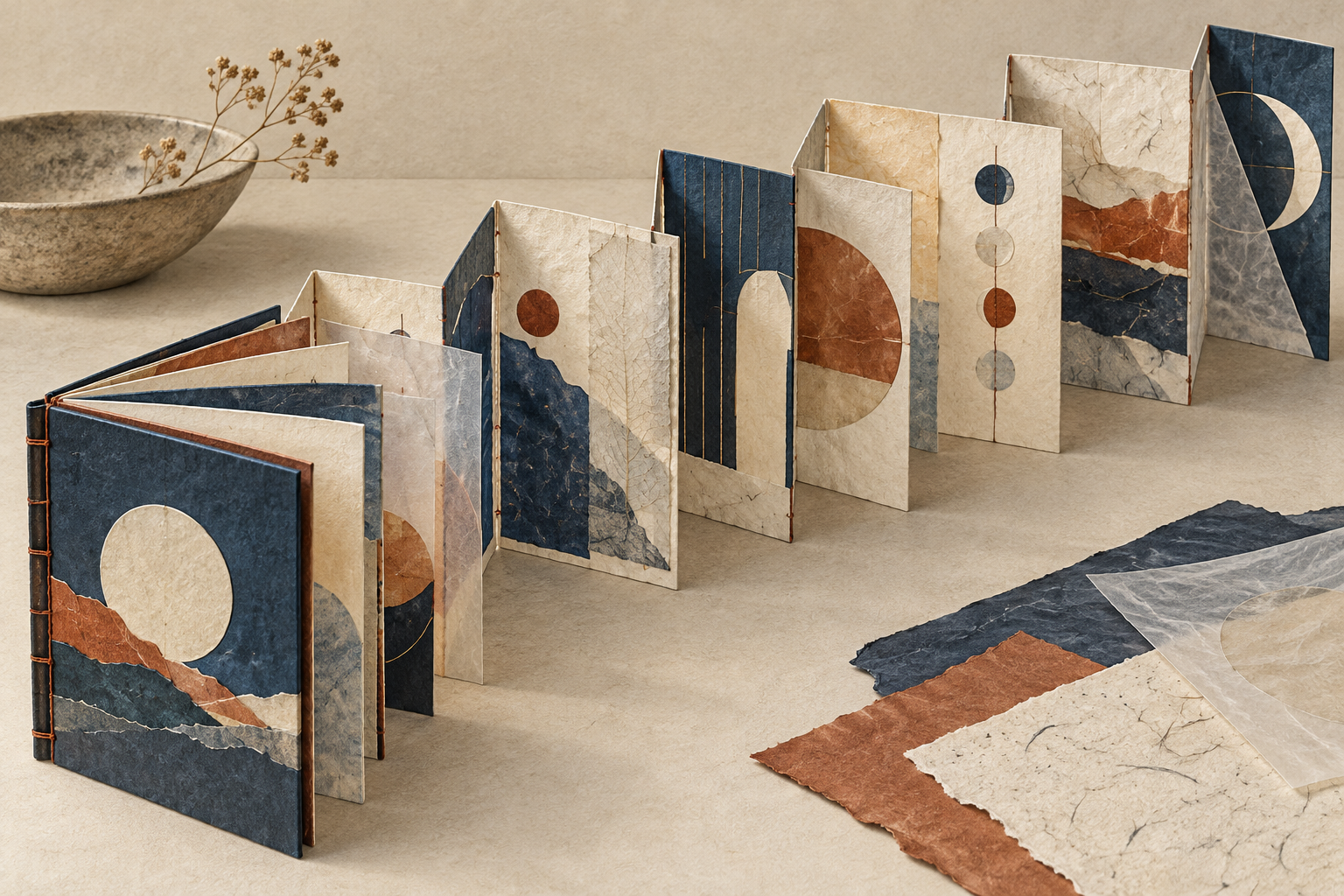
Opening image: Original AI-generated editorial illustration of imagined artist books; it does not reproduce Smithsonian exhibition objects.
The announced opening has arrived
The opening date in our original preview is now behind us. The National Museum of American History’s September 24, 2026, calendar announced American Stories: Artists’ Books from Smithsonian Libraries and Archives for October 8. October 8 reporting from Axios also described the exhibition’s opening. This October 9 update replaces the preview’s future tense and develops the questions the exhibition raises. It draws on public institutional descriptions and object records, rather than an on-site visit or an interview with the artists. That distinction matters for an exhibition in which movement, scale and physical encounter are central to the art. [1] [2]
The museum places the exhibition in the Smithsonian Libraries Gallery on the first floor, west wing. The Libraries and Archives exhibition page brings emerging artists into conversation with established figures including Sol LeWitt, Adrian Piper and Ed Ruscha. Its organizing subjects are identity, community and history, explored through objects inspired by the book’s form or function. That is a broad invitation, but it poses a specific challenge: a book may tell a story through its structure before a reader has interpreted a sentence. The page, the fold, the enclosure and the sequence become part of what the work says. [1] [3]
An ordinary book often asks us to overlook its manufacture. We become absorbed in an argument or a character and stop noticing the hinge of the spine, the pressure of the binding or the distribution of blank space. An artist’s book can bring those decisions back into view. Its materials may interrupt an easy reading, or its organization may make a familiar subject feel unfamiliar. The question is not simply whether the object is beautiful. It is whether the experience of moving through it produces an understanding that a conventional paragraph, photograph or label would leave incomplete.
That makes American Stories a useful occasion to reconsider what a national story can look like. A collection of distinct works does not need to resolve into a single account of belonging. It can make the differences between accounts visible. One artist may present identity as something assembled; another may show it as something assigned; another may expose a gap between public symbols and private experience. These are possibilities for interpretation, not a claim that every object makes the same argument. The value of the exhibition’s premise lies in the freedom to compare how different forms carry different kinds of testimony.
Where the artwork begins
The University of Chicago Library describes artists’ books as objects made by artists and intended as visual artworks themselves, often using unfamiliar materials or structures. The distinction is useful because it separates the artwork from a book that merely reproduces artworks. A catalogue containing photographs of sculptures is generally a record of objects elsewhere. An artist’s book may be the object to which the photographs, typography, binding and arrangement all contribute. There is no need to insist on an absolute boundary for every example. The practical point is to recognize when the book’s design participates in the meaning. [4]
A lavish binding alone does not settle that question. Nor does an unconventional shape automatically make an object intellectually demanding. A work may use plain paper and familiar printing to powerful effect; another may employ elaborate engineering without giving a viewer much to consider beyond the mechanism. The useful distinction is between a decision that carries an argument and a decision that remains decorative. If removing the unusual feature would leave the work’s experience substantially unchanged, the feature may matter less than it first appears. If removing it would destroy a relation between images, voices or actions, it deserves sustained attention.
Imagine, as an explanatory example rather than an exhibition object, a family account divided between two books that must be opened side by side. Neither volume is physically strange. Yet the arrangement could make a reader compare two memories instead of allowing one narrator to dominate. The same words printed in an uninterrupted sequence would produce a different encounter. Alternatively, imagine a folded sheet in which a statement is visible only after another statement has been covered. That design could give disclosure and concealment a role in the argument. The physical decision changes what a reader can know at a particular moment.
These possibilities explain why a narrow search for a plot can miss the work. A book may organize repetitions, changes in scale, interruptions or competing viewpoints without telling a conventional story. Reading then includes looking at what remains constant and what alters between encounters. An image repeated with a small change may ask for comparison. A blank page may create an interval rather than signal missing content. None of those interpretations should be imposed automatically. They are hypotheses to test against the object and its description. The form supplies evidence; the viewer still has to explain what that evidence supports.
A page turn is a decision about time
A page turn introduces a small but consequential division. What was visible becomes memory, and what was hidden becomes available. A reader may turn back, but the first encounter has already happened in an order. That gives the book a way to control revelation without using the continuous motion of a film. It also gives the reader a measure of control over pace. A person can pause at a spread, compare it with an earlier one, or linger over an unresolved relation. Time is shared between the work’s arrangement and the reader’s decisions.
The Library of Congress glossary for the Russell Maret Artist Book Collection describes an accordion structure as a sequence of alternating folds. That basic construction offers a different relationship between parts and whole. A folded section can be encountered locally, while an extended form may allow several panels to be seen together. The definition describes a structure, not a universal meaning. An accordion does not inherently stand for community, travel or memory. But it can provide an artist with a way to make a sequence and an overview coexist, which is something a conventional bound volume does differently. [5]
Consider another hypothetical example: the same short account of a neighborhood printed once as a bound booklet and once across a folding strip. In the booklet, later events are generally encountered after earlier ones. Across an extended strip, a viewer could compare the beginning and ending while still seeing the transitions between them. Neither arrangement is necessarily more truthful. The differences concern emphasis and responsibility. A continuous view may encourage a person to notice a pattern; a sequence may make a delay, interruption or surprise more forceful. The physical arrangement can direct attention without deciding the interpretation in advance.
This is why photographs of artist’s books require careful reading. A photograph may show the object in an extended state that a museum visitor cannot see from every angle. It may present one spread selected by a curator or photographer. The image can be an excellent record of that state while remaining an incomplete record of the possible experience. A sensible interpretation keeps the two levels separate: what the photograph demonstrably shows, and what further movement through the book might reveal. The difference is not a reason to dismiss digital access. It is a reason to understand its particular point of view.
My Flag makes transformation part of the story
The exhibition page provides a concrete starting point in Babette Katz’s My Flag, dated 1995. The Smithsonian describes its illustrated people as working together and eventually becoming stars on the American flag. Its featured-works record identifies an edition of 700. The transformation matters more for an initial interpretation than the number: the national symbol emerges through the people rather than simply appearing as a finished emblem at the outset. Those are documented features of the institutional account. Any larger claim about the work’s politics or emotional effect would require closer attention to the sequence itself. [3] [6]
The description nevertheless opens a productive interpretive question. If a flag is presented as the result of collective activity, a viewer can ask what happens to the individuals when they become part of the symbol. Are they made more visible, or are their differences absorbed? Does the transformation suggest cooperation, a shared aspiration, a demanding compromise, or something less settled? These are alternative readings to consider rather than conclusions supplied by the short online description. An artwork can make a familiar image available for questioning without requiring the viewer to choose between unqualified celebration and unqualified rejection.
The book form is especially relevant here because transformation takes time. A final image of a flag could show an outcome but leave the process implicit. A sequence can make the relationship between work and outcome an experience of reading. The viewer carries an earlier image forward and compares it with a later one. A national symbol becomes connected to an action, not merely a label. That connection can make the symbol feel contingent: something produced through relationships rather than something that has always existed in a completed, unchanging state. This is our interpretation of the described structure, not an attributed statement from Katz.
The edition also prevents a simplistic equation between artistic significance and uniqueness. An object issued in multiple copies can still be a deliberately composed artwork. Conversely, a unique object does not automatically speak more directly to a public audience. The interesting question is what circulation makes possible. Can different readers encounter the same sequence? Do the format and scale invite intimate reading, shared looking, or both? The Smithsonian’s record gives a bibliographic fact; the broader discussion concerns how artworks move between personal experience and public meaning. That distinction helps keep an interpretation accountable to what is actually documented.
An inventory can become a portrait
The Smithsonian’s featured-works list includes Sol LeWitt’s Autobiography, dated 1980. Its accompanying image description identifies a spread containing a grid of black-and-white photographs of kitchen utensils and cookware. That is a modest but useful piece of evidence. It allows a discussion of a portrait built through things, while avoiding claims about pages not examined here. A viewer approaching the spread might initially look for an account of the artist’s life in words. The ordinary objects suggest a different possibility: an arrangement of surroundings can become a way to consider a person. [6]
There is an important difference between noticing possessions and claiming that possessions explain their owner. A utensil does not transparently disclose a biography. It can indicate an activity or setting, but it leaves much unsaid. The interest of an inventory lies partly in that limitation. Objects can be close to a person’s daily life while offering little direct access to feelings or intentions. Their arrangement may encourage a viewer to infer relationships, yet the inference remains the viewer’s responsibility. A book of things can therefore make the act of constructing a portrait visible as an act, rather than presenting a complete identity as a settled fact.
A grid introduces another tension. It can give each photograph a comparable area and make unlike objects appear to occupy an equivalent position. That apparent equality can be useful, but it is a design choice. The objects still differ in function, history and significance. A viewer may notice patterns that the regular arrangement helps expose, or may find that the regularity suppresses a difference that matters. The same issue appears in many everyday forms of representation, from a family album to an institutional directory. Order makes information manageable; it can also make its maker’s decisions harder to notice.
Read beside a work organized around collective symbolism, an inventory-based portrait changes the scale of the question. It asks how much of a life resides in ordinary arrangements rather than dramatic milestones. It also leaves room for disagreement about what a portrait owes its subject. Must it explain, reveal, acknowledge, or simply register? These are useful questions because they do not depend on treating an object as a puzzle with a single secret answer. The book can sustain an encounter with partial evidence. Its restraint may be as important as its visible accumulation.
Materials can carry an argument without speaking for everyone
The original museum calendar identifies experiences involving Native Hawaiian culture, a Louisiana community preparing for a hurricane, and heritage expressed through African and American fabrics. Those descriptions establish the exhibition’s range, but they do not authorize a single reading of those communities. An artwork made in relation to a place or tradition remains a specific work by a specific maker. Its inclusion in a national institution does not turn it into an exhaustive account of a people. That is an essential distinction when an exhibition places intimate experiences under a broad title such as American Stories. [1]
The featured-works list names Allison Leialoha Milham’s Uluhaimalama: Legacies of Lili’uokalani, dated 2012. The institutional image description presents it as a multi-part object, including a record, printed components and paper flowers with text intended to form a lei. Here the relevant observation is the variety of parts, rather than an invented account of what a visitor will hear or do. Multiple components can distribute meaning across different actions and senses. A work that asks for that kind of encounter may resist being reduced to a single representative image of a place or culture. [6]
Material interpretation requires a similar discipline. Cloth can suggest bodily proximity, domestic work, inherited techniques or collective labor, but it does not mean the same thing in every work. A piece of fabric may be selected for its texture, its provenance, its image, its associations or its practical suitability. Those possibilities can overlap. The viewer’s job is to relate a material to the documented work, rather than assigning a familiar symbolic meaning and stopping there. Specificity protects an artwork from becoming an interchangeable example of a theme. It also protects an artist from being treated as a spokesperson by default.
A useful comparison separates material, evidence and interpretation. The material is what the object uses. The evidence includes a label, a maker’s account or a documented production history. The interpretation connects those things to an argument about the work. A persuasive interpretation can be revised when new evidence appears; it does not need to pretend that every association is confirmed. That makes room for curiosity without turning uncertainty into an excuse for vague claims. It also gives a viewer a practical way to recognize when a description has moved from observable features into broader conclusions about identity or belonging.
The window, the wallet and the problem of scale
Two further records show how an everyday form can change the encounter. Alisa C. Banks’s Storm Sequence, dated 2011, is pictured as a wooden window with shutters and a paper shade containing handwritten phrases above a landscape photograph. Laura Russell’s Anything Helps, dated 2013, is described as a small book constructed from a wallet, with illustrated signs visible inside. These are institutional descriptions of particular objects. They offer a basis for considering enclosure, opening and scale, while leaving the full textual content and the artists’ intentions to more detailed sources. [6]
A window-like structure makes the act of looking conspicuous. A viewer does not merely receive an unrestricted landscape; the view arrives through a constructed opening. The shutter and shade can bring barriers, exposure and the possibility of withdrawal into the encounter. That does not prove a particular emotional meaning, nor does it establish that an artist intended every association a viewer might bring. It does give interpretation something concrete to work with. The structure can make the relation between observer and scene part of the work, instead of leaving that relation outside the frame.
A wallet carries a different set of everyday expectations. It belongs close to a body and is normally opened selectively. When a book takes that form, the scale and enclosure may make its contents feel personal or precarious. A sign encountered inside a small object can produce a different experience from a sign presented at public scale. The difference concerns position as well as size: the viewer is brought toward something ordinarily kept close. These are observations about possible effects of the documented format, not a claim that every visitor will feel the same response.
The comparison helps explain why unconventional structures deserve more than a quick reaction of surprise. A window and a wallet both control access, yet they do so in different relationships to space, privacy and the body. The important question is what the familiar form contributes once it becomes part of an artwork. If the form changes the viewer’s position, the work’s subject may be encountered differently even before the text is read. This is where a book can become an argument through an object: its physical arrangement gives a relationship a shape that ordinary description alone would struggle to reproduce.
Identity can be assembled rather than announced
Julie Chen’s The Accretion of Identity, dated 2022, appears in the featured-works list. The institutional image description identifies an interactive, multi-panel structure with paper compartments opening to reveal a photographic portrait and text. The title and the visible structure provide a focused point of comparison with a conventional portrait. Something is disclosed through parts rather than offered all at once. That observation does not tell us the complete argument of the work. It does suggest that the relationship between an image and the actions required to reach it belongs within the interpretation. [6]
An assembled portrait can challenge the expectation that identity is a stable summary waiting to be discovered. A viewer may encounter a component first, form an impression, and then revise it when another element appears. The revision is part of the experience. It resembles the ordinary difficulty of understanding someone through incomplete encounters, although a work’s sequence is more deliberately organized. The analogy should remain modest: an artwork cannot reproduce the full complexity of a person. It can, however, make the limits of a first impression visible and give reconsideration a physical role.
Interactive forms also complicate the idea of a passive audience. A reader may need to unfold, turn or reposition a component in an authorized setting. Each action can change what is available to see. In a museum case, that action may be performed by staff or represented through photographs instead. The difference affects access to the work’s structure, but it need not erase the structure’s significance. Interpretation can account for the action even when a visitor cannot perform it. The honest account describes how the work operates and how the current display mediates that operation.
There is a larger consequence for a national exhibition. If identity can be partial, layered and revisable in the encounter with an individual work, the exhibition’s title need not promise a finished definition of America. It can hold several accounts together without requiring them to be interchangeable. The strength of that arrangement depends on maintaining distinctions. A work about an intimate relationship, a work about public recognition and a work about community memory may share a room while making different demands on the viewer. Comparison becomes useful when it clarifies those demands, rather than smoothing them into a general message about diversity.
The colophon reveals another kind of authorship
The Library of Congress glossary describes the colophon as a place for information about a book’s production, including contributors, materials or techniques; it can also become part of an artist’s explanation. That modest piece of apparatus has substantial interpretive value. A viewer absorbed in an image may overlook the labor required to make the object. Production information can bring that labor back into the account. The book is then encountered both as an artwork and as something made through particular decisions, skills and relationships. The credits are evidence about making, not merely a formality after the experience. [5]
Collaboration can be easy to recognize in a film because the credits openly announce a large production. A small book may appear to have emerged from a single pair of hands, even when printing, binding, image preparation or paper production involved several contributors. That is a general possibility, not a claim about every object in this exhibition. The distinction matters because the visible scale of an object can mislead us about the scale of its making. An intimate format does not necessarily imply solitary authorship, just as a large format does not necessarily imply a large team.
The featured-works records themselves give reminders of shared production. Several entries identify collaborators, contributors or gifts, while others distinguish unique works from editions. These records answer different questions. A collaborator credit concerns making; a gift credit concerns how a collection acquired an object; an edition statement concerns the work’s issued copies. Conflating them would produce a poor account of authorship. Separating them allows a more precise appreciation of the relationships behind the exhibition. A donor is not automatically a maker, and a maker’s contribution is not defined by the way the institution obtained the object. [6]
The production record can also alter an interpretation of the form. Knowing that a component was printed, cut, sewn or assembled in a particular way may explain an effect that otherwise appears accidental. It can reveal a deliberate constraint or the reason an object takes a specific shape. The record cannot dictate every response, but it can narrow the range of plausible claims. That is one reason a close encounter with an artist’s book benefits from reading the surrounding information. The material object and its documented making inform each other; neither should be treated as a complete substitute for the other.
Libraries make the encounter possible
An exhibition of artist’s books is also an exhibition of collecting decisions. Somebody identified the objects, described them, arranged their care and made them available for study. These activities are easy to overlook because a well-presented display can make access feel effortless. Courtenay McLeland’s 2017 article in the Association of College and Research Libraries journal RBM examines the development of artist’s-book collections using a survey and other research. It describes the practical challenges posed by unusual forms and the importance of collection policies and description. The article provides institutional context, rather than evidence about this exhibition’s particular internal procedures. [7]
The problem is not simply finding a shelf for an object. A work may have detachable parts, an unfamiliar opening sequence, an enclosure that belongs to the artwork, or a form that cannot be understood from a conventional catalogue entry alone. A description that says only book and gives a title may be technically recognizable yet interpretively weak. A useful record needs enough specificity to help someone know what kind of encounter is possible. At the same time, it must avoid interpreting so aggressively that the cataloguer’s preferred reading displaces the work’s other possibilities.
Collection development introduces another set of choices. Institutions cannot acquire everything, and an exhibition cannot show every work in a collection. A selection therefore has a point of view even when its purpose is to widen access. Viewers can acknowledge that fact without assuming bad faith. The productive questions concern the rationale: what relationships does the selection make visible, what areas receive emphasis, and what cannot be represented within the available space? The title of a national exhibition can invite broad expectations. The actual selection is necessarily a set of decisions made within practical and curatorial limits.
This does not reduce the importance of preserving particular objects. On the contrary, specific records and sustained care make later reconsideration possible. A future researcher may ask different questions from those that organized the current display. A work acquired for one apparent theme may reveal another when read alongside new evidence. Keeping the object accessible and its history legible allows that change in understanding. A library’s contribution is therefore not limited to endorsing an interpretation today. It includes maintaining the conditions in which other interpretations can be developed, checked, challenged and improved tomorrow.
A glass case changes the reading
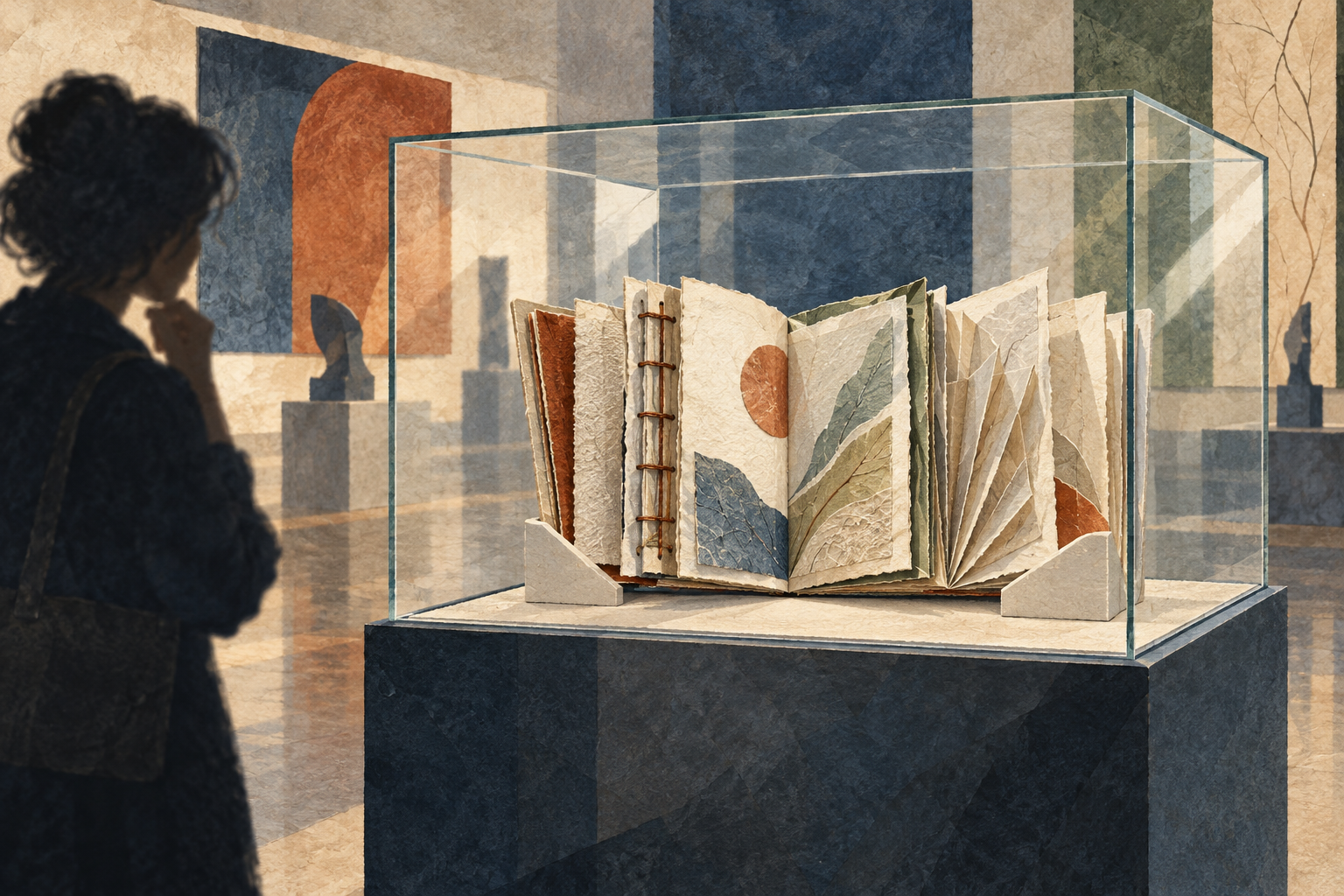
A book designed to move presents an obvious difficulty when it must be displayed safely. A case can show an object clearly while preventing the visitor from turning its pages. An open spread may make a strong visual statement while concealing the sequence that gives it context. These are general exhibition tensions, not reports of a particular installation we have inspected. They matter because a visitor can otherwise mistake a selected display state for the whole work. A carefully chosen view is still a view. Recognizing that limitation can make the encounter more attentive rather than less satisfying.
Preservation and access do not need to be treated as opposing moral positions. Allowing unrestricted handling could damage an object and reduce future access. Preventing every form of meaningful engagement could preserve the material while obscuring what makes it an artwork. The difficult task is to support an encounter appropriate to the object and the setting. That might involve explanatory images, a demonstration, a surrogate or a supervised research appointment when available. None of those options should be assumed to exist for this exhibition without an announced program or a confirmed institutional arrangement.
The Library of Congress’s public guidance on handling books advises against forcing bindings into an opening they cannot comfortably support. Its advice is a useful reminder that the physical condition of an object affects what can be shown. A visitor should follow museum instructions and leave handling decisions to staff. This article is not a guide to repairing or manipulating special-collections material. The interpretive point is that an artwork’s movement has a material cost. Care can determine which movements are possible now and which must instead be explained through another form of access. [8]
The same issue arises when a book is photographed for public viewing. A single image can preserve the appearance of a spread at a moment and make it accessible far beyond the gallery. A series can indicate transitions. Neither necessarily conveys weight, resistance, depth or the time required to manipulate a structure. That incompleteness is not a failure unique to digital media; every mode of access selects some features and leaves others out. A good account makes the selection explicit. It explains what the viewer can see, what the record demonstrates and where the full physical experience remains outside the frame.
What a thoughtful visit can accomplish
The exhibition page lists daily hours of 10 a.m. to 5:30 p.m., with December 25 closed, at the National Museum of American History in Washington, D.C. The museum’s September calendar also states that admission is free and does not require passes. These are the public details verified for this update; check the institutional listing again before traveling. The calendar says accompanying workshops and programs will be announced later in the year. That is a statement about future announcements, not a confirmed appointment, and it should not be converted into a workshop date. [1] [3]
A visit does not need to become an effort to absorb every object equally. One sustained comparison can be more revealing than a rapid sequence of recognitions. Consider a work in which a symbol changes through a sequence beside one in which a portrait is built from fragments or objects. What does each arrangement let a viewer know? What does it withhold? How does the form change the relationship between part and whole? Those questions can guide attention while leaving room for the object to surprise the viewer. They are an invitation to look, not a prescribed interpretation.
The distinction between evidence and response remains useful in a gallery. A label may confirm a date or material. A visible structure may establish that a component can unfold. A viewer’s emotional response may be powerful without being a fact about the artist’s intention. Keeping those categories clear does not drain the encounter of feeling. It gives feeling somewhere to go: toward a more precise account of what caused it. A person can say that a constrained view made an object feel intimate while recognizing that another viewer may describe the same arrangement differently.
For someone unable to visit, the official featured-works list provides a starting point for comparison, including titles, dates and images of selected objects. It should be approached as a documented selection of views, not as a replacement for every aspect of the exhibition. The record can still support serious attention. Read an object’s description before expanding an interpretation, and keep a question open when the available image cannot answer it. Acknowledging an unresolved question is a productive outcome. It identifies what further evidence or encounter would be needed, rather than allowing a confident description to outrun its basis.
A national story need not become a single book
The force of American Stories lies in the relationship between its broad title and its particular objects. A national story can sound as if it requires one voice, one sequence and one conclusion. A room of artist’s books offers another possibility: different forms can remain distinct while entering a shared conversation. The encounter is strongest when the viewer resists making every object illustrate the same lesson. An edition, a unique construction, a portrait through ordinary things and a structure associated with the body can each establish a different relationship between the individual and the public.
That relationship also changes what counts as reading. Reading can include attending to a fold, recognizing a pause, comparing an image with a remembered earlier image, or noticing whose work is named in a production record. It can include accepting that a display does not make every movement available. These acts do not replace attention to language; they place language within the full arrangement of the artwork. A sentence has a position, a material surface and an interval around it. An image has neighbors and may appear differently after another page has been encountered.
The exhibition’s opening supplies a timely reason to ask these questions, but its usefulness extends beyond the opening date. Artists’ books make the relationship between telling and making unusually visible. They remind us that an account is shaped by what it includes, how it is ordered, who contributes and how it reaches another person. Those decisions are present in ordinary communication too, even when they become easy to overlook. Here they can be examined as part of the artwork itself. A viewer leaves with more than a theme to remember: a sharper sense of how form participates in meaning.
Our original preview asked what would be lost if a work were flattened into a single image. The expanded question is what becomes possible when it remains a book. It can make change an encounter, keep competing views in relation, or connect a public symbol to private labor. It can also resist an easy summary and require care before it can be encountered at all. None of those possibilities guarantees a successful work or a complete national account. They explain why the physical book deserves attention as an active part of the story, rather than a container we hurry past on the way to its words.


