


A Möbius Strip Has One Boundary, Not Two

Geometry & Connections | Science & Space
OnelROR Editorial Team | November 18, 2026 | 3 min read
A loop of ribbon seems to offer an inside, an outside and two separate edges. A Möbius strip changes that expectation with a half-turn at the join. The useful question is not which part faces the viewer, but where a continuous route can lead.
Compare the joins
Imagine two rectangular strips. Join the short ends of the first without twisting it. For the second, turn one end through 180 degrees before joining it to the other. The University of Wisconsin–Madison's museum uses this construction to distinguish an ordinary loop from a Möbius strip. [1]
The half-turn changes which parts meet at the seam. In our diagrams, matching letters identify those connections. Perspective alone can hide a join, so a crossing in a drawing is not enough to explain the surface.
Diagram key: The dashed short ends represent the seam. In the untwisted loop, A joins A at the top and B joins B at the bottom. After a half-turn, the top of one end joins the bottom of the other; equal letters mark the matching points.
Follow the surface
On an ordinary loop, a route along the outside stays separate from the inside unless it crosses an edge. On the Möbius strip, a continuing route can reach what originally looked like the opposite face without crossing an edge. Wisconsin's tracing activity illustrates this one-sidedness. [1]
That does not mean a single thin line covers every point. It demonstrates a connection between regions that looked separate. The Royal Institution describes the band as a non-orientable surface with one face. [2]

Diagram key: This is a coordinate map of two successive passes through one band, not two physical bands. Across the width, y runs from 0 at the top to 1 at the bottom. The seam identifies y with 1 minus y, so one-quarter becomes three-quarters and the second pass returns to one-quarter. No boundary is crossed.
Trace the boundary separately
Now follow the rim rather than the broad surface. The Royal Institution identifies one outside edge for a Möbius band. [2] What look locally like two long edges belong to one continuous boundary after the twisted join is made.
Keep the two questions distinct: a route across the surface explains one-sidedness; tracing the rim counts boundary components. In the connection map, one color follows both long edges. Matching endpoint letters show how they join into one circuit.
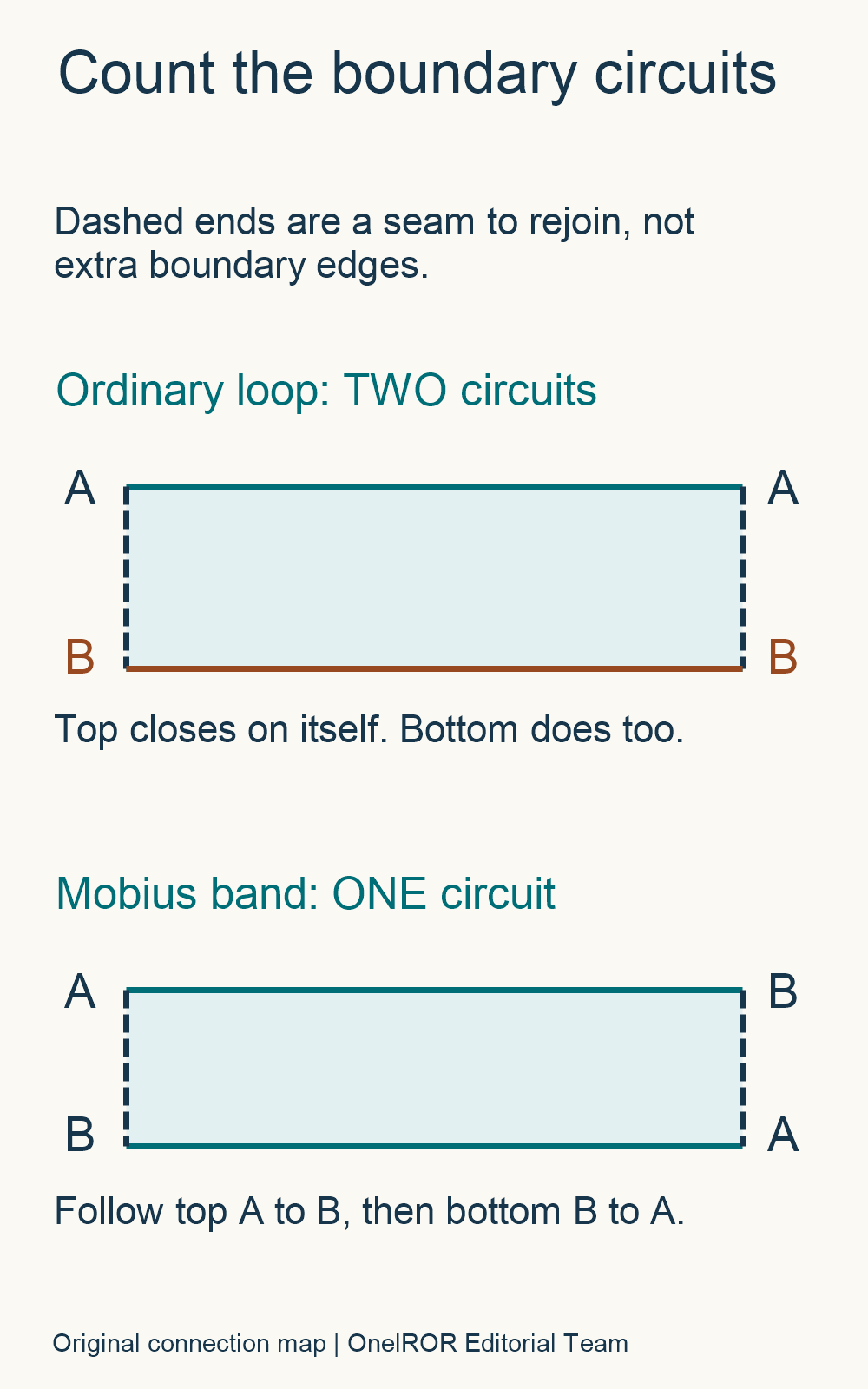
Diagram key: Only the long horizontal rims are boundary segments; the dashed short ends are rejoined. In the ordinary loop, A-to-A and B-to-B close separately. In the Mobius map, follow the upper A-to-B rim and then the lower B-to-A rim to complete one continuous boundary.
These illustrations treat the band as a mathematical surface. Paper thickness, adhesive and accidental creases are outside the model. No cutting experiment or physical build was performed for this explanation. The point is to read connections through the join, rather than count the front-facing patches in a picture.
Sources and scope
- UW–Madison: Mobius Strip. Construction and surface tracing.
- Royal Institution: Mobius band. One face and one outside edge.
Sources consulted November 18, 2026. Original cut-open connection maps, not photographs or a physical build. The dashed seams mark identifications, not cuts made in an actual band.