


California’s First Sea Turtle Nests Open a New Conservation Chapter
OnelROR • Environment
California’s First Sea Turtle Nests Open a New Conservation Chapter
California’s first documented sea turtle nests connect an extraordinary beach observation with questions about incubation, marine research and the everyday practice of conservation.
By OnelROR Editorial Team · Originally published October 3, 2026 · Updated October 4, 2026 · 26 min read
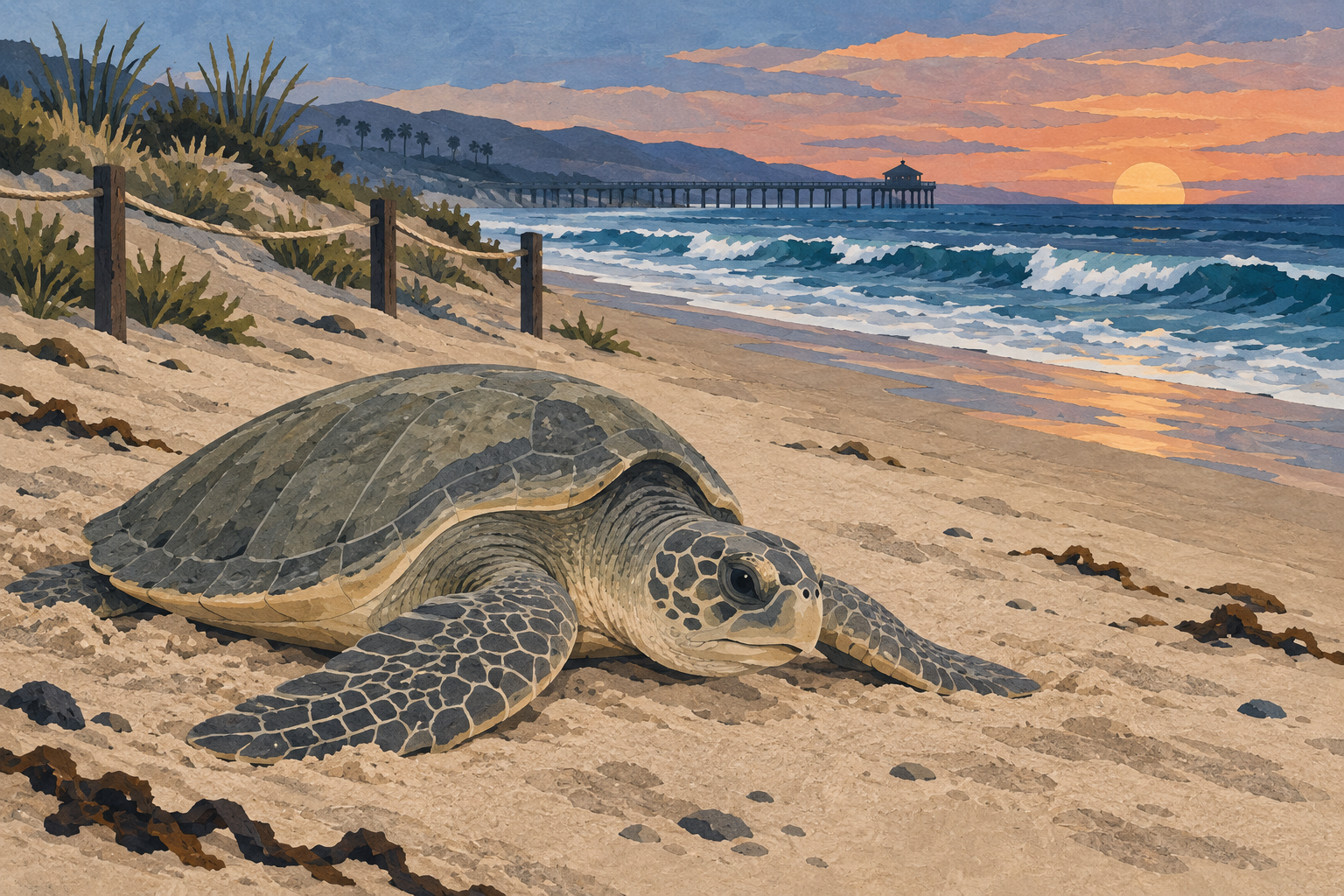
Featured image: original OnelROR editorial illustration, not a photograph of the documented nesting events.
Two nests, a documented first, and a careful timeline
California's first recorded sea turtle nests are a remarkable observation with an unfinished outcome. According to NOAA Fisheries' account, an olive ridley laid eggs near Seal Beach on September 16, 2026, and another nested near Huntington Beach Pier on September 19. Scientists transferred the eggs to the Aquarium of the Pacific on September 25. The agency published its story that day; the version checked for this expansion carries an October 3 update date. Those are different dates for different events.
As checked on October 4, NOAA says the eggs' fertilization and viability remain unknown. Release on the original beaches is conditional on successful hatching. This article does not report hatchlings, a release or a newly established California breeding population. It expands the context around the confirmed nests and explains what beach visitors, students and readers can learn while the outcome remains open.
The distinction is scientifically useful. A nesting observation documents an animal's behavior at a place and time. Incubation concerns what happens next to the eggs. Later survival concerns a much longer sequence. Keeping those stages separate makes it possible to appreciate the event without treating an anticipated result as accomplished. It also creates a clear basis for future coverage: a later report should say which stage has newly been confirmed, rather than simply repeat the discovery in a more confident headline.
What first recorded actually tells us
The phrase first recorded is a statement about documented evidence. It indicates that the event is new in the record described by the responsible agency. It cannot establish that no turtle ever attempted to nest unnoticed anywhere along the coast. Nor does it mean that every sea turtle seen in California waters is unusual. The specific behavior, rather than the mere presence of a marine animal, is the finding that needs to remain visible.
This distinction matters when a story travels through social media. A photograph of a turtle offshore can be genuine while saying nothing about a nest. A picture of eggs can show a real nesting event while coming from another country or an earlier year. To evaluate an image, identify what it depicts, where it was made and which dated report connects it to the claim. A compelling image should not be asked to establish facts that are outside its frame.
A useful reading exercise is to write one sentence containing only the observed event. Then write a second sentence describing the possible significance, explicitly as a question or interpretation. In this case, the first sentence can concern documented California nesting. The second can ask whether nesting will recur and what conditions may have contributed. Separating those sentences protects both the discovery's importance and the uncertainty that makes further observation worthwhile.
A sea turtle in coastal water is not a nesting record
Southern California is already part of a wider marine turtle research landscape. NOAA's marine turtle biotelemetry overview describes work on green turtle foraging grounds in places including San Diego Bay, the San Gabriel River and Seal Beach National Wildlife Refuge. It also discusses loggerheads during warm-water periods and leatherback movements across the Pacific. Those examples concern different species and activities; they are not additional olive ridley nests.
A useful mental map has at least three layers. One shows places where turtles feed or travel. Another shows locations where nesting is documented. A third shows where researchers have collected observations. Those layers can overlap, but they answer different questions. An animal can use coastal waters without reproducing on an adjacent beach, and a research location is not automatically a nesting location.
For readers, the practical consequence is to look for the noun and the verb in a claim. Which turtle species? Swimming, foraging, nesting or hatching? A headline that drops those details can make an ordinary presence sound like a new reproductive event. Restoring them does not reduce interest in the animals. It makes the coast's ecological variety easier to understand and helps distinguish the extraordinary record from the broader, already documented use of regional waters.
Olive ridleys can nest alone as well as in gatherings
NOAA's olive ridley species overview identifies the species as a marine reptile distributed primarily across tropical parts of the Pacific, Indian and Atlantic oceans. It describes both solitary nesting and synchronized mass nesting, known as arribadas. The name olive ridley refers to the olive coloration of the shell. These basic features provide context for the California observation without implying that a mass nesting event is developing there.
Images of a crowded nesting beach can easily become the default picture of this species. Yet a solitary nest belongs to its behavioral repertoire too. A reader should not interpret two documented nests as the beginning of an arribada simply because that better-known phenomenon is visually dramatic. The classification of an event must follow the observations, not the most striking photograph available for the species.
This also illustrates a broader ecological point: a species description summarizes a range of behavior, while a local record concerns a particular occurrence. General biology can suggest questions worth asking, but it cannot fill gaps in a local account. If a report has not documented additional females, eggs or repeated seasons, those details remain open. Good explanation moves between the general and the particular carefully, using each for what it can establish.
Why the identity of the animals matters
Counting nesting events is not the same as counting nesting individuals. One animal can produce more than one observation, and several photographs can depict the same individual. NOAA's California account says scientists distinguished the two turtles through photographic identification. The principle is important even without turning readers into amateur identifiers: repeated sightings need a method for deciding whether they represent the same animal or different animals.
An imagined beach log might contain observations on three evenings. That alone would not prove the presence of three females. Researchers would need suitable identifying evidence and a way to compare records. Conversely, a single evening could include more than one animal. The counting unit should therefore be stated explicitly: sightings, identified individuals, nesting attempts or completed nests. Each can be meaningful, but combining them without explanation produces misleading totals.
For someone submitting a sighting, the useful role is to provide the information requested by the official reporting process while maintaining distance. Do not chase the turtle or try to obtain a close-up identifying photograph. A scientist's use of images is not permission for a visitor to disturb an animal. The record is valuable when it is collected responsibly, with the observation's limits intact and the animal's behavior left as undisturbed as possible.
Warm water is a hypothesis to investigate, not a complete explanation
The current California account discusses warm sea surface conditions among likely contributing factors while keeping the exact reasons for nesting uncertain. That is an appropriate distinction between a plausible mechanism and a fully established explanation of a particular event. The discovery does not justify a claim that one environmental factor has conclusively explained every part of the turtles' movements and nesting choices.
Think of the evidence as several connected questions. What conditions existed offshore? Where had the animals been? What routes did they take? What conditions existed at the beaches? Why did they nest on those dates? A regional temperature observation helps with one part of the picture. It does not directly provide the complete movement history of either individual or measure every cue relevant to nesting.
Readers should also distinguish a short unusual period from a longer pattern. Both can matter, but a report about one season does not establish how often nesting will occur in later seasons. The productive follow-up is to compare future observations with their environmental context and the methods used to obtain them. This preserves the possibility of learning something important about changing conditions without forcing two nests to carry a conclusion that requires a longer and more detailed record.
Incubation introduces another environment to the story
After an egg is laid, the relevant environment is no longer described adequately by an ocean temperature map. The egg's surroundings, moisture and temperature become important to the next stage. NOAA's explanation of temperature-dependent sex determination describes how incubation temperature influences whether sea turtle hatchlings develop as male or female. It is a general biological explanation, not a report of the sex or viability of the California eggs.
That difference prevents a tempting shortcut. Warmer water near a coast does not tell us the exact conditions around an egg, and a general relationship between temperature and sex does not tell us the outcome of one clutch. Readers need actual information from the teams caring for these eggs before attributing a particular incubation result to them. A simple causal phrase can hide several measurements that have not been reported.
For an educational discussion, draw separate boxes for the adult at sea, the nesting beach and the incubating eggs. List which conditions are relevant in each box and which have actually been observed in the current story. This makes the environmental transitions visible. It also explains why a responsible report can discuss established biology while still declining to forecast the eggs' outcome: understanding a mechanism is different from having the data required to apply it to a particular case.
Moving eggs is a professional conservation decision
The transfer to the Aquarium of the Pacific is part of the documented response. It should not become an informal instruction for visitors who encounter another nest. Professionals decide whether intervention is appropriate based on the circumstances, responsibilities and relevant permissions. This article explains the event and the official public guidance; it does not provide an egg-handling or relocation procedure.
An important distinction is between an authorized response and an action that merely resembles it. Seeing a photograph of scientists collecting eggs does not equip a bystander to repeat the task. The photograph leaves out planning, training, coordination and information about the particular nest. Copying the visible movement while lacking that surrounding process could undermine the very outcome the person wants to support.
The useful public action is therefore to report an observation and follow the responsible teams' instructions. If a protective barrier is present, keep clear of it. If an animal appears in difficulty, notify the appropriate responders rather than attempting an improvised rescue. Those boundaries make assistance more effective because they preserve the animal, the site and the professionals' ability to assess what is happening. Curiosity can produce an important record without becoming an intervention.
Hatching, emergence and release are separate milestones
Several words commonly used in turtle coverage refer to different stages. Hatching concerns leaving the egg. Emergence concerns coming out of a natural nest. Release, in an assisted-care setting, concerns the managed return described by the responsible organization. In the California case, NOAA's announced plan remains conditional on successful hatching. None of these later stages should be inserted into the story before it is confirmed.
Suppose an official update eventually reports that some eggs have hatched. A careful follow-up would identify that new milestone, its date and the source. It would not automatically report that every egg succeeded or that every hatchling has already reached the sea. Similarly, a release announcement would not establish the animals' long-term survival. The language should move forward only as far as the evidence has moved.
This is useful for readers waiting for news. Silence between updates is not evidence of either success or failure. An incubation range in a general account is not a promise of a public event on a specific day. Follow the organizations caring for the eggs, rather than an invented countdown. The next informative report will say what has actually happened, and its scientific value depends on being precise about the stage rather than dramatic about the outcome.
A nesting count is not a whole-population measure
NOAA's olive ridley science guidance explains that population assessments use multiple sources of information, including surveys, nesting studies, fisheries observations and other biological evidence. The reason is straightforward: animals spend much of their lives away from the beach, and a record at one life stage cannot describe every other stage or every region occupied by the species.
A hypothetical increase in recorded nests could result from more nesting, more search effort, better reporting or some combination. An assessment needs to examine those possibilities rather than assume that a number's movement is entirely biological. This is not a suggestion that the California records are unreliable. It explains why a confirmed first observation and a quantified population trend are different scientific products.
When reading a trend chart, ask what is counted, which locations are covered and whether the method remained comparable. A series that changes its geographic coverage halfway through needs explanation. A nesting total also should not be called a count of all living turtles. Keeping the unit visible allows readers to interpret good news and continuing concerns together, without pretending that one dramatic beach event settles the conservation status of a wide-ranging species.
Tracking can connect the beach with the ocean journey
NOAA's tagging overview describes several tools used to identify or follow marine turtles, including flipper tags, internal identification tags and telemetry. Different tools answer different questions. An identifier helps recognize an individual later; a transmitter can provide information about movement. This general research context is not a claim that either California nesting turtle was fitted with a transmitter.
For readers looking at a track map, each point represents information obtained by a particular system at a particular time. A line joining points can make the path easy to see, but it should not be mistaken for continuous observation of every turn or dive. The precision and timing of the measurements matter. A map becomes more informative when its legend explains the method rather than presenting the line as an omniscient view.
The conservation value of tracking lies partly in connecting places that otherwise look separate: feeding grounds, travel routes and reproductive areas. That connection can help researchers ask where animals overlap with human activity. Yet a track is still evidence about monitored individuals, not a census of every turtle. The appropriate response is to use the map for its stated purpose and consult the accompanying explanation before extending its meaning to an entire population.
Genetics answers a different kind of identification question
The science guidance also describes genetic work used to understand population structure and origins. Genetic evidence and a photographic comparison are not interchangeable tools. Photographs can help determine whether two observations depict different individuals; genetic analyses can address relationships and population questions that appearance alone cannot settle. Both depend on methods and interpretation that should be explained in the relevant study.
This distinction is particularly useful when discussing an unusual location. A turtle appearing on a beach does not by itself identify its birthplace or full ancestry. A map of known nesting areas provides context, but it is not a personal travel history. Without direct evidence, readers should avoid assigning an individual to a specific origin simply because that location is the nearest familiar nesting region.
For a classroom exercise, separate the questions into individual identity, movement history and population association. Ask which kind of evidence could help with each. The exercise shows why ecological research often combines methods rather than relies on one impressive technology. It also encourages better reporting: describe what an analysis establishes, avoid adding conclusions from an unrelated method and retain the uncertainty where the required evidence has not been collected or published.
Protecting a nest is one part of protecting a life cycle
A successful nest can be an important conservation outcome, but sea turtles also face risks away from the beach. The California discovery naturally directs public attention to eggs and nesting habitat. A wider view asks how protection at that stage connects with the marine environments the animals use afterward. That connection prevents the visible part of the story from becoming the whole definition of conservation.
Think of a hypothetical conservation plan as a sequence rather than a single photograph. It considers nesting habitat, the movement of young animals, feeding areas and encounters with human activity. A measure effective at one stage may have little direct effect on a different hazard elsewhere. This is why several kinds of action can be needed at the same time, and why an encouraging nesting record can coexist with continuing concerns.
Readers can evaluate an intervention by naming the risk it addresses. A barrier around a nest aims to protect a site from disturbance. A gear modification addresses an interaction in a fishery. A lighting change addresses a different mechanism at the shoreline. These actions are connected through the animal's life, but they are not substitutes for one another. Naming the mechanism makes conservation claims easier to assess and helps avoid a false choice between celebrating a local achievement and acknowledging the work still required beyond it.
Bycatch is an interaction that can be changed
NOAA's bycatch resources discuss the unintended capture of animals during fishing. For sea turtles, the practical question is how fishing operations and gear can reduce harmful interactions while supporting the target fishery. That requires understanding where, when and how encounters happen. A general concern about turtles does not automatically identify the most effective modification for every type of fishing.
Different gear creates different pathways of risk. A net, hook or line interacts with an animal differently, so a measure designed for one arrangement cannot be assumed to solve another. A responsible explanation identifies the fishery and the relevant mechanism before discussing an intervention. It should also distinguish a device's performance in testing from how it performs when installed, maintained and used during ordinary operations.
For the California story, this context broadens the reader's view beyond the nest without asserting that a particular local operation affected the two observed females. No such claim is made here. The useful lesson is that conservation can include engineering, operational practice and monitoring, rather than only restricting access to a beach. The most persuasive account explains how an action changes a specific interaction and what evidence will show whether that change works.
Turtle excluder devices illustrate the role of engineering
NOAA's turtle excluder device explanation describes a grid fitted into a trawl net, with an opening through which larger animals can escape while smaller target catch passes into the collection area. The device addresses a specific problem: a turtle captured in a trawl needs a route out. It is a fishery technology, not an intervention at a nesting beach.
The design illustrates why conservation tools need to work within an actual operation. An opening that lets a turtle leave while retaining the target catch involves geometry, animal size and water flow, as well as the way the gear is used. A drawing can explain the principle, but evidence about installation and performance is needed to assess the result. This article does not recommend a design or interpret operating requirements for a particular vessel.
NOAA's history of the devices describes continuing development, including work on narrower bar spacing for smaller turtles. That history shows why a successful intervention may still evolve. The category of animal at risk, the dimensions of the gear and the practical needs of a fishery can generate new design questions. Conservation engineering is an ongoing process of testing and improvement, rather than a claim that one invention has permanently removed every hazard.
Beach lighting can alter an animal's route
The Florida Fish and Wildlife Conservation Commission's lighting guidance explains why artificial light visible from a nesting beach can create problems for turtles. The source concerns lighting principles and Florida guidance; it is not a statement of Orange County's local requirements. Readers should use the responsible local authorities for site-specific instructions rather than transplant a rule from another jurisdiction.
The practical issue is the light reaching the beach, not merely the appearance of a fixture from inside a building. Placement, shielding and the surrounding setting influence that exposure. A product described as wildlife friendly should not be treated as an automatic guarantee that any installation is appropriate. A lighting assessment considers the actual scene and the guidance applicable to it.
For visitors, the relevant lesson is simple: do not add illumination to a turtle encounter for the sake of a photograph or a closer look. Follow barriers and instructions, and leave monitoring to the responsible teams. For property managers, the question requires more specific local advice about how light can be reduced or redirected. Those are different roles. Keeping them separate helps turn awareness into appropriate action without encouraging a beachgoer to experiment with lights around an animal.
Ordinary beach habits can make the route easier
The U.S. Fish and Wildlife Service's Leave Only Footprints guidance discusses obstacles and disturbance on nesting beaches. Removing equipment, filling holes and flattening sandcastles before leaving are familiar examples of making a beach less obstructed. These habits matter because a place used for human recreation can also be an animal's route between water and nesting habitat.
This does not mean visitors should dig around a marked nest or rearrange a protected site. Routine cleanup and authorized nest management are different activities. Stay outside barriers and follow local instructions. If an object or situation near a protected animal raises concern, tell the responsible staff rather than assuming that moving it yourself is helpful.
A useful family explanation is to focus on the route. Chairs, deep holes and unattended items can change what an animal has to navigate. Before leaving an ordinary recreation area, restore it as instructed and take belongings away. The habit does not require searching for a turtle or approaching a nest. It is a modest way to reduce a preventable obstacle while respecting the larger principle that wildlife should be allowed to carry out its behavior without becoming the center of a crowd.
Reporting should preserve the observation and the animal
For the California episode, NOAA asks people not to disturb turtles, nests, hatchlings or protective barriers and signage. Its current account directs beach sightings to lifeguards, its linked reporting form or the listed response number. If you need to report an encounter, consult that current official account for the appropriate channel. This avoids circulating an incomplete instruction detached from its geographic context.
A useful report describes what was observed rather than supplying an unsupported diagnosis. State the place, time and visible behavior as requested. If you are uncertain about the species, say so. An honest description of uncertainty can be more helpful than a confident but mistaken label. Responders can then assess the information using their methods and responsibilities.
Do not make obtaining a better report an excuse to approach, touch or follow the animal. The goal is to pass along a useful observation while leaving conditions as undisturbed as possible. If others are present, encourage respect for the barriers and notify staff about concerns. A calm report helps coordinate a response; a crowd attempting to investigate on its own can create another problem at the same site.
A photograph can inform without inviting a crowd
Images are powerful in a first-record story because they make an unfamiliar event tangible. They also need context. A caption should identify whether an image is a documented photograph, an archive image or an illustration. The featured image on this article is an original editorial illustration, not a photograph of either California nesting event. That distinction is part of accurate reporting, not a minor design detail.
When sharing an actual encounter, consider whether the image or caption encourages people to congregate at a sensitive site. An official account can communicate the significance while also explaining the boundaries around observation. Repeating its non-disturbance guidance is more useful than presenting the animal as a destination for close-up viewing. Curiosity need not become a physical audience at the beach.
For a hypothetical school presentation, one slide could show an appropriately credited official image and a second could explain what the image cannot establish: viability of eggs, future hatching or a permanent breeding population. This connects visual literacy with ecological understanding. Students can enjoy the photograph while learning to resist the impulse to turn everything visible into evidence of an outcome that has not yet happened.
Monitoring effort belongs beside the results
A survey's results become easier to interpret when readers know how the observations were sought. Time spent searching, locations covered and the reporting process can influence how many events enter a record. Monitoring does not manufacture the event; it affects the chance that the event is detected and documented. This is why scientific accounts should describe effort alongside counts where those counts are used to infer a pattern.
Imagine two years of a beach record. In the first, only occasional reports are collected; in the second, trained staff survey repeatedly. A higher count in the second year would deserve examination, but it would not automatically establish that nesting increased by the same proportion. This is an illustrative comparison, not a description of monitoring in Orange County. It explains the importance of comparable methods.
For future California updates, look for information about additional confirmed events and how they were documented. Distinguish the absence of a report from evidence produced by a systematic search that found none. Both can be relevant, but they are different statements. Understanding that difference helps readers follow the record over time without either exaggerating a possible trend or dismissing the importance of the observations that have been confirmed.
A conservation response combines different responsibilities
NOAA's California story describes coordination among agencies and community partners. A response around a nesting animal can involve marine science, beach management, public communication and animal care. The presence of several organizations is therefore understandable: no single photograph shows the full set of tasks required. Readers should assess the responsibilities and the evidence rather than assume that a long partner list itself demonstrates an outcome.
One way to understand the response is to distinguish observation, decision, care and communication. Observation documents what happened. A decision determines the authorized next step. Care concerns the eggs or animals under the appropriate team's responsibility. Communication tells visitors what is known and what they should do. Those functions connect, but a statement from one stage should not be mistaken for confirmation of another.
This framework can also help when sources appear to differ. Check their dates and the part of the response each is describing. An older account may discuss eggs still on the beach, while a later account reports a transfer. That need not be a contradiction. A careful update explains the change and preserves the sequence, allowing the reader to understand how the response developed rather than forcing every report into one timeless description.
How to discuss the discovery with children
The event offers a concrete way to introduce observation and uncertainty. Begin with the confirmed dates and locations at a broad level, using the official account rather than asking children to visit a protected site. Explain that scientists know eggs were laid while still investigating what will happen next. A child can understand that an unanswered question is part of learning, rather than proof that the whole story is doubtful.
An editorial classroom activity could use cards labeled observed, planned and unknown. Place the nesting record under observed, the conditional release under planned, and viability under unknown. If a later official update appears, move only the card supported by the new information. This is a learning suggestion, not a curriculum used by the response teams. It helps make the changing evidence visible without inventing a result for a satisfying ending.
A second activity can compare a beach photograph with a map of marine habitat and a diagram of a fishing-gear modification. Ask what question each image helps answer. The exercise broadens conservation beyond one picturesque nest and encourages students to connect environments and life stages. It also supports a practical ethic: learning about an animal does not require disturbing it, and respecting a boundary can be an active part of caring about wildlife.
Read a hatchling result with its denominator
If a later report supplies numbers, the denominator will matter as much as the headline. Eggs collected, eggs judged viable, eggs that hatch and hatchlings released would be different quantities. A percentage based on one of those totals cannot be described accurately without saying which total was used. This is a guide to reading possible future data, not a calculation of a California result that has not been announced.
For a purely hypothetical example, imagine a report about ten eggs, with six hatching and five animals eventually released. The hatching fraction would be six of ten; the release count would be five. Saying that six were released would merge two stages, while saying that half the eggs hatched would substitute the later count for the earlier outcome. These invented numbers illustrate the accounting distinction only. They have no connection to the number or condition of the California eggs.
The same care is needed when comparing nests. Different nests may contain different numbers of eggs, so an average of their percentages can differ from the percentage calculated across all eggs combined. A report should state its method rather than leave the reader to infer it. If the information is absent, retain the published counts and avoid inventing an overall rate.
Finally, successful release is an outcome at the end of a particular response stage, not a direct measurement of adulthood. Long-term survival requires evidence collected over a longer period and presents its own observation challenges. Keeping denominators and endpoints visible lets a reader celebrate a confirmed achievement without accidentally enlarging it. It also makes future comparisons useful, because the figures then refer to the same kind of event rather than several distinct measures hidden behind the word success.
Follow the next milestone without losing the wider picture
The most useful next updates will say explicitly whether the eggs were viable, whether hatching occurred and whether a release took place. Additional confirmed nests or records in later seasons would answer different questions about recurrence. These are areas to watch, not forecasts that those outcomes will happen. A future account should identify the new evidence and explain how it changes the earlier picture.
Keep the original timeline beside later reporting. That makes it possible to distinguish a new observation from a newly published account of an old event. Check the date of the occurrence, the date of publication and the source's update date. Avoid interpreting an old image reposted today as proof of a fresh nesting episode. A clear record is more useful than a rapid stream of claims that cannot be compared.
The California nests deserve attention because they are documented, unusual and connected to real conservation questions. Their significance does not depend on declaring a permanent range shift, promising hatchlings or overlooking uncertainty. Readers can help through responsible reporting, respect for protected sites and ordinary beach habits that reduce obstruction. They can also follow the research that connects a nesting beach with the animals' lives at sea. Those connections give the discovery depth while keeping the confirmed facts, the conditional plans and the questions still open in their proper places.
Sources and editorial note: NOAA Fisheries, NOAA Ocean Service, U.S. Fish and Wildlife Service and Florida Fish and Wildlife Conservation Commission resources are linked above. Checked October 4, 2026. Illustrative counting exercises and classroom suggestions are OnelROR explanations, not measured outcomes. California egg viability and successful hatching remain unconfirmed in the current official account.