

American Archives Month: How to Turn an Old Document Into Reliable History
OnelROR • History
American Archives Month: How to Turn an Old Document Into Reliable History
October invites us to look beyond a familiar story. A practical research plan can turn letters, maps, photographs and government files into evidence you can explain, check and share responsibly.
OnelROR Editorial Team • October 3, 2026 • 28-minute read
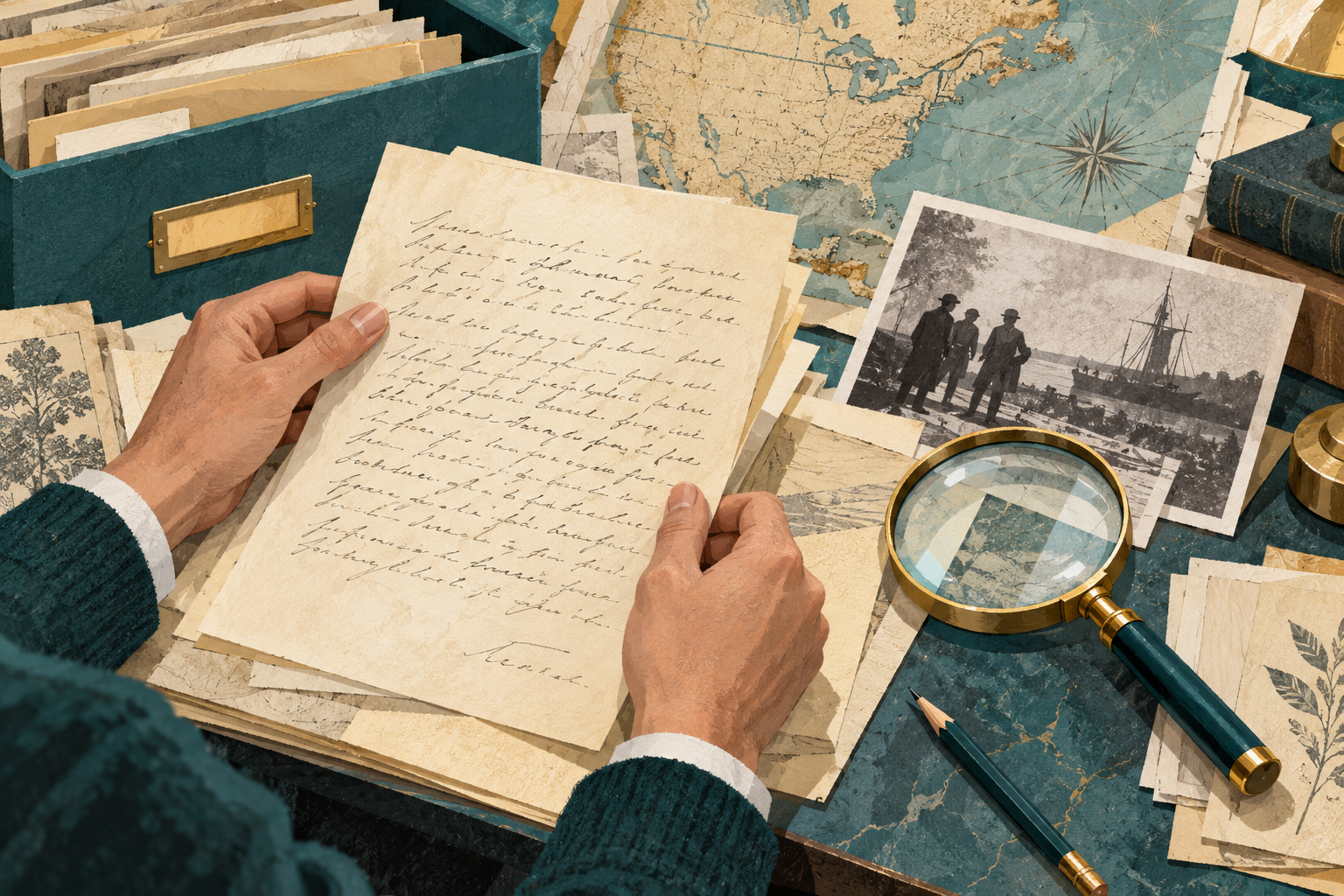
Featured image: original editorial illustration. Its documents, handwriting and historical photograph are imagined, not reproductions of archival evidence.
Why October is a useful starting point
The National Archives identifies October as American Archives Month, an annual opportunity to highlight archives and the people who make historical records accessible. Its official observance page was reviewed in November 2024. This article uses that recurring October occasion; it does not report a newly announced 2026 festival, funding program or discovery. A fresh calendar date should never make an older source look like breaking news.
The agency’s Getting Started overview, reviewed January 15, 2026, offers a useful sequence: define a topic, gather background, find relevant records and decide whether a research visit is needed. That sequence is more practical than promising that one search will reveal an entire family history. It treats research as decisions whose quality can improve even when the desired document has not yet appeared.
This guide develops original exercises and decision tools around those verified starting points. All invented scenarios are hypothetical. They demonstrate reasoning rather than report findings from real collections. Readers can use these habits for a family project, classroom assignment, neighborhood history or public exhibition: identify the question, establish what a source is, test what it supports and leave a trail someone else can follow.
A useful outcome need not be spectacular. You might establish that a photograph cannot yet be dated, that two people with similar names should remain separate, or that an official file concerns a proposed action rather than a completed one. Those are advances. They replace a fragile story with an account explaining both what is known and what still needs checking. Archives become especially valuable when the research makes uncertainty visible.
Start with a question small enough to answer
“Find everything about my town” is a motivation, not yet a research question. It gives you no stopping point and no way to distinguish a relevant result from an interesting distraction. “What evidence can establish when this building was used as a school?” is more productive. It identifies an object, activity and time problem. It leaves room for a firm date, a range, contradictory evidence or an explanation of why available material cannot resolve the issue.
Write your question before opening a search engine. Under it, list what you know, where each statement came from and which details are only recollections. A date copied from a plaque and a date remembered by a relative should not silently become equivalent. Both can guide research, but each needs its own description. Keep the original wording of a recollection where possible so a later paraphrase does not accidentally strengthen it.
Consider a hypothetical reader investigating a photograph labeled “the school, about 1910.” Ask who wrote the label, whether that person knew the building, and whether “about” refers to the photograph, the building’s opening or the writer’s estimate. A photograph and its later label are separate pieces of evidence with different origins. Treating them separately creates better questions before any archive search begins.
A second question might concern location. Does the image show a street corner, hill, fence or neighboring structure that could identify it? If identification remains uncertain, record that before searching school records under a presumed name. Otherwise the assumption shapes every result. You may reject documents that disagree with the guessed identification while accepting weak matches because they fit a story already chosen.
Set a first-stage goal for one evening: locate a collection description, identify an office, compare two images or create a timeline. A bounded goal makes research easier to resume. It also lets you notice when the question changes. A search about a school may become a search about a relocated building. Record that change instead of pretending it was the plan all along.
Match the question to the record’s creator
The National Archives preserves federal records. Its immigrant-records overview asks researchers how a topic intersects with the United States federal government and warns that many records remain on paper or microfilm. That is a useful routing principle. A document’s likely custodian depends on the activity that produced it, not simply whether an event happened in America. Local and federal administrative matters can leave different documentary trails.
Build a responsibility map. Put the historical action in the center: enrollment, construction, transfer, arrival, employment or an official decision. Around it, write organizations that might have recorded that action. Mark candidates as confirmed, possible or unlikely. Investigate their responsibilities during the relevant period. Do not assume a modern department always existed under the same name or that today’s jurisdiction describes an older recordkeeping arrangement.
For the hypothetical school photograph, a municipal archive, school district collection or historical society could be sensible starting inquiries. These are possibilities, not promises that records survive there. A federal connection needs its own explanation. Perhaps the project involved a federal agency; perhaps it did not. Identify an actual administrative relationship before expecting a national institution to contain every locally generated document.
Separate the creator from the present holder. An office may have made a file later transferred elsewhere. A family may have donated papers to a university. A publication may reproduce an image held by another institution. Preserve both identities. The creator helps explain why information was recorded. The holder explains where you can inspect it now. A website displaying an image is not automatically either one.
Before an archive inquiry, gather a compact description of the question, dates, place and known names. Include what you have consulted. “Do you have anything on my grandfather?” gives staff little to work with. A message describing a known location, activity and unresolved date permits a focused response. Avoid sending unrelated personal information. Share only what identifies the historical material and research problem.
Understand what a catalog result represents
The National Archives Catalog guide for family historians explains that descriptions often concern series rather than individually named people. A result can describe many records without listing everyone mentioned inside. It also distinguishes descriptions with digital objects from those without images. An unsuccessful name search does not establish that a person is absent from the underlying records.
Imagine a hypothetical result titled “Correspondence about school buildings.” Identify the description level. Is this one letter, folder or sequence of files? What dates does it cover? Who created it? How much material does it describe? Where is it held? You may have found evidence, a route toward evidence or a collection worth asking about. Each is useful, but they are different research outcomes.
Read the surrounding description before opening the most attractive image. A page can be difficult to interpret apart from its file. A note referring to “the previous proposal” invites a search for related pages rather than an immediate conclusion. A heading can provide context but may be broad or supplied later. Record whether a title belongs to the original document, file arrangement or catalog description.
Keep collection structure in your notes: institution, creating office, series, folder, document, page. Terminology varies, so copy fields supplied by the repository instead of forcing records into a homemade scheme. Remember where a document sits among related material. A direct image link alone often loses that relationship when shared outside the catalog. Context can be as important as the words visible on one page.
Restricting results to digitized objects makes online work manageable, but removes relevant descriptions without images. Record that choice. If you later describe the search as exhaustive, the filter contradicts the claim. A better sentence is: “This stage examined digitized items returned by these searches.” It states the scope and leaves a next step for work in undigitized material.
Search systematically without letting spelling control the story
Begin with terms expressing the question, then change one feature at a time. Search a place, an activity and a combination. Add an older name only when there is a reason to believe it was used. Save queries and the search date. This is helpful when returning months later without remembering whether an absence reflected the collection, a filter or your wording.
In a hypothetical family project, “Ellen Marlow” might appear with an initial, spelling variant or another surname. These possibilities prompt investigation, not permission to merge similar results. Start a candidate table with separate rows. Include each candidate’s place, dates, associated people and references. Balance a column called “reason to connect” with another called “reason to keep separate.” Keep both open while evaluating evidence.
A matching surname is weak evidence for a common name. A matching name and location are more useful but may remain insufficient. Ask what distinguishes the person: a household connection, address, occupation or chronological sequence. Appropriate details depend on documents you have. Do not fill missing fields from intuition. A blank signals that more evidence is needed, rather than a formatting problem to solve.
Search by activity when names fail. A person can appear in a file described under a project, office or event. In the school example, a teacher may be mentioned inside letters without appearing in the catalog description. Searching the school, activity or date range can reveal another route. Keep broadening queries connected to the question so the project does not become aimless browsing.
Save a promising result’s title, identifier, URL, date and reason for opening it. A note such as “may identify east entrance; not confirmed” is better than anonymous downloads. It separates a lead from a conclusion. It prevents an image’s growing familiarity from becoming an unconscious reason to treat it as verified. Familiarity shows that you have seen something often, not that its identification is correct.
Separate observation, transcription and interpretation
Use distinct spaces in notes. Observation describes visible features: a date, torn corner, heading or signature. Transcription reproduces words. Interpretation explains their possible meaning. Mixing them creates circular reasoning. You think a document concerns a school, read an unclear word as “school,” then use that reading to confirm your belief. Separate notes let you notice when the conclusion is being smuggled into the reading.
Make a literal inventory. How many pages are visible? Are they numbered? Is the reverse shown? Is text complete at the edges? Does a stamp overlap writing? Is an attachment mentioned but missing? These observations establish whether you have an object or a fragment. A fragment is valuable when its limits remain in the explanation. It should not quietly stand in for the entire file.
Preserve uncertainty in transcription. Use consistent notation for unreadable words or tentative readings and explain it. Do not silently modernize a name or repair an implausible date. Propose corrections separately with reasons. An unexpected statement may be important. Altering text to fit expectations destroys the clue that could redirect research. The original reading and your proposed interpretation should remain distinguishable.
Automatic text extraction helps locate passages, but consult the image when accuracy matters. In a hypothetical exercise, extracted text reads “1918” while the scan could read “1913.” Compare other digits in the handwriting and nearby dates. If ambiguity remains, publish the uncertainty. Clean software output is not historical certainty. It is a reading that should be checked against the evidence used to produce it.
Retain an unaltered working copy alongside a transcription, subject to repository conditions. Connect filenames to the source reference. When revising a reading, record why: a clearer scan, another page, comparison with the handwriting or a provisional assumption. This makes later corrections intelligible. Without the reason, a future researcher cannot tell whether a change improved accuracy or merely made the story more convenient.
Ask why the document was made
A funding request, completion announcement and payment ledger can concern one project while answering different questions. The request establishes that someone sought action; the announcement establishes a public claim; the ledger may establish a recorded transaction. None proves every aspect of the project’s history. Identify the act of record creation before deciding what it tells you. A document is evidence of something specific, not a guarantee for every related narrative.
In a hypothetical school file, a letter may emphasize overcrowding to seek funding. That does not make it worthless or dishonest. Distinguish the argument from independently measured conditions. Does it cite a count, personal observation or complaint? Where can the underlying statement be checked? Purpose provides a way to read carefully instead of accepting or rejecting a source wholesale. A persuasive document may contain both useful information and claims needing corroboration.
Consider the audience. A private note may assume knowledge a public report explains. A form constrains answers to categories. An administrative report emphasizes information relevant to a decision while omitting what interests later historians. Silence may reflect the task. Before calling an omission concealment, ask whether the creator had reason to include the information. This question cannot resolve every absence, but it improves the alternatives you consider.
Three repetitions are not necessarily independent confirmations. A report may quote a memorandum while a newspaper relies on the report. Draw a chain showing where information appears to originate. If it leads to one unsupported statement, repetition has widened circulation, not multiplied the evidence. Keep uncertain links in the chain marked as uncertain. Similar wording can suggest dependence but does not alone establish how one writer obtained information.
Apply this habit to modern stories about archives too. An article, social post and caption may repeat one announcement. Follow them to the original and preserve its qualifications. Distinguish documented institutional statements from later inference. A method useful for century-old correspondence also prevents present-day retellings from becoming more certain than their source. It is the same question of who said what, on what basis and for which audience.
Read photographs as selected views
A photograph records a view from a position at a moment. Begin with the frame before inferring what lies outside it. Count what is visible. Describe visible people rather than an entire community. Note obscured roads or doors. Vividness does not remove the need to establish date, location and context. A compelling image can make a narrative memorable while leaving the historical identification almost entirely unresolved.
Children outside a building in our hypothetical image support a description of the scene. They do not establish attendance, curriculum or everyone’s enrollment. A caption might make those claims, but needs assessment itself. Was it contemporaneous, written later by a witness or attached by an unidentified collector? The conclusion should reflect the strongest verified layer. If the image and caption differ in certainty, explain that difference to readers.
Look for related images. Another frame might reveal a hidden sign or show that the gathering had a special purpose. A sequence can complicate an attractive interpretation. Different captions might identify different places. Retain disagreements in the notes. They could indicate mistaken labels, multiple events or a gap in your knowledge. Do not select only the image that supports the identification you hoped to make.
A close crop may hide the setting that identifies an event. Retain the full image when making a crop and describe the change. Do not use editing to manufacture evidence. Enlargement cannot reveal a detail the original resolution does not support. For a historical presentation, aesthetic choices should remain subordinate to what readers need to see to understand the claim. A beautiful crop may be a poor research illustration.
Separate identification from interpretation in captions. “Undated photograph believed to show the west entrance; identification provisional” is informative when evidence is incomplete. Do not assign names because faces look similar. Explain the basis for an identification and what would confirm it. Readers can appreciate a photograph without being supplied an invented certainty. A restrained caption can open a productive inquiry rather than close one prematurely.
Read maps as arguments about place
A map has purpose, scale and conventions. Identify its legend, date, extent and revisions before using it. A line may mark a boundary, proposal, survey feature or route. Read the legend rather than assuming meaning from appearance. Precision in drawing does not guarantee the interpretation a modern viewer expects. The information omitted can also matter: a map made for one task may not represent features relevant to another.
In a hypothetical exercise, two maps show a road in different positions. Perhaps it moved; perhaps they generalize differently; perhaps one shows a proposal; perhaps you misunderstood the reference. The difference is a question rather than proof of construction. Compare dates and purpose, then seek an action record. This moves a visual discrepancy toward a testable explanation. It prevents a neat before-and-after display from overstating what the maps establish.
Keep historical place wording separate from modern identification. A name may describe a different area now. If boundaries changed, specify which boundary matters. “The town” can mean a settlement, municipality or district. Switching between meanings creates apparent agreement where the sources concern different places. Write the definition used in your notes before comparing documents. This small step can explain disagreements that otherwise seem impossible to reconcile.
A report may describe a building by a landmark; a map may identify a parcel without naming its occupant. They can supply missing context, but the connection needs evidence. State the shared feature supporting the match. A vague resemblance remains tentative even when the combined story is plausible. Consider what other building, parcel or route could also fit. Testing alternatives is more useful than repeating the favored interpretation.
Preserve a map’s title, date, legend and source reference for display. A decorative crop may remove the very details needed to interpret it. If the reproduction must be small, explain the feature in text and link to the fuller image. Accessibility and legibility matter as much as visual appeal. Readers should not need to guess what a faint line represents simply because the presentation made the legend unreadable.
Use family records without merging identities too soon
The genealogy overview, reviewed January 15, 2026, directs readers to census, military, immigration and naturalization resources, including partner-digitized material. It warns that the general website search box is not a person-finding service. Start with an appropriate record type. Distinguish a collection guide from an index of people. The difference affects what a search can reasonably reveal and what an unsuccessful result means.
Make one timeline row for each documented appearance. In a hypothetical project, records in different places suggest movement, but the gap remains. Do not narrate a journey without supporting documents. “Documented here by this date” differs from “moved here on this date.” Wording keeps conclusions aligned with evidence. A timeline can be useful even when it contains large blank intervals, provided those intervals do not become invented episodes.
Retain conflicting ages or dates. Ask who supplied information, when it was recorded and whether images are clear. Does another detail establish that both sources concern the same person? Inconsistency could be an error, misunderstanding or mistaken identity. Choosing the value that makes the timeline neat avoids the research problem. Investigate the disagreement before allowing a polished narrative to conceal the alternatives.
Treat a family tree as a display of conclusions. Keep documentary reasoning outside it so each connection can be explained. Mark uncertain relationships and identify missing evidence. A polished chart otherwise appears complete when later relatives copy it without the notes. The clarity of the display should not exceed the clarity of the research. Visual simplicity is useful only when it does not erase qualifications.
Be thoughtful about living people’s information. Availability does not make every detail relevant to a public story. Ask whether it answers the historical question or whether a less intrusive description suffices. This is an editorial choice about relevance and respect. It also improves the narrative by removing unrelated personal facts. Historical curiosity is not a reason to include every detail encountered during a search.
Understand the limits of land records
NARA’s land-entry guide distinguishes federal public-land transfers from later ownership research in local and state repositories. Completed patents and cancelled or relinquished entries involve different paths. “Had a homestead” needs a precise question: an application, completed transfer or later purchase? The everyday expression does not identify the administrative transaction or tell you which record should answer the question.
In a hypothetical land project, identify the location and record type. A certificate, family narrative and modern map answer different questions. Copy names, dates and identifiers exactly. Retain a legal land description if supplied rather than replacing it with an address. They may serve different purposes. A modern locator can be helpful without preserving the filing reference needed to investigate an older transaction.
Separate a transaction from the person’s wider life. A file does not automatically establish farming methods, feelings about a place or relationships with neighbors. Those questions need other evidence. Do not turn a sparse record into a detailed frontier narrative because it seems familiar. Useful expansion identifies further questions while keeping documented facts narrow. A modest supported account has more lasting value than a dramatic invented one.
Compare an application with a decision before describing an outcome. A claim’s existence does not prove success. A search of completed transactions can miss other files. State the scope: “The search examined completed entries in this resource.” That is more defensible than “No land records exist.” It also tells another researcher which alternative route remains open and prevents an incomplete search from becoming a permanent conclusion.
This historical exercise does not resolve present ownership or legal rights. Keep the article descriptive: who appears, what transaction is recorded and how it connects to other sources. If the project concerns a current dispute, consult appropriate authoritative records and professional advice. An old document’s historical meaning and its present legal significance are different questions. Do not allow an interesting archival discovery to blur that distinction.
Build conclusions that can survive disagreement
Make a claim table: proposed sentence, evidence, limitations. “The building operated as a school by this date” requires dated evidence connecting that building with school activity. An undated photo may be relevant but insufficient. The table exposes weakness before polished prose hides it. It also shows where an additional source would have the greatest effect, helping you prioritize research instead of collecting context indiscriminately.
Give conflicting material equal attention. Ask whether sources concern the same object, time and definition. One might describe a proposal, another completion. Two buildings might share an informal name. Resolving scope can explain disagreement. If it cannot, present competing evidence honestly. A reader who understands the conflict can evaluate the conclusion better than one who receives only the evidence selected to make it look settled.
Ten repetitions may provide less independent support than two records created for different purposes. A single source may establish a narrow fact well. Assess how directly evidence relates to a claim and whether plausible alternatives remain. Source counts help organization; they are not a mechanical certainty score. The same collection can contain many pages that all depend on one initial report, and the number of pages does not remove that dependence.
Choose verbs carefully. Requested, reported, recorded, proposed and completed describe different relationships. If a letter requests construction, say that. Do not say construction occurred without another basis. Accurate verbs make evidence understandable. This discipline often improves an account more than pages of broad background. A reader should be able to tell whether your sentence describes an event, an intention or someone else’s statement about an event.
Negative findings need scope. “I did not find a record in these digitized results” describes work. “The event never happened” makes a much larger claim. Understand what should exist, what survives, how it is arranged and whether your search could find it. Absence can matter after those conditions are examined. Without them, it is often evidence of a search limitation rather than evidence about the historical event.
Plan an archive inquiry or visit
NARA’s online research tools overview, reviewed January 15, 2026, distinguishes catalogs, databases, finding aids and guides. It points toward contact or visits for material unavailable online. Check current repository instructions for location, access and availability before traveling. This article does not promise hours, appointment rules or production of a particular file. Those details need confirmation directly from the relevant institution.
Prepare a one-page brief with the question, dates, places, references and uncertainty. List material consulted. Staff can then assess the repository’s relevance and the request’s scope. The brief also helps you prioritize instead of spending a visit repeating online work. It should describe what you need to learn, not demand a predetermined conclusion. An inquiry is strongest when it invites useful correction of your assumptions.
Distinguish essential targets from optional context. If access takes longer than expected, the distinction protects your purpose. Photographing unrelated material can feel productive while leaving the problem unresolved. A smaller relevant set often gives a better result. For each target, write the question it could answer. If you cannot describe its relevance, it probably belongs on the optional list until further evidence connects it to the project.
Preserve reference information and page sequences while collecting copies. Follow staff handling and reproduction instructions. Different formats and facilities may require different processes. If photography is unavailable, plan accurate notes another way. Interpretation depends on maintaining the relationship between a copy and its source. A clear image with no reference or sequence can be much harder to use responsibly than a modest transcription accompanied by careful context.
Review collected material before leaving. Check legibility, sequences and missing pages while questions can be asked. Organize it promptly afterward and write what the visit established, including disappointments. An honest visit report is better than an impressive unexplained folder. Record the next action while it is clear: request an attachment, compare another series or revise the question. This keeps the visit connected to the wider research process.
Create citations another reader can use
NARA publishes a dedicated record-citation guide. Consult it and repository references for the appropriate structure. Preserve description, date, creator, identifier, collection relationship, repository and page or image in notes. These details let someone locate evidence and assess a claim. A bare web address seldom supplies everything, especially when it points to an institutional homepage rather than the specific material consulted.
A caption describes what readers see; a citation explains origin. Keep both. If a caption says “school opening,” the reference should lead to evidence for that identification, not only an undated image. Otherwise confident wording may be an interpretation masquerading as a fact. The distinction is useful even in a personal project because it reveals which statements came from a source and which you added during analysis.
Make references specific to the claim. Link an item or collection where possible and identify the relevant page. Describe physical references when material is offline. A reader should understand what you consulted even if access requires a request or visit. Do not imply that everything behind a citation was available in the same way. A catalog description and an inspected document are different research experiences and should be described accordingly.
Quote only when wording matters. Summarize otherwise. Retain conditions and attribution. Do not extract a confident phrase from a conditional sentence or erase that a report repeats someone else’s claim. Precision matters especially when historical language supports a present-day argument. Short quotations with clear context are usually more useful than long extracts whose relevance readers must work out for themselves.
Test links and compare citations with notes before publication. Check identifiers and page references. A small error can make a sound interpretation impossible to verify. Reference checking belongs to reasoning, not merely administration. It may also reveal a substantive mistake: a citation intended for one document could point to another similar item, requiring you to revisit the claim rather than simply repair the link.
A weekend project that produces a checkable result
First choose one question and assemble existing material. Separate observations, readings and interpretations. Write a short provisional account with each claim connected to evidence. Expose gaps rather than finish the story. The most important uncertainty may be simpler than the topic that inspired the project. A short account also makes it easier to notice which paragraph rests on a recollection or assumption rather than a document.
Next investigate the creator and repository. Read a guide before searching extensively. Log meaningful queries and filters. Preserve references for promising results and explain why others fail. Distinguish irrelevant, inaccessible and insufficiently described material. Those labels prevent repeat work. They also make it possible to return when access improves without having to reconstruct why a particular collection was considered in the first place.
Then compare sources side by side. Identify agreement, differences and mismatched questions. Build the claim table and adjust verbs. If there is no firm result, write a research note describing the question, scope, observations and next step. Incomplete work can be shared transparently without pretending to resolve a history. It may help another reader suggest a relevant source precisely because you have explained the unresolved point.
For classrooms, rotate roles: describing the object, checking wording, examining context and challenging conclusions. Do not permanently assign someone only to find support. NARA’s document-analysis resources offer worksheets for multiple formats and a progression toward historical evidence. Use them as a scaffold, then ask students to explain reasoning in their own words. Their explanations should identify what they observed and what they inferred.
Finish with a concise result explaining evidence and limits. Show what changed from the starting assumption. Identification may strengthen while a date remains uncertain; a relationship may be rejected; an undigitized file may be the next lead. These outcomes show accountable historical work. October’s invitation can produce something more durable than an attractive anecdote: a small account that others can examine, question and improve.
Write the result at the right level of certainty
Return to the hypothetical school photograph for one final exercise. Suppose the image’s location is reasonably supported by a matching doorway and a documented building plan, but the only date is a later handwritten label. Write two separate conclusions. The first concerns the building identification and explains the matching features. The second concerns dating and explains that the label supplies an estimate whose author is unknown. Combining them into “The school in 1910” would hide the difference between the two kinds of support.
Now imagine finding a dated letter that mentions repairs to the building. This adds a documented activity at a particular time. It still does not necessarily date the photograph. The letter can establish context without transforming the image into a dated view. Your revised account should say what the new source changes: it supports the building’s use during the period, while the photograph’s exact moment remains unresolved. This is a specific improvement, not a license to strengthen every sentence in the story.
A reader-friendly presentation could place the photograph beside a brief timeline, then include a paragraph explaining the distinction. Keep the timeline restricted to dated documentary appearances. Place the photograph outside that sequence if its date remains approximate. The arrangement communicates uncertainty visually instead of relying on a small qualification readers might miss. It also gives the image a useful role without making it carry more evidence than it contains.
Before sharing, ask someone unfamiliar with the project to identify the strongest conclusion and the unresolved question. If they understand both, the presentation is doing its job. If they leave believing an uncertain date is established, revise the wording or layout. Good historical communication makes the boundary between evidence and interpretation easy to see. That boundary helps a modest archive project remain useful when new records appear and the account needs to change.
Sources and editorial method
This original research-planning guide uses the annual October observance. Institutional facts and resource descriptions were checked against the linked National Archives pages on October 3, 2026. Their review dates differ. The scenarios are hypothetical teaching exercises, not discoveries, verified identities or descriptions of particular files. The illustration is fictional. No interview, personal archival visit or hands-on examination is claimed.