


PACEARTH Swing Seat Recall: What Owners Should Do Now

PACEARTH Swing Seat Recall: What Owners Should Do Now
A newly announced recall calls for immediate stop-use and a full refund. Here is how to identify the seat, document a request and keep a safety report separate from the remedy.
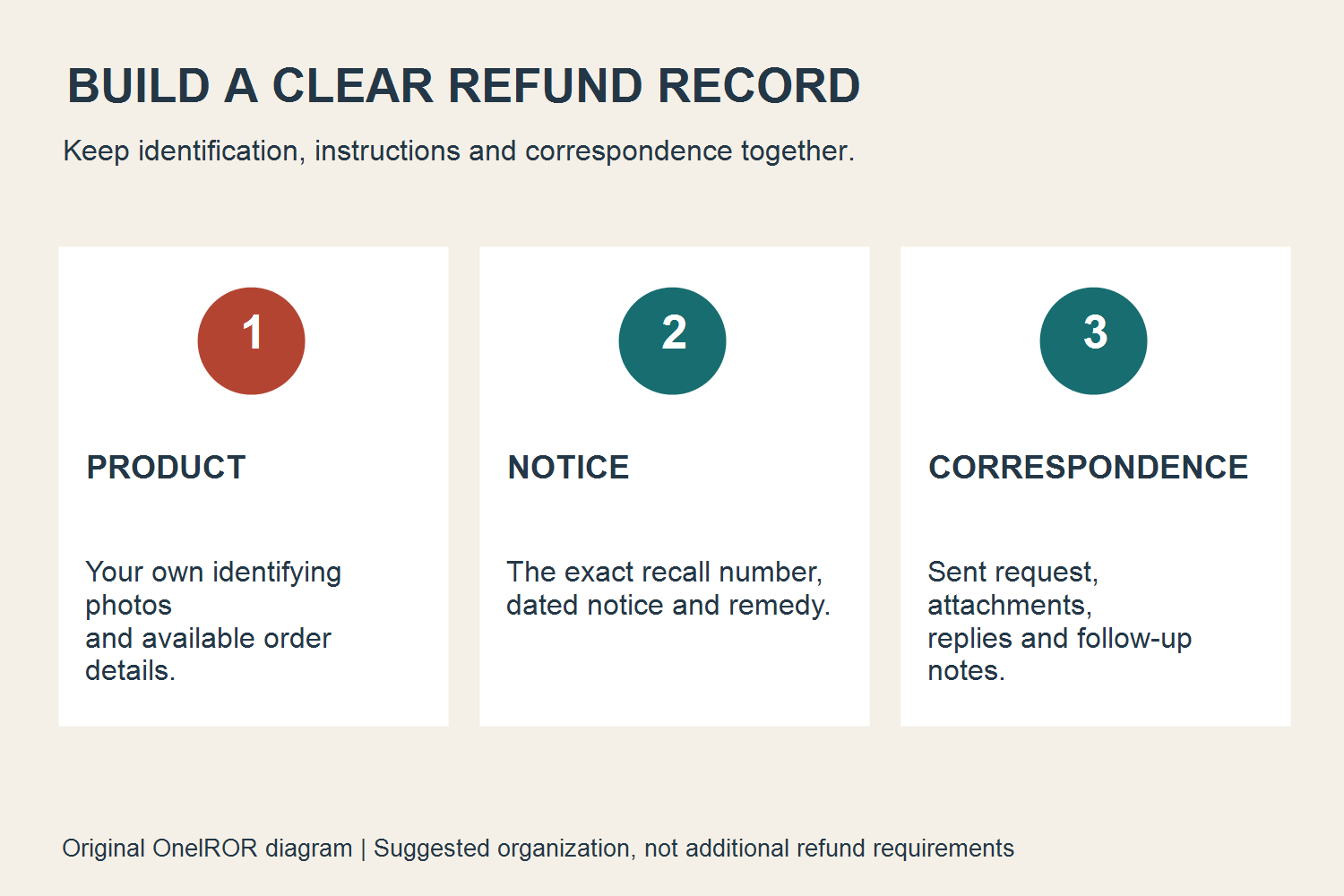
Opening image: original OnelROR editorial diagram, not a photograph or an illustration of the recalled product. Use the official recall images below for product identification.
The October 8 notice and the immediate decision
PACEARTH U-type swing seats are the subject of an October 8, 2026 recall covering about 110,550 units. The U.S. Consumer Product Safety Commission says the seat, metal carabiners or quick links, or webbing straps can break during use, creating a serious fall-injury hazard. The named remedy is a full refund through Pacearth Direct. Owners should stop using an affected seat immediately. The official notice, recall 27-019, is the starting point for identifying the product and following the remedy, rather than a marketplace description or an old instruction leaflet. [1] [2]
The notice describes multiple seat colors, yellow plastic-coated chain and included yellow webbing straps. The seats were sold singly or in two-packs through Amazon from May 2017 through June 2026. Pacearth Direct received at least 30 reports of falls, with at least nine injuries. The refund instructions call for permanent-marker identification and a photograph. These are the reported facts; they do not establish which individual household seat will fail, an injury rate or a safe remaining period of use. The official notice is linked below so readers can compare its product images directly.
Cox Media Group’s Natalie Dreier reported the recall through WHIO on October 8 at 2:11 p.m. EDT, corroborating its product description and remedy. That reporting provides a useful independent check on the announcement, but it is not a substitute for the regulator’s current instructions. This article was prepared on October 11 in Miami. The announcement date, the date of the reported incidents and the publication date of this explanation are different things. We have not inspected a seat, interviewed an injured owner or tested any replacement hardware.
The practical task has two clocks. The safety decision belongs to the present: keep the affected product out of use. The administrative task can take longer: identify it, assemble the requested evidence, contact the named business and retain the correspondence. Waiting for an email reply does not pause the safety instruction. Separating those clocks prevents a familiar mistake in household recalls, where a product remains available because its owner has not yet found an order confirmation or decided how to phrase a refund request.
Read the numbers without turning them into a prediction
A large recall count describes the estimated number of units in the recall, not the number of seats currently installed, the number still owned or the number that have failed. Some may be boxed, discarded, passed to another family or used in a different setting. The announcement does not supply a census of those later circumstances. For an owner, the useful question is whether the product matches the recalled item. The population figure helps convey scale, but it cannot answer the identification question for a particular seat.
Likewise, reports received by a business are not a controlled study of every use. Dividing the injury figure by the unit figure would produce a number with an unjustified appearance of precision. We do not know all exposure times, reporting patterns, unused stock or unreported events from this notice. It would be misleading to convert those counts into a household probability. A family should not need a numerical forecast to follow a recall that already identifies a serious hazard and a specific action.
Keep the qualifiers attached when sharing the news. A headline may reasonably round the scale for space, while the notice gives a more specific approximate count. A summary that drops a qualifier can imply a completeness the underlying source does not claim. A useful message to another owner can be short: name the brand and product type, give the announcement date, link the official notice and state the action. It does not need an invented explanation of exactly why each reported failure occurred.
This distinction also sets a boundary for later updates. If the official remedy changes or additional information is published, readers should use the current notice and preserve the version they relied upon for their request. An old screenshot can document what a person read; it cannot prove that instructions remain current forever. The article’s date tells you when our source check happened. It is not a promise that every future customer-service response, business status or product listing will stay the same.
Identify the seat from more than one clue
Begin with the product you actually have, while keeping it out of use. Read visible branding and compare the seat, suspension components and any retained packaging with the official identification images. An order record can help connect an item to its original seller, but a physical product and a shopping-history entry are different kinds of evidence. Photograph accessible identifiers without putting anyone on the seat. If reaching a label would require climbing, handling unstable equipment or working at height, keep the area unavailable and obtain appropriate help instead.
Color is an identification aid, not an independent clearance test. Similar-looking outdoor seats may come from different suppliers, and household components may have been changed after purchase. A visual resemblance can justify investigating; it cannot by itself prove a precise brand or model. Conversely, a faded or dirty seat should not be cleared merely because it no longer looks as bright as a promotional image. Note the identifying features you can establish and the ones you cannot. The difference should remain visible in any inquiry you send.
Use an identification note with separate fields: where the item is located, what its marking says, which photographs you took and what supporting record you found. This is an editorial organizing suggestion, not an extra condition imposed by the recall. A brief note such as ‘brand visible on underside; order record available; original packaging unavailable’ is more informative than ‘definitely the same thing’ when the latter is based only on memory. It gives the business a concrete question to answer if identification remains uncertain.
If you cannot confidently match the product, do not use an uncertain identity as a reason to keep trying it. Send the identifying evidence to the official contact and ask whether the item falls within the notice. Avoid declaring an unrelated brand recalled in a public post. An unresolved match is an unresolved match, and the safe interim choice is to keep the questionable item unavailable. The purpose of comparison is to reach a supported identification, rather than to find the fastest argument for returning it to play.
Account for two-packs, spare parts and mixed installations
A household installation may no longer resemble the original purchase. One seat might be hanging outside while another is stored in a shed; a spare connector may be in a toolbox; a gifted seat may be at a relative’s home. Before considering your check complete, trace the items associated with the purchase as far as your records allow. Keep each physical item associated with its own photo and location. This avoids submitting a picture of one seat while forgetting a second one that remains available elsewhere.
For a mixed installation, write down changes you know about rather than trying to reconstruct a history from appearances. For example, an owner might remember replacing a strap but not know whether the metal link was original. That uncertainty matters to product identification. The notice’s remedy should not be transformed into a home-engineering project based on whichever component looks newest. A different connector does not give the owner evidence that the recalled seat assembly has been cleared for use, especially when the notice identifies more than one possible failure component.
Keep detached parts out of the general collection of useful hardware while the recall is being resolved. A labeled container or clearly separated storage location can prevent another adult from reusing a component simply because it looks serviceable. Choose a storage arrangement that is inaccessible to children and does not create a new hazard. Do not leave a loose chain, hanging cord or improvised restraint in the play space as a substitute for a clear closure. If safe handling is beyond your capability, secure access and seek assistance.
If the original pair has been split between households, each holder needs the notice and enough information to identify their item. Do not assume that a refund request for your seat automatically tells another owner what happened. A transfer history can be as simple as ‘the second seat went to my sister last summer; she has been given the official notice.’ That records a concrete communication without claiming that you have inspected her setup or verified her remedy. Follow up on the missing item as a separate unresolved task.
Make stop-use clear to every person with access
A decision recorded in one person’s inbox is easy for another caregiver to miss. Explain the closure in plain language to anyone who might supervise play, open a shed or reinstall equipment. State which item is unavailable and where the official notice can be found. A short, specific instruction is better than an alarming but vague message that all backyard equipment is dangerous. The goal is to prevent the identified product from being used while preserving enough clarity for adults to manage the rest of the space responsibly.
Choose a physical arrangement appropriate to the setting so that the affected seat cannot casually return to use. Safe removal may be straightforward in one installation and unsuitable for an untrained person in another. Do not climb a tree, stand on unstable furniture or improvise a removal method just to finish the recall quickly. Prevent access while arranging competent assistance where needed. This article does not provide a rigging method, a tree assessment or a procedure for dismantling a structure, because those depend on the actual installation and its condition.
A notice to a child can focus on the immediate boundary: this seat is closed, and an adult will choose another activity. Children do not need to understand refund correspondence to respect that boundary. Adults should avoid making the closure negotiable with offers of a short ride, a lighter rider or closer supervision. None of those arrangements is a remedy identified in the announcement. A product that remains physically available can undermine even a clear verbal instruction, particularly when visitors have not heard the explanation.
At the end of the initial check, ask whether someone arriving later could mistake the item for ordinary equipment. That is an operational question, not a technical certification. A guest may see an intact seat without knowing the recall; a helpful relative may find a boxed spare and reinstall it. Clear separation, identification and communication reduce those avoidable misunderstandings. They do not repair the recalled product. Keep that distinction intact when documenting what you have done, so ‘closed and awaiting remedy’ does not become ‘checked and safe.’
Follow the actual photograph instruction
For this remedy, the notice asks owners to write ‘RECALLED’ on the seat with permanent marker, photograph it with the PACEARTH logo visible and email the image to recall@pacearth.com. Read that instruction on the official page before preparing your evidence. A picture should show the requested marking and the identifying logo clearly enough to be understood. This article does not add a cutting, drilling or destruction procedure, and it does not assume that instructions from a different recall apply to this product.
Before sending, open the image file rather than relying on its tiny thumbnail. Check that the required information is legible and that glare, shadow or cropping has not obscured it. Use a neutral background where practical, and avoid including a child’s face, a house number or unrelated personal documents. You do not need to create a polished advertising photograph. You need an accurate view of your own item that answers the remedy’s identification request without changing the product’s appearance or pretending it is a different seat.
If the logo is missing, damaged or impossible to photograph safely, explain that limitation and ask the named contact how to proceed. Do not add a brand label digitally, borrow a photograph from a listing or use another owner’s picture. Those substitutions would turn uncertain identification into misleading evidence. Retain a copy of whatever you actually send. If customer service requests a different view, the original file and correspondence can help you understand whether the new request concerns the product identity, the marking or another unresolved detail.
Do not dispose of evidence impulsively before understanding the official process. At the same time, evidence preservation is never a reason to leave the item available for play. Keep it safely out of use while you ask for clarification about any step that the notice does not explain for your circumstances. The photo instruction establishes what the announcement requests; it does not establish a guaranteed response time, a payment method or every possible exception. Ask those questions directly rather than inventing an answer from someone else’s experience.
Write a refund request that can be understood in one reading
A useful request starts with the recall name and number, states that you have an affected item and attaches the requested photograph. Add available purchase information only as relevant supporting detail. Keep the message factual and easy to scan. An optional subject line could name the product and recall number; that is an organizational aid, not an official requirement. Avoid placing unrelated complaints, lengthy speculation about manufacturing or a demand based on an unverified online claim ahead of the information needed to identify your item.
Describe what you are asking for without inventing the remedy: you are requesting the announced refund and instructions for any remaining step. If you have two seats, state that clearly and associate photographs with the appropriate items. If an order record is missing, say so plainly rather than supplying a guessed purchase date as fact. The announcement does not spell out every documentation exception. An inquiry can be complete enough to start a conversation while still acknowledging that the business needs to clarify a particular situation.
Check the destination against the official notice immediately before sending. A search result, social-media comment or forwarded screenshot can contain a typo or an obsolete contact. This article links the notice so readers have a direct path to the source. We are not submitting a request on anyone’s behalf. When you contact the company, include only information relevant to your claim and review any further request in context. A refund announcement does not make every message that mentions the brand an authentic instruction.
Save the sent message, the attachment and any acknowledgment together. The useful record is the content that left your mailbox, not just an unsent draft or a photograph on a phone. If your email application reports that the message could not be delivered, preserve that notice too. It records a specific delivery problem and gives you something concrete to reference when seeking help. Do not treat an automated acknowledgment as proof that the refund is approved or paid unless the message actually says so.
Missing receipts and gifts require questions, not invented eligibility rules
An older household product may outlast its packaging and receipt. A gift may be associated with someone else’s shopping account, and an account search may not find an item purchased years earlier. Those circumstances complicate documentation without resolving whether the physical seat matches the recall. Start with the evidence you have: the product itself, its identifiers, the requested photograph and any reliable purchase or transfer information. Do not assume that missing paperwork makes a matching recalled product safe to use while you investigate the administrative question.
Ask the official contact what information is needed for your specific situation. This explanation does not promise eligibility for a gift recipient, dictate an acceptable replacement for a receipt or assert that an order number is mandatory. The notice provides a remedy and a photo instruction, but does not publish a complete decision tree for every ownership history. A clear question can say that the item was a gift and that the original purchaser may have an order record. That lets the recipient distinguish established facts from a request for guidance.
If you ask the purchaser for help, request the relevant product information rather than broad access to their account. They may be able to locate an order and pass along a useful record without sharing a password or unrelated purchases. An owner and purchaser can also agree which person will manage the correspondence, reducing conflicting requests. Keep the recalled item unavailable regardless of who handles the email. A family discussion about who should receive a refund should never become a reason to postpone the stop-use action.
When ownership is uncertain, record the limits of your knowledge. ‘Received as a gift; approximate year unknown; logo visible’ is honest and useful. A made-up exact date can produce avoidable inconsistencies later, especially if a genuine order record is found. The same discipline applies to quantity. Do not claim a two-pack merely because two similar seats are present. Separate what you know about each item from what you infer about the original transaction, and let the official contact answer any unresolved remedy question.
Track follow-up without treating silence as clearance
The announcement does not give us a verified processing schedule. We therefore cannot promise a refund within a particular number of days or declare a claim rejected because a response has not arrived by an arbitrary deadline. Use a simple status note: request sent, acknowledgment received, clarification requested, instructions completed or refund confirmed. Each status should describe something that actually happened. ‘Awaiting reply’ is a legitimate state. It is more accurate than turning uncertainty into either a reassurance or an accusation.
A follow-up is easier to understand when it refers to the earlier message and asks a specific question. Include the date of your first request and any reference number the business actually supplied. Reattach a file if asked or if the prior message failed, but avoid opening multiple disconnected threads without a reason. This is an editorial communication suggestion, not a claim about how the company’s support system operates. We have not observed its queue, measured response times or verified how it matches messages to individual cases.
If the instructions you receive seem to conflict with the notice, pause the disputed administrative step and ask for clarification through the verified contact. Keep the product out of use. Preserve both messages so the difference can be stated precisely. For instance, ‘the notice requests a marked-seat photo; this reply asks for an additional view’ is a concrete observation. It is different from assuming that the remedy has changed for everyone. An individual reply should not be broadcast as a universal policy without supporting confirmation.
Once a refund is confirmed, keep the confirmation with the original request and follow any verified disposition instructions. Payment confirmation and safe disposition are separate facts. An item can remain hazardous after the financial part is finished if someone can still retrieve and reinstall it. If the notice or correspondence leaves disposition unclear, ask rather than improvising a resale or donation. Your completion record should describe what happened to the physical product as well as what happened to the claim, without claiming a technical repair that was never authorized.
A safety report serves a different purpose
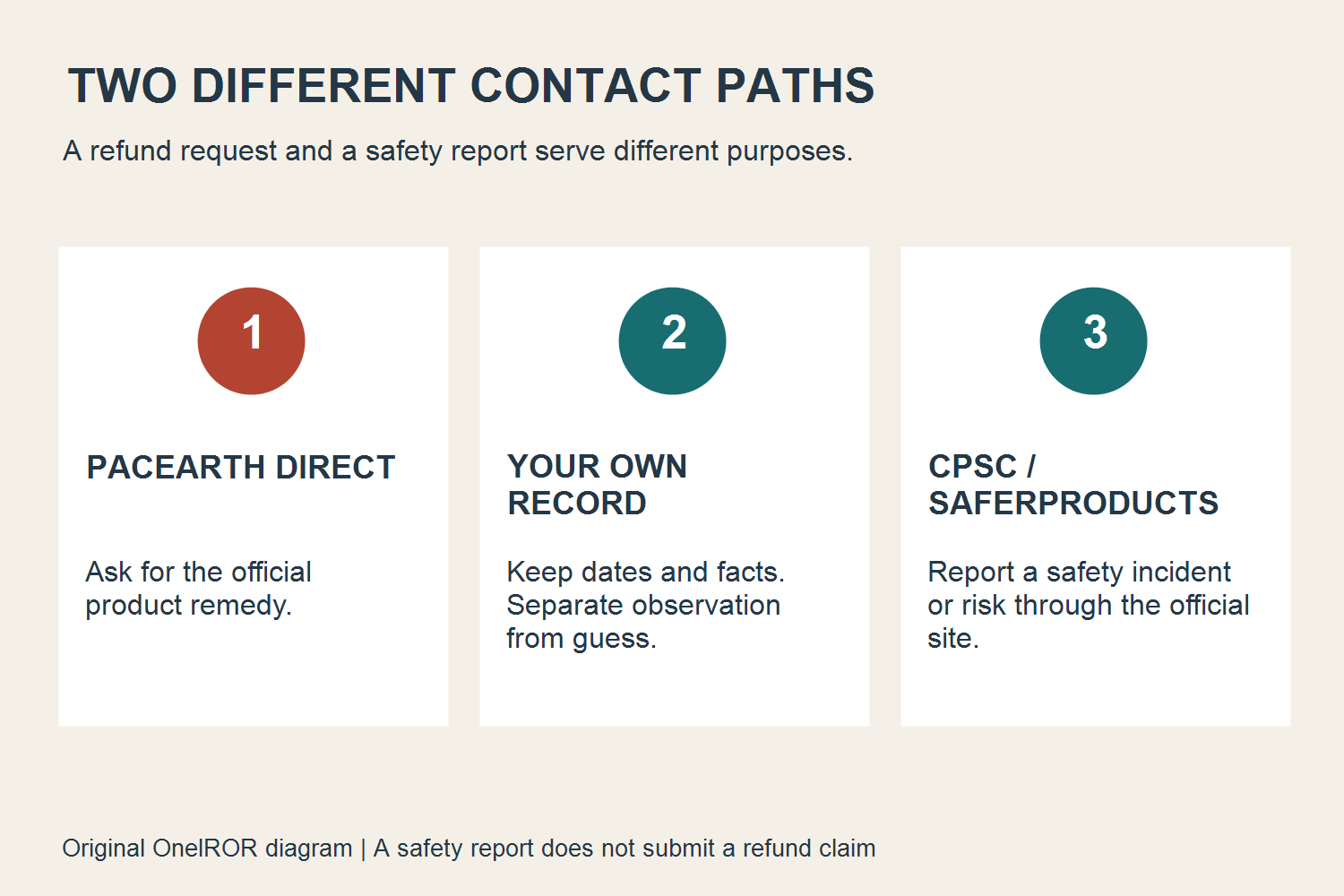
SaferProducts.gov is the CPSC’s public route for reporting and reading consumer-product safety concerns. Its incident-reporting page and FAQs are linked below. A report concerns an injury or risk of injury, rather than simply dissatisfaction with price or product quality. It does not submit the company’s refund request for you. If you choose to do both, keep separate records for the remedy correspondence and the safety report. That prevents a confirmation from one process being mistaken for completion of the other. [3] [4]
For an incident account, begin with observations. Describe the item, the setting, the approximate date if exact timing is unknown and what you saw happen. Distinguish a component you observed breaking from an explanation you inferred afterward. If someone else witnessed the event, identify which details came from that person rather than presenting them as your own direct observation. Do not recreate a fall, perform a load test or put a child back on the seat to generate a more convincing demonstration.
Photographs of accessible damage can support identification, but they should not become a hazardous reenactment. Preserve original files and note when you took them. If there was an injury, attend to the person’s care first and use qualified medical help as appropriate; this article does not assess symptoms or diagnose the event. Avoid posting private medical records or identifiable images of a child in a public discussion merely to prove that a recall is serious. The official reporting route explains its own information and privacy choices.
Do not alter your account to make it fit the wording of a headline. A useful report can include uncertainty, such as not knowing which part separated first. That limitation helps a reader understand the evidence. An exaggerated account may obscure the facts that investigators need. Equally, a near miss should not be dismissed simply because no one was injured: the FAQ explains that risk of injury can fall within reportable harm. Follow the official form’s questions and answer to the best of your knowledge.
Understand the reporting privacy choices before submitting
The SaferProducts FAQ explains that publication requires certain identifying and incident information, consent to publication and an accuracy attestation. It also explains that the submitter’s name and contact details do not appear in the public database, and that sharing those details with the named manufacturer is a separate permission choice. Read the current form rather than relying on a social-media summary of those rules. Anonymous reports can be accepted by CPSC but cannot be published in the searchable database under the rules described in the FAQ. [5]
Privacy choices should be made deliberately by the person submitting the report. The fact that an article links a government page is not consent to transmit anyone’s information. Our role here is to explain where the official process is and why it differs from a refund email. A parent can prepare a factual account offline before deciding what to submit. That preparation helps separate the product description and event sequence from details about family life that do not explain the safety concern.
Before submission, read the narrative once as if you were an unfamiliar reviewer. Can you tell which product is involved, when the incident or risk became known and what the writer actually observed? Remove guesses disguised as facts and correct a mistaken brand attribution. If you do not know a model number, say that rather than copying one from a similar listing. The reporting site sets the required fields; this article does not replace them or promise that every submitted account will become public.
Keep the report confirmation and any retrieval information privately with your own record. Do not publish a retrieval code as part of a screenshot announcing that you filed a report. A public narrative and the tools used to manage a submission are different things. If you later discover an error, consult the official instructions for addressing it. We cannot assume that a database entry updates automatically when a person edits a social post or sends another email to the retailer. Use the correct process for the record you want to correct.
Reach people who received the item after the original purchase
Recall news can reach the buyer while missing the current user. A seat might have been lent to a neighbor, moved with a play set or given to a relative when children outgrew it. A purchase account tells only part of that story. If you know where an affected item went, share the official notice directly with its current holder. Make the message specific enough to identify the item and clear enough that the recipient understands why it should remain out of use while the remedy is arranged.
An optional message can contain four elements: the product name, the announcement date, the official link and the immediate instruction. Add your relationship to the item, such as having supplied the second seat from a pair, if that helps identification. There is no need to forward private order details to a neighborhood group or reproduce an injured person’s story. A direct owner-to-owner notice is about locating a physical product and communicating an action, not building a public case against someone who accepted a gift.
Ask for acknowledgment when it is practical, and record what you actually know. ‘Notice sent’ differs from ‘owner confirmed receipt,’ which differs again from ‘item taken out of use.’ Those distinctions keep a household checklist honest. If you cannot reach someone, retain the unresolved status instead of marking the item complete because you tried once. We are not suggesting an investigative campaign through strangers’ accounts. Work with the transfer information you already have and respect the privacy of the people involved.
For shared spaces, identify the person responsible for equipment and tell them which product may match the notice. Do not enter a private yard or dismantle someone else’s installation. A visitor can provide the official link and an identifying observation while leaving the responsible owner to verify the item and manage access. If the setting is a school, child-care facility or public playground, its operating responsibilities and applicable guidance may differ from a private home. The notice should be routed to the responsible operator rather than treated as permission for unauthorized alterations.
Do not pass the unresolved item into the secondhand market
CPSC’s resale guidance tells sellers to screen inventory for recalls and explains that hazardous or noncompliant items should not be sold or given away. This is relevant to a family clearing a shed as well as to a secondhand business. A recalled seat is not made acceptable by a low price, a candid description or a buyer’s willingness to take it. Keep the identified product out of resale and donation while following the recall process. The official resale information is linked for readers with specific regulatory questions. [6]
If you had already planned to sell a play set, distinguish the recalled component from the rest of the transaction. Do not offer it as a free extra or place it in a box of spare parts for the buyer. An unresolved component can travel farther than the original seat if people view its metal pieces as generic hardware. Preserve the identification record and seek clear disposition instructions. This article does not certify the remaining structure or tell you that removing one item makes every other component compliant.
If a matching item has already changed hands, contact the recipient with the notice and make the uncertainty clear if identification is not settled. Avoid assurances such as ‘it was fine when we used it,’ because prior experience is not evidence that a recalled product is now cleared. A factual transfer message can explain when you handed it over and where the recipient can read the announcement. It need not speculate about liability or negotiate a private agreement. The immediate usefulness is getting reliable information to the current owner.
Secondhand buyers can make recall checking part of product identification before accepting equipment. The useful information includes a readable brand or label and enough of the product’s original identity to search the official database. An unbranded photograph and a vague statement that an item is sturdy leave questions unanswered. If the identity cannot be established, do not treat the absence of an easy search result as a safety certificate. Recall screening is one part of a responsible purchase decision, alongside the condition, instructions and suitability of the actual item.
General playground guidance cannot override this recall
CPSC’s Outdoor Home Playground Safety Handbook addresses residential settings and distinguishes them from public-use facilities. Its older references should not be presented as a new October 2026 standard. The handbook discusses planning, protective surfacing, assembly, maintenance and supervision. Those are useful context for managing a play area, but they do not turn a recalled seat into a usable one. A current product-specific stop-use notice and general maintenance guidance answer different questions. Start with the specific recall, then consult the appropriate broader guidance for the remaining equipment. [7]
For unaffected equipment, a review can ask whether the instructions are available, who maintains the installation and how the surrounding area is managed. The handbook emphasizes following manufacturer instructions and maintaining equipment and protective surfacing. That context supports a careful inventory of responsibilities; it is not a reason to improvise a repair to this seat. We do not reproduce a universal checklist of dimensions here because the setting and equipment matter, and a reader should consult the complete applicable guide rather than a fragment stripped of its qualifications.
A softer landing surface cannot be treated as permission to use a product identified for a fall hazard. Nor can close supervision eliminate the possibility of a component failure. These measures address other aspects of playground safety, and the recall remains a separate condition. A good closure note might therefore have two entries: the affected seat is unavailable pending the remedy, and the owner will separately review the rest of the play area using the relevant instructions. Combining the entries into ‘playground checked’ would hide what remains unresolved.
There is also a boundary around tree-hung equipment. This explanation cannot assess a particular branch, tree condition, attachment point or installation. A product notice mentioning a use setting is not a site-specific endorsement of that setting. Anyone considering future equipment should obtain the correct instructions and appropriate assessment for the actual location. Do not reuse old assumptions because a new seat looks similar. The support structure, attachment system and surrounding space are part of the real installation, even when the shopping decision focuses mainly on the seat.
Choose a replacement through compatibility, not urgency
The recall does not oblige a household to buy another seat immediately. A temporary change of activity can give adults time to identify an appropriate replacement and resolve the original product. If you decide to replace equipment, begin with the installation’s actual requirements rather than the first item described as heavy duty. Marketing language is not a complete set of instructions. You need to know what the replacement is designed to connect to, the intended users and the assembly and maintenance requirements stated by its maker.
Do not assume that leftover parts from the recalled purchase are suitable accessories for a replacement. Compatibility should be established from the new product’s instructions and the relevant supporting structure, not from the fact that two pieces can physically connect. A connector that fits through an opening may still be outside the intended system. This article provides no component rating or substitution recommendation. When the documentation does not answer a compatibility question, ask the manufacturer or a competent installer before returning equipment to use.
Keep new-product identification and instructions together from the beginning. A small record containing the model, purchase information, installation instructions and location can make a later recall check much easier. The record should describe the equipment actually installed, including any approved changes, rather than merely retaining a screenshot of an advertisement. That is a useful lesson from this announcement without becoming a shopping guide. We are not ranking replacement brands, supplying affiliate links or claiming to have tested products that we have not handled.
After replacement, the old item still needs a clear destination consistent with the official instructions. A new seat on the structure does not resolve a recalled spare in the garage. Record the replacement separately from the recalled product’s remedy and disposition. This makes it possible to answer three different questions later: what is installed now, what happened to the former item and whether the refund was completed. Keeping those answers distinct is more useful than a single vague note that the family ‘fixed the swing.’
A worked example of a clear household record
Consider a hypothetical household that bought a pair of seats, installed one and gave the other to a relative. This is an illustration of record keeping, not a reported incident or a claim about any actual customer. The first record identifies the installed item, includes its readable markings and notes the official notice used for comparison. The owner keeps it unavailable and prepares the requested evidence. The second record identifies where the other seat went and whether the relative has acknowledged the notice.
The household finds an order email but cannot establish whether every currently installed connector came in the original package. Its request states that uncertainty rather than asserting an invented installation history. The owner attaches the required product photograph and asks the named business how to handle the pair and the second holder’s situation. No one assumes that a single request automatically covers an item they have not documented. The record can remain short while still distinguishing quantity, current location, known identifiers and unanswered questions.
Suppose the business sends an acknowledgment. The status becomes ‘request acknowledged,’ with the date and message retained. It does not become ‘refund paid’ or ‘product cleared.’ If a later reply asks for another view, that is recorded as a clarification request. The seat remains out of use throughout. If the household also has a safety concern to report, it prepares a separate factual account through SaferProducts.gov and retains that confirmation separately. The refund correspondence is not copied into a public narrative with private details intact.
The record is complete only when each relevant task has a supported outcome: the physical product has been handled according to verified instructions, the remedy has a documented status and the other holder has received the necessary information. If a response or second item is still unresolved, the record says so. This example demonstrates why a few precise status labels are useful. They prevent an administrative step from silently becoming a safety assurance, and they make the next action obvious without relying on memory weeks later.
Check what an update actually establishes
The year embedded in a web address is also a poor substitute for the date printed on the notice. This recall’s official page displays October 8, 2026 even though its address contains a later year. Readers should cite the displayed announcement date and recall number rather than guessing an event date from the URL. The same discipline applies to photographs: our original diagrams illustrate processes and do not show the recalled product or a reported accident. Identification images belong on the linked official notice, where their context is explicit.
Our source list distinguishes the dated announcement and dated independent report from standing guidance checked for context. We have not established a response-time guarantee, complete incident history, an approved home repair or a measured failure probability. Those limits are relevant because each would change what an owner might do. The absence of those details should not obscure the action that is established. Keep the matching recalled item out of use and follow the official remedy rather than filling gaps with confident but unsupported advice.
The useful endpoint is a resolved product, not an unread email
Before closing your own record, check the questions that matter: where is each affected item now, could anyone use or reinstall it, what verified instruction governs its disposition and what evidence shows the refund status? If you chose to submit a safety report, keep that status separate as well. Do not substitute a payment for safe handling or a submission confirmation for an investigation result. Each process has its own purpose, and an honest unresolved entry is better than a completed check mark unsupported by evidence.
For owners finding this news later, the linked official page remains the first place to check the current remedy. For people sharing it now, the most useful contribution is a direct, accurate notice to someone who may have the seat. There is no need to add a product recommendation, a dramatic anecdote or an improvised technical solution. The announcement already provides a concrete decision. Carry that decision through to the item in front of you, then keep a clear record of the steps that resolve it.


