


Gravity Assists Explained: How a Flyby Changes a Spacecraft’s Orbit
SCIENCE & SPACE
Gravity Assists Explained: How a Flyby Changes a Spacecraft’s Orbit
A planetary encounter can change a spacecraft’s speed, direction and destination. NASA’s mission histories explain where that change comes from.
By OnelROR Editorial Team · October 23, 2026 · 4-minute read
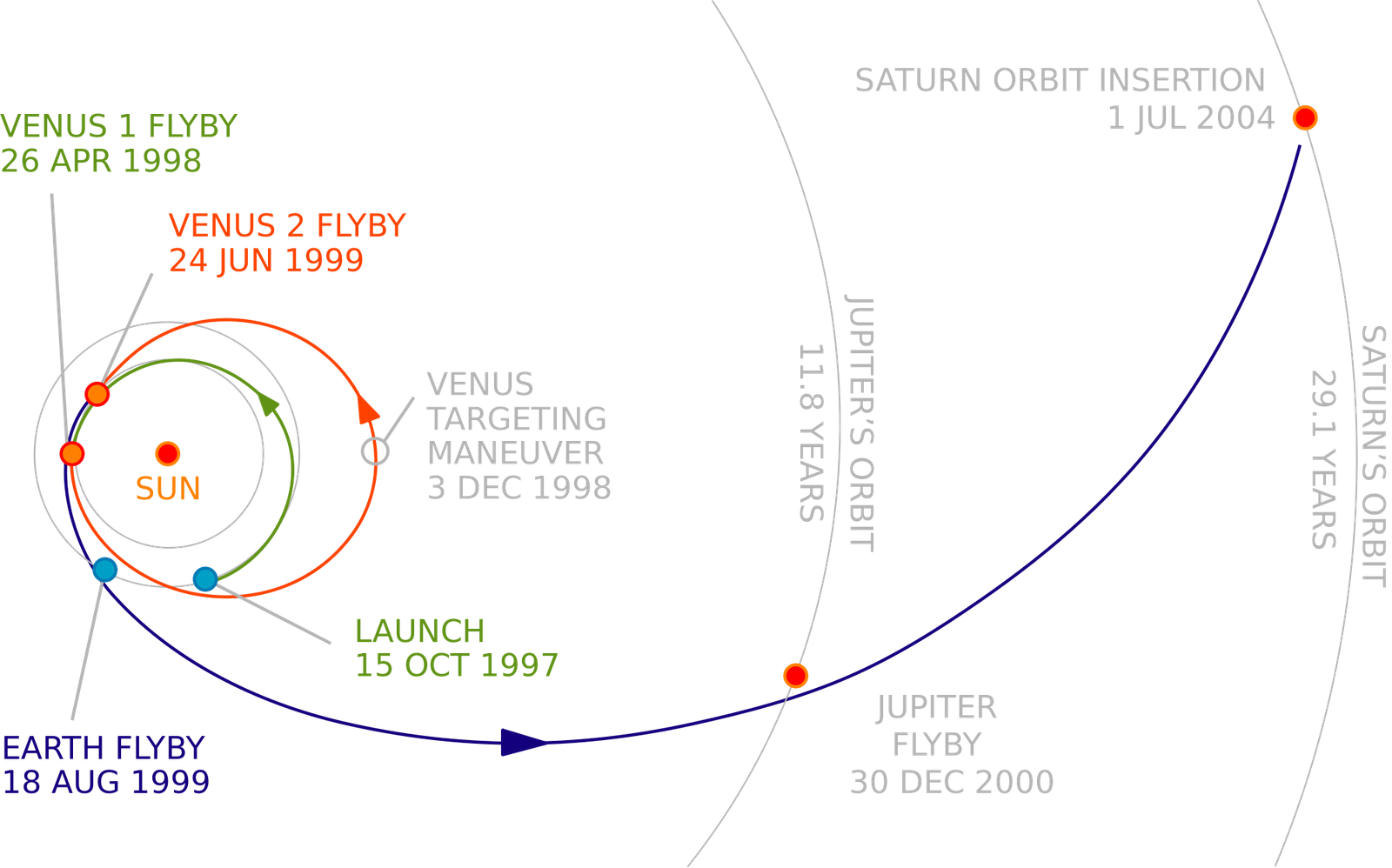
Featured diagram: Cassini’s interplanetary trajectory. Credit: NASA/JPL-Caltech.
A spacecraft can leave a planetary flyby on a very different route without firing its main engine during the encounter. The useful change comes from a gravitational exchange with a moving planet or moon. Understanding that exchange starts with a question that everyday descriptions of “speed” often leave out: speed measured relative to what?
First, choose your point of view
In the simplified flyby described in NASA’s gravity-assist primer, a spacecraft accelerates as it falls toward Jupiter and slows as it climbs away. Far from the planet, its incoming and outgoing speeds relative to Jupiter are the same. Its direction, however, has changed. The temporary rush near closest approach is not itself the lasting boost.
Now view the encounter relative to the Sun. Jupiter is already moving along its own orbit. Combining that motion with the spacecraft’s changed direction can produce a different outgoing velocity relative to the Sun. The flyby geometry determines whether the spacecraft gains or loses orbital energy. “Gravity assist” therefore does not always mean “go faster.”
The energy comes from an exchange
NASA’s Cassini explanation treats the spacecraft, the assisting body and the central body as a system. Energy is conserved. A spacecraft that gains orbital energy takes it from the assisting body; the reverse exchange can reduce the spacecraft’s energy. Because the planet or moon is so much more massive, its corresponding change in motion is tiny.
Cassini also shows why the central body matters. During its interplanetary journey, flybys changed its motion around the Sun. After it reached Saturn, encounters with Titan reshaped its orbit around Saturn. Mission planners used Titan to change both the path and its inclination, opening different views of Saturn and its rings. The same physical idea served different navigation goals.

A flyby can choose a destination
The Voyager missions make the consequences visible. NASA’s Voyager mission FAQ describes the original route as Jupiter and then, using gravity assists, Saturn. Voyager 1’s encounter with Titan sent its trajectory upward out of the planets’ orbital plane, preventing further planetary encounters. Voyager 2 continued toward Uranus and Neptune. The two spacecraft’s different routes reflected the encounters selected for them.
A mission’s next target is therefore part of the flyby design. Reading a trajectory as a list of sightseeing stops misses what each encounter does to the route. The science observation and the navigation opportunity can be connected: where a spacecraft passes a body helps determine where it can go afterward.
Even returning to Earth can help
A spacecraft does not have to borrow momentum from a giant planet. In a January 10, 2001 mission report, NASA’s Jet Propulsion Laboratory explained how Stardust’s planned Earth flyby would add energy and lengthen its orbit to set up its meeting with Comet Wild 2. Engineers had already adjusted the approach to obtain the intended energy change. Returning toward home was a step toward a more distant destination.

How to read the next “slingshot” headline
Look for three details: the assisting planet or moon, the central body used to describe the orbit, and the intended change. A report might describe gaining speed around the Sun, losing energy to make an arrival easier, or tilting an orbit for a new viewing angle. Those are different results of the same general technique.
Also distinguish a flyby from an engine maneuver. Cassini still needed its main engine to brake into Saturn orbit. Gravity assists can save propellant and shape a mission, but a successful encounter is one element of an entire flight plan. The useful question is what the encounter changes—and why that change helps the spacecraft reach its next goal.
Sources and editorial date
Checked October 23, 2026. This explainer uses historical mission examples and NASA’s educational accounts: A Gravity Assist Primer; Cassini: Gravity Assists; Voyager: Frequently Asked Questions; and JPL’s Stardust Earth-flyby report (January 10, 2001).