


Find Your Home’s Main Water Shutoff Before an Emergency

A leak is easier to manage when you already know which valve controls the entire home. That valve is not always beside a sink, and it may not look the same from one property to another. Find the main shutoff before you need it, then confirm the location and operating guidance with your local water provider or property manager.
A water meter and nearby wheel valve; the image is an example, not a map of your home. Photo by Bijay Chaurasia Photography, CC BY-SA 4.0, via Wikimedia Commons.
Start where the service line enters
Walk the route where the water service enters the building. Depending on the property, the main valve may be in a basement, garage, crawlspace, utility area, closet, or outside near the foundation or meter. San Francisco Public Utilities Commission describes several of these arrangements and notes that homes vary. Use your utility’s instructions for your address rather than assuming that a valve in one familiar spot will be present in every house.
In a rented home or apartment, ask the landlord or building manager to identify the whole-building or unit shutoff and explain what residents may operate. Some apartments, manufactured homes, or older properties may not have an obvious customer-operated main valve. If you cannot find it, ask the water provider or a licensed plumber before an emergency.
Separate the main valve from fixture valves
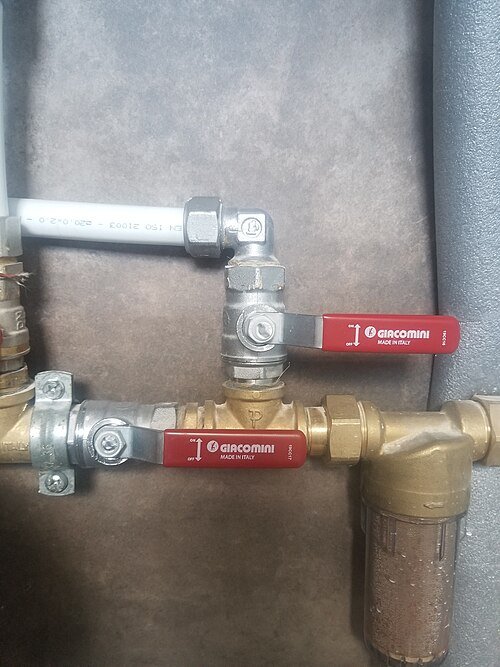
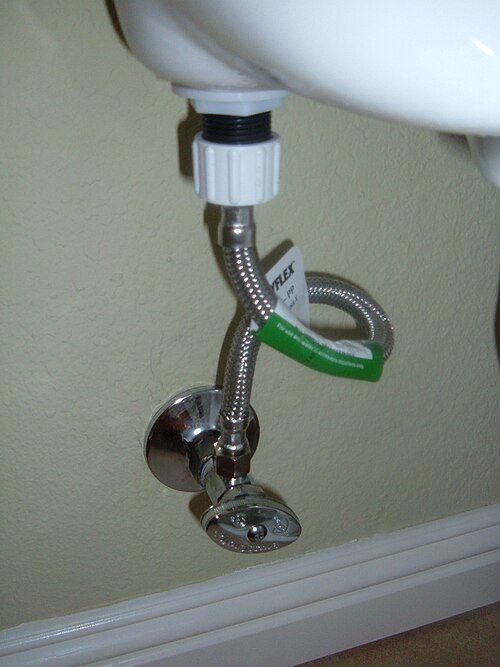
A main shutoff stops water to the home or unit. Smaller supply valves serve one fixture or appliance: a toilet, sink, dishwasher, or washing machine. Their handles can look similar, so trace the pipe and confirm what it supplies before labeling anything as the main. If only one fixture is affected, its local valve may be the right control; if a supply line elsewhere is leaking, that small valve will not stop the whole home’s water.
Recognize the handle, then follow local guidance
Two common designs are a wheel-style gate valve and a lever-style ball valve. Municipal guidance often describes closing a gate valve by turning its wheel clockwise and closing a ball valve when the lever lies across the pipe. But layouts and valve condition differ, so confirm the directions for your own service before relying on that rule. A handle’s color or position in a photograph does not prove that it controls your house.
Do not force a stiff, corroded, leaking, or unfamiliar valve. Forcing it can damage a fitting or turn a manageable problem into a plumbing repair. Stop and call your water provider or a plumber for help. If a meter box is at the street, ask the utility whether customers may operate its valve; some providers reserve certain meter shutoffs for staff.
Make the location easy to use later
Once the correct valve is confirmed, keep its access clear and share the location with the people who live there. A simple label on a nearby wall, a note in a home file, or a photo that shows the valve and surrounding landmarks can help someone find it under pressure. Do not put a label where it could be mistaken for the handle’s operating direction. If you rent, keep the manager’s contact details with the location note.
If water is already escaping
If you have a leak, the main valve is clearly identified, and the area is safe to approach, use the instructions for that valve to stop the supply. Follow local utility advice on how to confirm the flow has stopped. If water is near electrical equipment, the valve is stuck, or you cannot safely reach it, keep clear and contact the appropriate utility, building manager, or plumber. Do not enter a meter vault or operate a street-side valve unless your provider says customers may do so.
A quick check before you need it
- Ask your provider or building manager where the whole-home or unit shutoff is.
- Trace the pipe and distinguish the main from sink, toilet, and appliance valves.
- Learn the specific handle direction and whether a meter-box valve is customer-operated.
- Keep the route clear and share the location; never force a stuck valve.
The useful preparation is simple: know which valve serves your property, how you are permitted to operate it, and whom to call if it will not move. Local water providers’ instructions are the final guide for your meter and service line.
Official references
- San Francisco Public Utilities Commission: Home Water Shutoff Valve
- Regional Water Providers Consortium / Portland: Emergency Water Shut-Off
- Western Municipal Water District: How to Turn Off Your Water
Sources accessed October 24, 2026.
Written by OnelROR Editorial Team. October 24, 2026. 4-minute read.



