

How Honeybees Give Directions With the Waggle Dance—and Why It Isn’t GPS
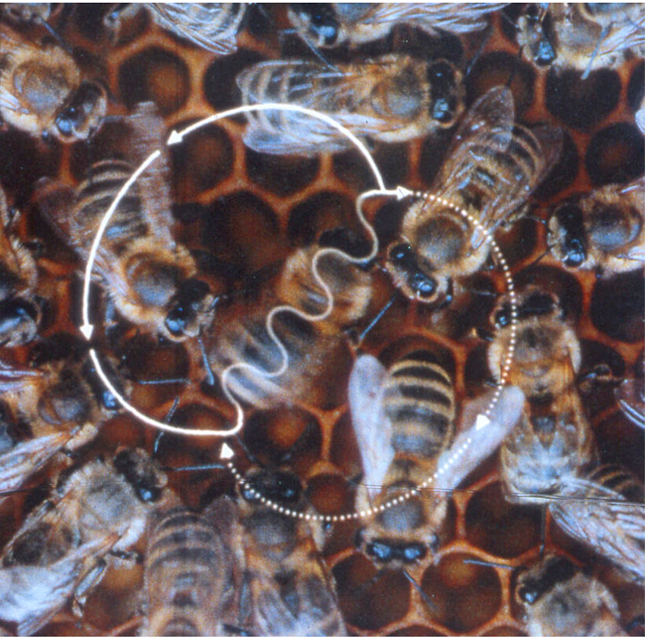
A honey bee returning from a successful foraging trip may run a repeated pattern across the comb, vibrating her abdomen during each straight “waggle run.” Nestmates follow the movement in the dark hive. The dance can communicate an approximate food location, but it is not a spoken address or a perfect route. Its cues have to be interpreted in relation to the sun, the hive, and the bee’s recent flight.
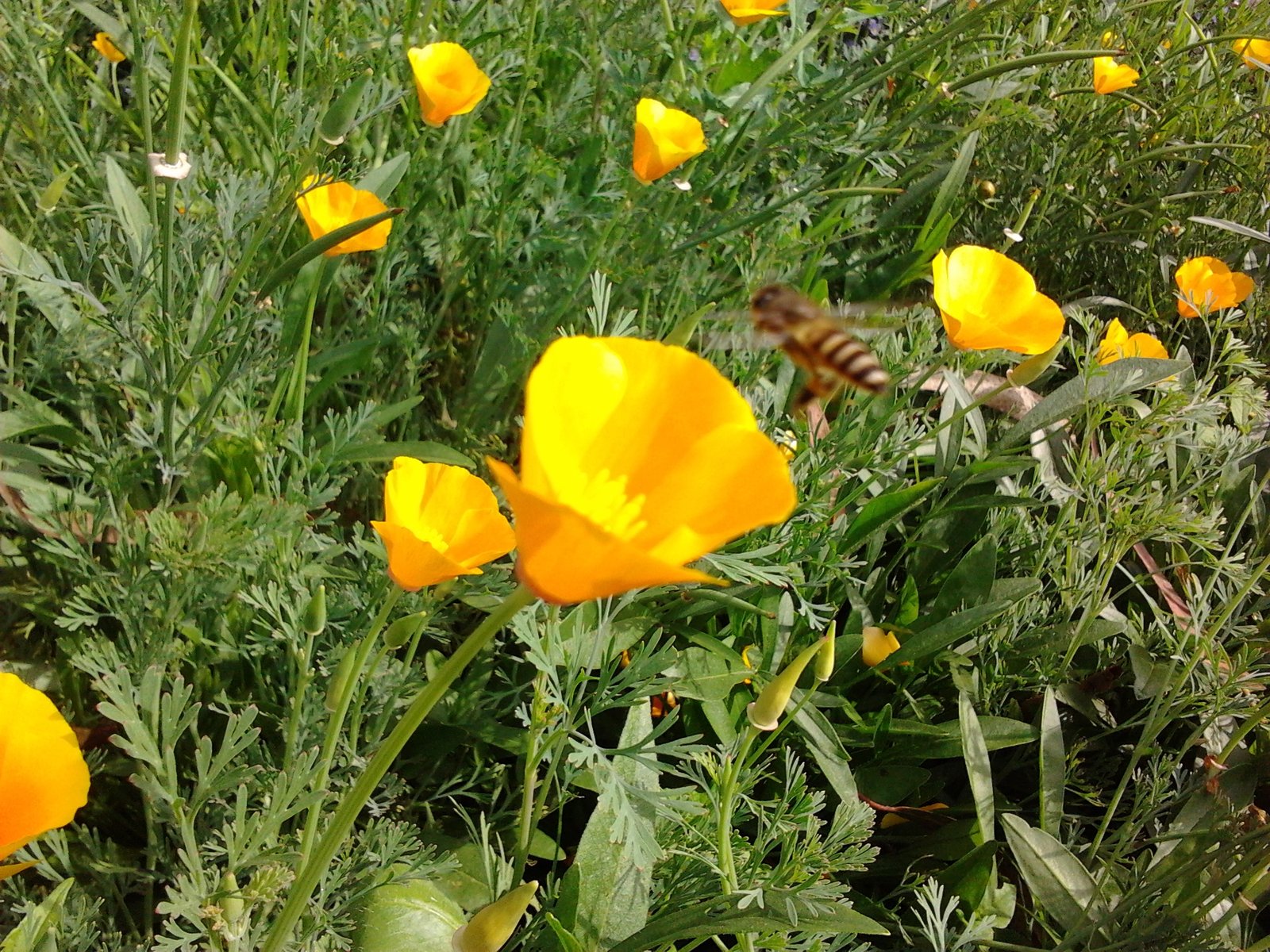
Featured photo: A honey bee approaches a yellow flower. Photo by Apm.ceg, 2012, CC BY-SA 4.0, via Wikimedia Commons. Unmodified.
How the dance points to a direction
Inside the nest, the dancer moves on a vertical comb. The angle of a waggle run relative to straight up represents the direction of the resource relative to the sun’s position outside. For example, a run angled to one side of vertical indicates a corresponding angle to one side of the sun’s direction. The sun acts as a compass reference; the bee does not need to see it while dancing.
The dance is not a map drawn at a fixed orientation. As the sun appears to move across the sky, a bee uses celestial cues when foraging. A follower must combine the dance’s angle with that changing reference. The angle gives a bearing-like cue, not an exact set of turn-by-turn instructions.
What the waggle run says about distance
The waggle phase also carries information about how far the bee traveled. A longer waggle generally signals a more distant destination. A 2021 study that measured waggle phases over feeder distances from 0.1 to 1.7 kilometers found that the increase in waggle duration was better described by a nonlinear curve than by a simple straight line. In that study, the rise in duration flattened as distance increased, so a single universal “seconds per meter” conversion would be misleading.
Researchers link the distance cue to visual information gathered during flight, often described as optic flow: the apparent movement of nearby scenery across the bee’s field of view. This is why a dance is better understood as a compact estimate than a precise coordinate. Landscape, route, and the limits of the signal matter when interpreting it.
The dance has an audience
A dance is a signal that other bees must be able to follow. A 2026 study reported that dancers communicated direction and distance less precisely when they had fewer actual followers or fewer age-appropriate potential followers. The authors observed dancers spending more time moving across the comb when the audience was scarce. They interpret this as the cost of searching for receivers while continuing to signal.
The study suggests that dancers may use tactile contacts—and possibly age-related odors—as cues to sense follower availability. Those explanations remain interpretations of the results, not a complete account of how every dance is adjusted. The finding is a useful reminder that the dance is social: the receiver group can affect how clearly information is conveyed.
Why “bee GPS” is only a metaphor
The waggle dance is remarkable because it conveys direction and distance through movement, but calling it GPS can imply more precision than the research supports. The dance does not provide a latitude-and-longitude coordinate, and followers still have to orient themselves using the sun and find the resource in the landscape. Measurements show variation, and the relationship between dance features and distance is not a perfect linear scale.
A careful summary is simpler: a returning forager can use the dance to give nestmates an approximate directional and distance cue to a resource. The angle relates to the sun; the waggle phase carries distance information; and the precision can vary with the dance and its audience. It is a flexible communication system, not a guarantee that every follower will arrive at an exact point.
Research and image sources
- Kohl and Rutschmann, “Honey bees communicate distance via non-linear waggle duration functions,” PeerJ (2021): full text.
- Lin et al., “The audience shapes the information content of the honey bee waggle dance,” PNAS (March 23, 2026): article.
- Chittka, “Dances as Windows into Insect Perception,” PLoS Biology (2004): article.
Sources accessed October 24, 2026.
Written by OnelROR Editorial Team. October 24, 2026. 4-minute read.