



A Brain Implant Can Now Decode Speech and Gestures at the Same Time
Science & Space · Technology
A proof-of-concept brain–computer interface translated intended phrases and upper-body gestures in parallel, allowing people with severe paralysis to control a digital avatar with more of the expression used in ordinary conversation.
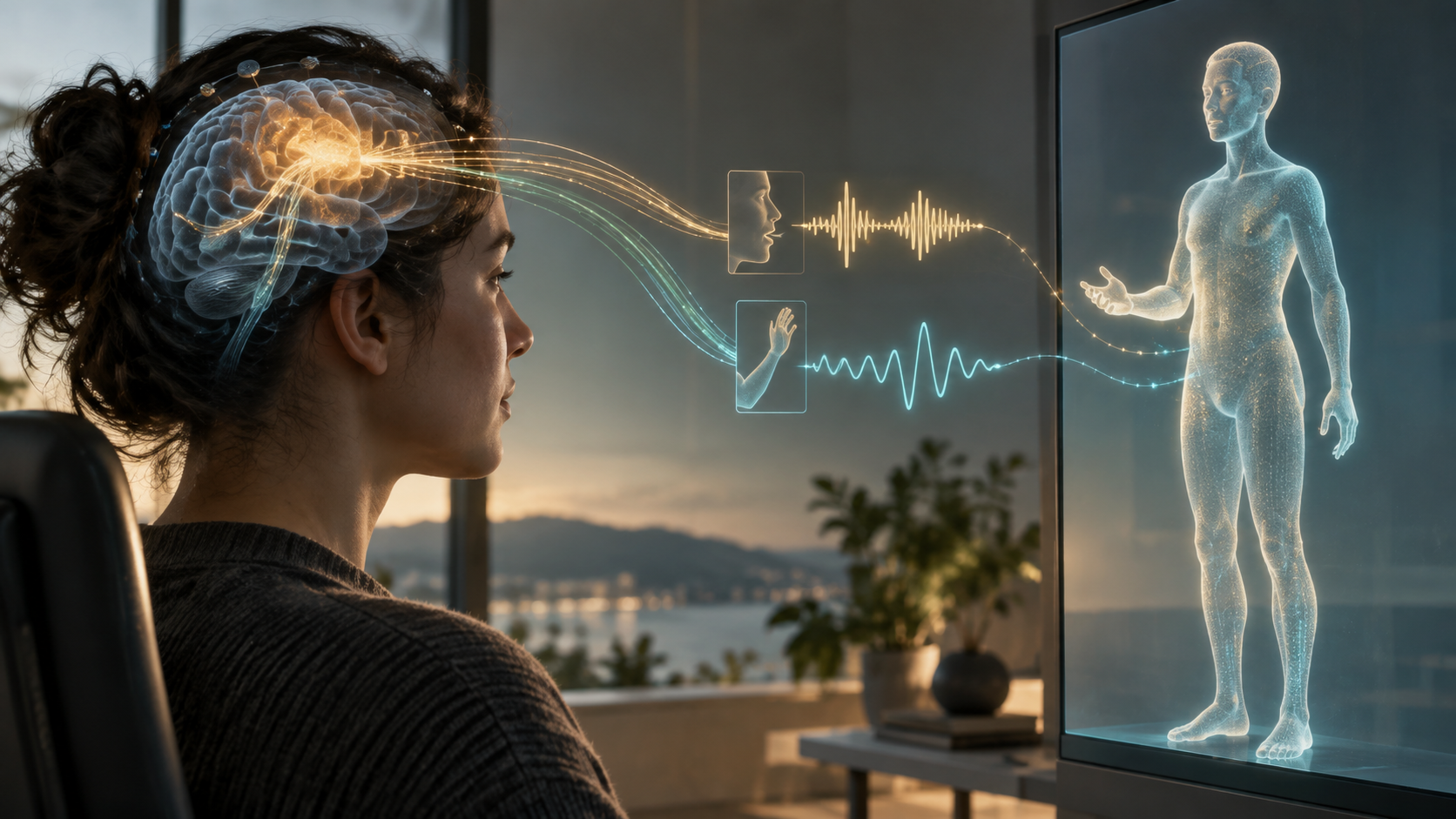
Researchers have demonstrated a brain implant that can decode attempted speech and gestures at the same time, then turn those signals into text and movement on a personalized virtual avatar.
The study, published September 14 in Nature Neuroscience, involved three people with severe paralysis. It addresses a basic gap in brain–computer interfaces: communication is rarely made of words alone. A nod, wave or shrug can add meaning that a text-only system cannot convey.
The finding in one sentence
One high-density implant placed over the sensorimotor cortex supplied enough information for parallel computer models to identify restricted sets of intended phrases and gestures, including attempts made simultaneously.
Why speech alone is not enough
Human conversation combines several systems. People point while giving directions, nod while agreeing and use their hands to emphasize a phrase. Paralysis caused by a brainstem stroke or amyotrophic lateral sclerosis can limit both spoken language and body movement, reducing not only speed but also personality and nuance.
Previous brain–computer interfaces have restored individual functions such as selecting letters, producing speech, moving a cursor or controlling a robotic arm. The new work asks whether a single implant can support more than one form of expression at once.
The advance is the combination: intended words and body language can be decoded in parallel rather than treated as separate channels.
How the experiment worked
The researchers used a grid of 253 electrodes placed on the surface of the brain’s cortex. The array covered a broad part of the sensorimotor region, where activity related to speech and body movement partly overlaps.
Participants attempted short phrases and gestures such as waving, nodding, shrugging or giving a thumbs-up. Machine-learning decoders analyzed the electrical patterns. The predicted speech appeared as text, while predicted gestures animated a full-body avatar in real time.
The models performed better across mixed tasks when their training data included examples of speech and gestures attempted together. A system trained only on isolated actions did not automatically generalize as well to natural combinations, a practical lesson for future interfaces.
What the results show
In a conversational task reported in the paper, one participant’s average accuracy was 75% for the restricted speech set and 85% for gestures. Another participant reached a median of 100% for both channels across three blocks, although the vocabularies, number of trials and individual conditions differed.
Those figures should be read as proof-of-concept results, not a general performance guarantee. The study used only three participants and small, predefined vocabularies. Larger conversations, continuous decoding and everyday environments introduce much harder problems.
What this does not mean
The device is investigational and requires brain surgery. It is not a consumer product or an approved treatment for paralysis. The current system also uses a wired connection between implanted sensors and external processing equipment.
According to the National Institutes of Health, the research team plans to test a fully implantable wireless version. That could improve prospects for long-term use, but safety, durability, calibration and performance across a broader population still require study.
Why the next step matters
A useful communication prosthesis must work beyond carefully cued laboratory tasks. It needs to recognize when a person intends to speak or gesture, avoid false activations, adapt as neural signals change and offer enough vocabulary for unscripted interaction.
The research provides a map for that work. It shows that overlapping brain signals do not make simultaneous decoding impossible, but they do make the right training data essential. If future systems expand the vocabulary and become wireless and stable, digital communication could preserve more of a user’s rhythm, emphasis and social presence.
Reporting note: The featured image is an original editorial illustration, not a photograph of a study participant. This article summarizes early investigational research and does not provide medical advice.