



A Plane, the ISS and the Sun Aligned in a 30-Million-to-One Shot
Science & Space
A Czech astrophotographer planned a split-second International Space Station transit. A training jet entered the frame by chance, turning a precise observation into an extraordinary celestial coincidence.
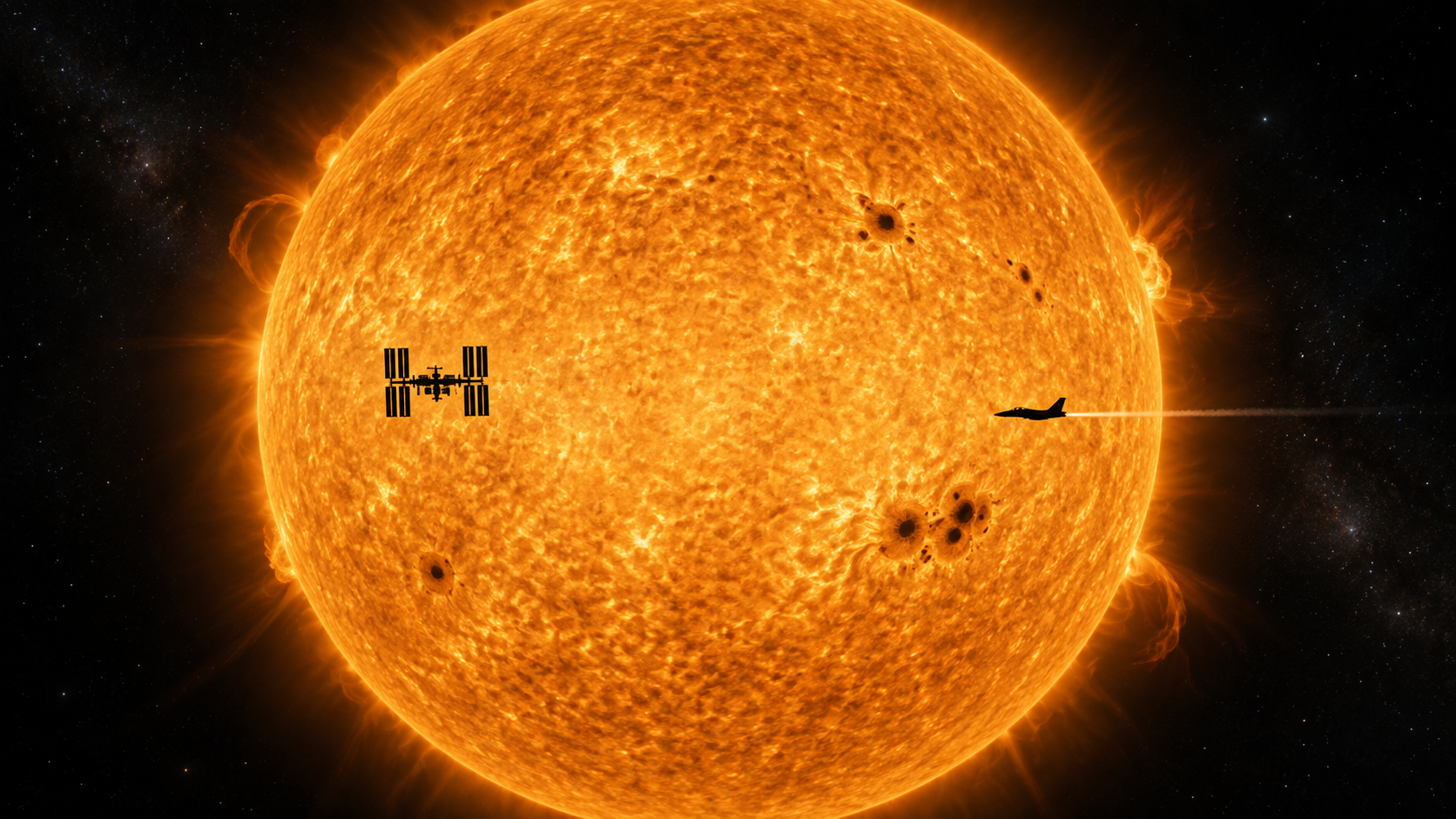
Featured image: original OnelROR editorial illustration; it is not the documentary photograph described in this report.
The International Space Station was supposed to be the difficult part. On June 8, astrophotographer Petr Horálek positioned himself near Prasek in the Czech Republic, pointed a filtered telescope at the Sun and waited for the orbiting laboratory to cross the solar disk. The entire transit lasted about 0.67 second.
Then an aircraft appeared.
Horálek’s camera caught both silhouettes against the Sun in the same sequence: the carefully anticipated ISS and an L-39 Skyfox training jet that arrived without warning. The resulting sequence shows a coincidence whose drama depends as much on timing as on scale.
The ISS transit lasted roughly 0.67 second. The station travels about 17,500 mph (28,000 km/h) and completes an orbit approximately every 90 minutes. Horálek estimated the chance of a random aircraft sharing that solar frame at about 1 in 30 million.
One event was calculated. The other was luck.
Solar transits of the ISS can be predicted because the station’s orbit is tracked and the narrow visibility path can be mapped across Earth. Photographers still have to reach the right location, contend with weather and synchronize equipment for an event that may be over in less than a second.
NASA has described those constraints before. Even though the ISS circles Earth many times each day, a visible transit occurs only along a limited strip of ground. Clear skies, accurate positioning and rapid exposures all have to coincide. In a 2020 NASA example, the station crossed the solar disk in just 0.54 second.
Horálek had planned that part. He used a Nikon Z6III attached to a 10-inch Dobsonian telescope with a 1.4× converter, shooting at ISO 1000 and 1/16000 second. His published sequence shows frames separated by 0.04 second.
The jet was different. According to Horálek, the Flight Training Center Pardubice later identified it as an L-39 Skyfox and said the aircraft was inverted during the crossing. Its unexpected path turned a technically demanding transit image into a rare intersection of orbital mechanics, aviation and chance.
Why the photograph looks almost unreal
The Sun is enormous, but every object in the image is seen along a single line of sight. The ISS is hundreds of kilometers above Earth; the aircraft is vastly closer; the Sun is about 150 million kilometers away. Their apparent meeting exists only from the photographer’s precise position.
That compressed perspective is what makes transit photography so compelling. It converts objects separated by immense distances into flat silhouettes on one bright disk. Sunspots add another layer of scale: dark regions that can appear small in an image may be larger than Earth.
The result also reveals the difference between probability and preparation. The aircraft was chance, but the frame was possible because a photographer had already solved the predictable problem—where to stand, when to press the shutter and how to expose the Sun safely.
The “1 in 30 million” figure needs context
The widely repeated probability is Horálek’s own estimate, based on the Sun’s angular size, the short transit duration and the area across which an aircraft might travel. It is not a general scientific constant for every ISS transit. Flight density, observing location, lens field, weather and the definition of a successful overlap all change the odds.
That caveat does not diminish the event. It clarifies what the number represents: an informed estimate for this particular geometry, not a universal lottery ticket. The image is exceptional because two independently moving subjects occupied the solar disk during an exposure window measured in fractions of a second.
A safety lesson behind the spectacle
No one should point a camera, telescope or binoculars at the Sun without a proper solar filter secured over the front of the optics. NASA warns that unfiltered optical viewing can cause severe eye injury instantly. Ordinary sunglasses are not sufficient.
Casual observers can use NASA’s Spot the Station service to find ordinary dawn and dusk flyovers, which require no solar viewing. Photographing a solar transit is specialized work that demands the correct equipment and experience.
The appeal of the triple alignment is easy to understand: the picture compresses the familiar and the enormous into one frame. Its deeper lesson is quieter. Luck produced the surprise, but patient planning created the opportunity to catch it.