


Before the Newsfeed, the Printing Press Made Ideas Travel
OnelROR • History • News & Trending
A Smithsonian demonstration opens a deeper history of printed communication: reusable type, paper, skilled work, scale and the routes that carried a message from a workshop to a public.
By OnelROR Editorial Team · Published October 2, 2026 · Expanded October 9, 2026 · Miami (EDT, UTC-4) · 25 min read
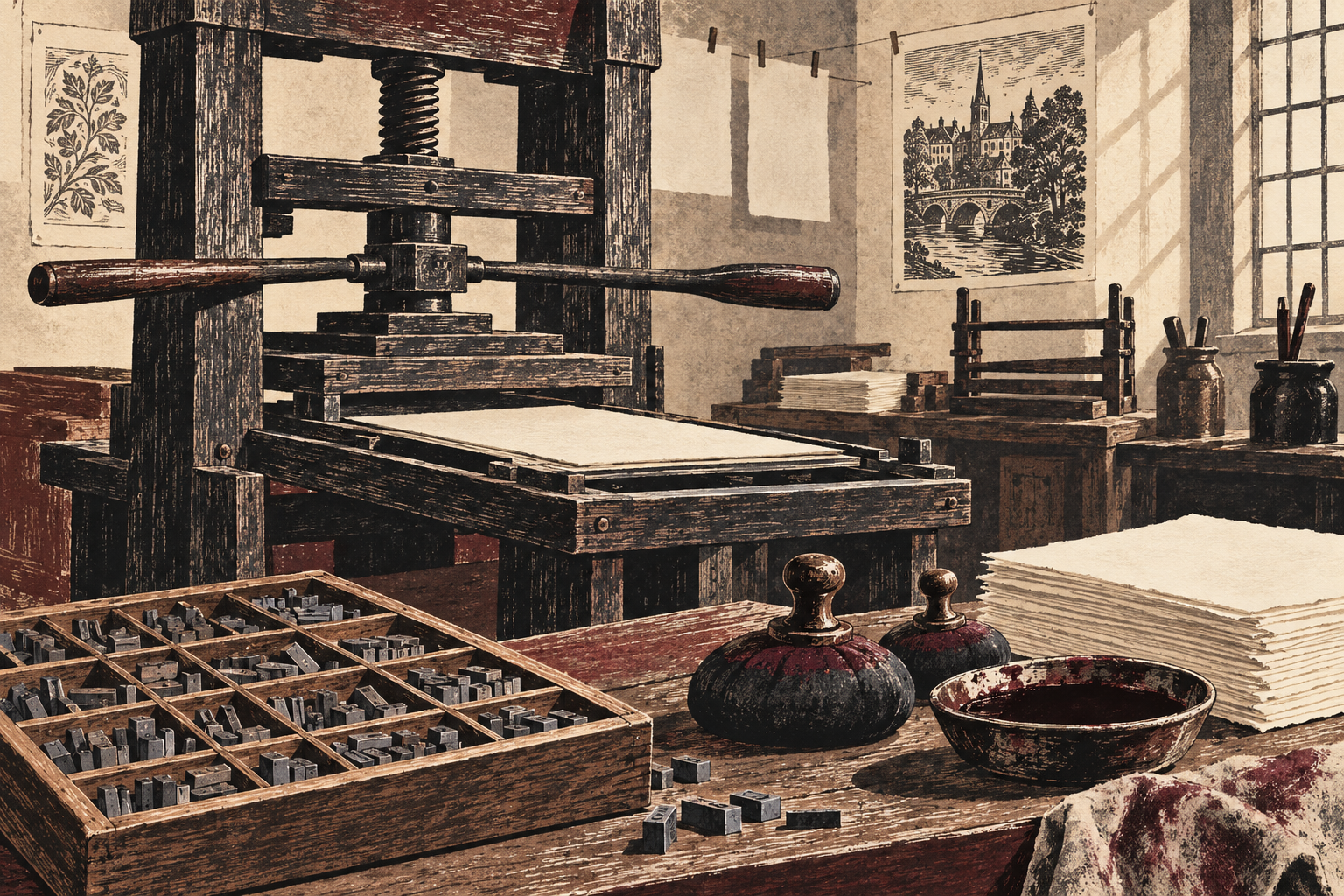
Opening image: Retained original conceptual illustration of a historical print workshop, not a photograph of a Smithsonian event or a documented museum object.
A past demonstration, an enduring question
The National Museum of American History advertised a free printing-press demonstration for October 2, 2026, from 2:30 to 4:30 p.m. EDT in its 2 East area. Its description identified a reproduction eighteenth-century press and connected printing with communication and democracy before the American Revolution. That scheduled window had already passed when this article first appeared. The October 9 expansion rechecks the announcement and adds collection-based context. It does not report attendance, describe an observed session or promise another demonstration. The event listing is evidence of a scheduled program, not a record of what a visitor actually saw. [1]
The useful historical question is larger than the machine: how does an idea become something that another person can encounter? A press can transfer ink to a sheet, but a sheet still needs words or images, materials, skilled work, an intended audience and a route out of the workshop. The familiar story of a remarkable invention becomes more informative when those connections are visible. It allows us to distinguish the capacity to produce copies from the ability to distribute them, and both from the ability to persuade or inform a public.
This article treats the workshop as part of a communication system. The physical process matters because it creates opportunities and constraints. Preparing a page requires choices before a copy exists; making more copies requires resources; circulating them requires relationships and arrangements beyond the press. None of those steps guarantees that the message is accurate, understood or welcomed. The historical achievement is easier to appreciate when it is separated from an assumption that technology determines the outcome. An efficient machine can serve different purposes, depending on who uses it and what reaches the reader.
That approach also improves a museum visit. An imposing press can draw attention to its frame and lever while the more revealing objects sit nearby: type, tools, paper and a finished impression. Looking across those objects changes the question from what the machine is called to what work it enables. One can ask which parts are reusable, which materials are consumed and which decisions must be made again for each new job. A reproduction can clarify a process without proving the precise appearance of an earlier workshop. Its explanatory value and its evidentiary limits belong together.
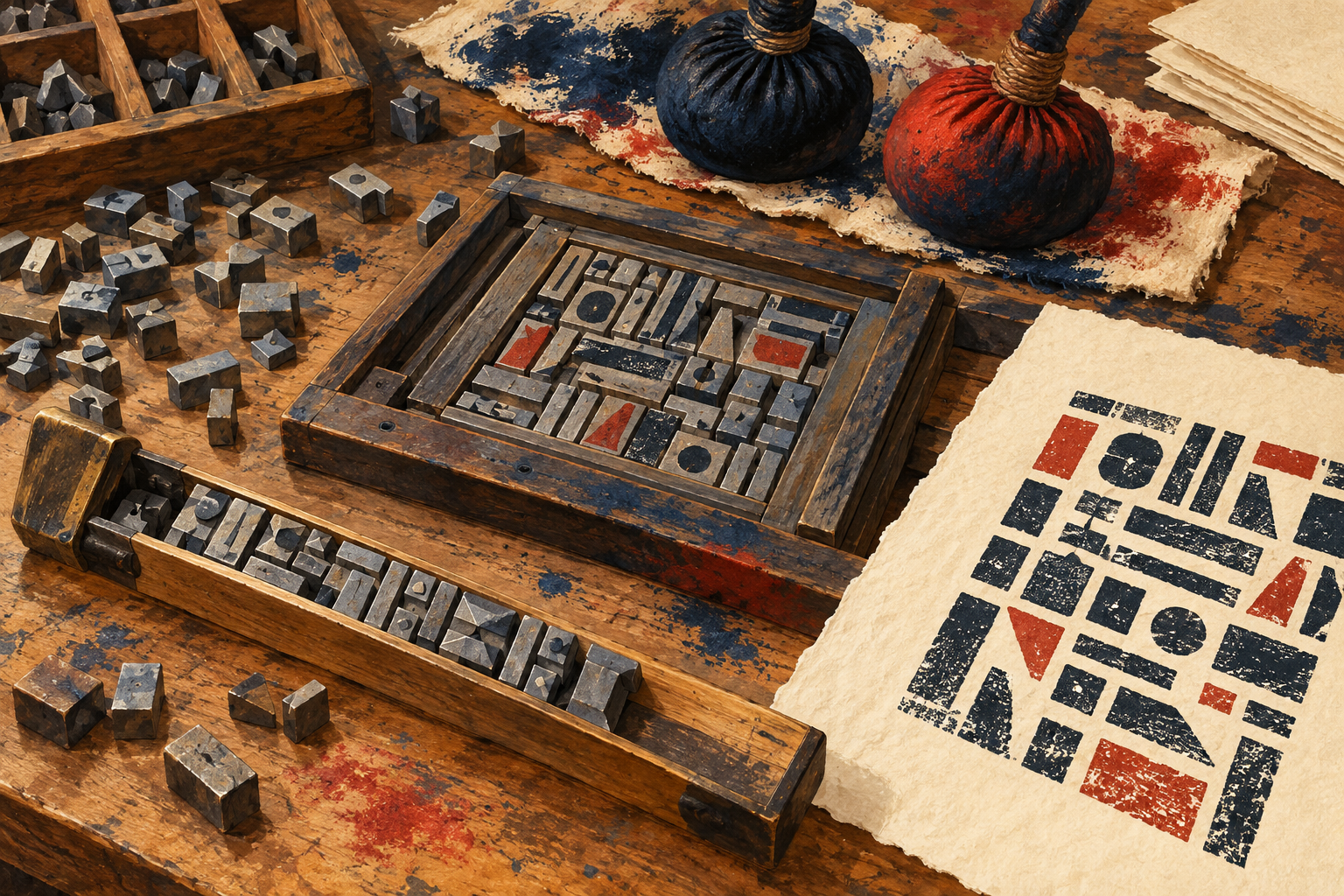
The images here follow the same distinction. The retained opening illustration and the two new illustrations are conceptual artwork, not documentary photographs of the Smithsonian event or exact reconstructions of identified artifacts. They help explain composition and circulation. The historical claims come from the linked institutional sources, with publication or access dates recorded below. Interpretive comparisons and hypothetical examples are identified as editorial analysis. The aim is to make the chain from machinery to public communication understandable without filling gaps in the record with invented scenes.
Be precise about what was invented, and where
The Library of Congress describes the Gutenberg Bible as a major early book printed in Western Europe with movable metal type, probably completed at Mainz late in 1455. Its account emphasizes uniform, interchangeable type and the practical problems of materials and methods. It also notes that colored headings and capital letters were completed by hand. This is a specifically European example of a major development in bookmaking. It should not be turned into a claim that printing, or even movable metal type, began everywhere with Gutenberg. [4]
UNESCO's Memory of the World record identifies the surviving second volume of Jikji as printed with movable metal type at Heungdeok-sa temple in Cheongju in July 1377. The record was registered in 2001. That documented earlier example makes geographical and technical wording important. The evidence cited here establishes the identity and date of a surviving work; it does not establish a simple line of transmission between every printing tradition or settle every debate about the first use of a process. A careful history can recognize the earlier evidence without inventing a connection it has not demonstrated. [5]
First is a demanding word. It can mean the earliest known use, the earliest surviving object, the first large-scale application in a region or the first example that influenced a later industry. These meanings should not be exchanged casually. A surviving book offers stronger evidence for its own existence than for everything that happened before it. A label can acknowledge that difference with words such as surviving, documented or regional. Those qualifiers do not diminish an object's significance. They explain the basis on which significance is being claimed.
Technical distinctions matter just as much. Printing from a carved surface, printing from rearrangeable pieces of type and operating a particular kind of press describe different parts of a process. A history that combines all three into one invention can obscure the problems people actually solved. Readers need not memorize an entire global chronology to notice this. They can ask whether a claim concerns the surface that carries the image, the mechanism that supplies pressure or the system that makes production repeatable. A clear answer places the object within a process rather than attaching every achievement to a single name.
The editorial lesson is to resist a triumphant origin story when a more precise account is available. Recognizing multiple traditions does not require pretending that all methods were interchangeable or that their social circumstances were identical. It requires keeping the claim proportional to the evidence. In a museum, that means reading the label's scope. In an article, it means preserving it when summarizing. A short sentence can carry the necessary qualification, and that qualification may be the most useful information in the sentence.
Reusable type changes the work before the press
Movable type makes it possible to arrange separate characters into a printing surface and rearrange them for another job. The immediate attraction is repeatability, but the process still requires composition. Words must be selected, ordered and fitted into a page. The workshop therefore separates the creation of a message from the production of its copies, even though the activities remain connected. That distinction is central to understanding the technology. Reusability reduces the need to recreate every character for each impression; it does not remove the work of deciding what the page will say.
Consider a hypothetical short notice. Before it can be printed, someone must choose the wording, determine which information deserves prominence and decide how the text will fit. A larger heading may make the subject easier to find but leave less space for the explanation. A narrow line may save room while changing the rhythm of reading. These are editorial and typographic choices, not automatic consequences of owning a press. The finished object records the decisions, though it may not reveal who made them or what alternatives were rejected.
The physical arrangement also introduces a useful distinction between a character and its function in a page. The same piece of type can become part of different words when moved. Its reusable material form does not have a permanent relationship to one message. This is why examining a type case or a composed surface can be as revealing as looking at the press. It shows how a supply of components becomes a particular statement through arrangement. The press then reproduces that arrangement. The order of those operations helps explain both the power and the limits of the machine.
Proofing belongs to the same chain. A repeatable surface can reproduce a mistake as efficiently as a correct sentence. The relevant editorial question is where an error can be noticed and what must change to correct it. A hypothetical misplaced character would be a composition problem; a faint impression might require a different explanation. Treating every defect as a failure of the press would confuse the stages of work. A useful demonstration can distinguish a decision about content from a problem in the transfer of that content to paper.
The point is not to romanticize manual work as inherently careful or digital work as inherently careless. Both depend on processes for checking what is being produced. The historical workshop offers a concrete setting in which the stages are visible: components, arrangement, impression and review. The comparison with present publishing should remain limited to that organizational insight. A hand press does not operate like a platform, and a typesetter does not face every constraint of a modern editor. What the comparison clarifies is the enduring difference between being able to reproduce a message and having verified the message first.
Pressure, ink and paper form a joint problem
The Smithsonian's account of wooden hand presses describes a wood frame, screw mechanism and long operating bar as characteristic features of the common press. It cautions that Gutenberg's exact press is not known. It also explains the two-pull arrangement: the platen printed part of the form, which was then moved so the remainder could be impressed. These details describe a family of mechanisms and their constraints. They should not be presented as a verified reconstruction of the particular machine used to print the Gutenberg Bible. [3]
The mechanism provides a way to think about the relationship among pressure, surface and material. A printing surface must carry an arrangement clearly enough for the desired transfer. Ink must be present where the impression requires it. Paper must meet that surface in a controlled way. The result depends on the interaction rather than the isolated excellence of one component. An editorial explanation can make that relationship visible without claiming a specific quantity of ink, a particular workshop practice or an exact setting that the sources have not established.
A hypothetical imperfect impression helps separate the questions. If part of a sheet appears faint, a viewer might wonder about pressure, ink coverage, the surface or the paper. The appearance alone may not identify the cause. A knowledgeable demonstrator can explain which evidence would distinguish the possibilities. That is more useful than assigning a confident explanation to every visible mark. An object invites questions; it does not necessarily answer them without context. A photograph of a finished sheet is especially limited because it may conceal the physical conditions in which the impression was made.
Paper also changes the way we understand a copy. The message may be reproduced from a reusable arrangement, but each impression becomes a separate physical object. A sheet can be folded, handled, transported, displayed or damaged. The copy's later history is therefore not identical to the history of the printing surface. Two sheets carrying the same words may have different evidence of use and different routes into a collection. That distinction allows a historian to ask both how an edition was produced and how a particular surviving copy came to be where it is now.
For visitors, the practical approach is to follow the contact. Identify the surface that holds the words or image, the means of applying ink, the mechanism of pressure and the path of the sheet. Then ask which part of that explanation comes from the machine on display and which comes from a broader account. This is a way to understand a process, not an instruction to touch, operate or diagnose a museum object. A demonstration is most valuable when it turns an impressive mechanism into a series of understandable relationships.
A faster press needs a faster surrounding system
The Smithsonian's printing-machines history traces the nineteenth-century change from wooden hand-operated devices to powered machinery. It describes Friedrich Koenig's flatbed cylinder press at The Times in London in 1814 and Daniel Treadwell's powered adaptation in Boston in 1824. Its central explanation is economic and mechanical: faster presses required other parts of production to keep pace, while more expensive equipment needed a sufficient volume of work to justify its cost. This is a history of linked constraints, rather than a claim that speed alone created a successful newspaper or print shop. [2]
The linkage can be explored with a hypothetical workshop. Suppose one stage produces sheets faster, but preparation of the printing surface remains unchanged. The new machine may reduce the time spent making copies of a completed page without shortening the time required to prepare that page. If another stage cannot accept the output at the new rate, the apparent gain may create a queue instead of a completed job. This example supplies no historical production figures. It illustrates why an improvement in one mechanism should be assessed within the work it is expected to serve.
Materials can become another constraint. A process that operates more frequently or at a different pace may ask more of the components around it. The relevant question is whether they can perform reliably under the new conditions. An account of innovation becomes richer when it includes those adaptations. The machine is then part of a continuing problem of coordination rather than an object that instantly resolves every difficulty. A collection of presses from different periods can help show that development, provided the differences are explained instead of presented as a simple ranking from primitive to advanced.
There is a business question as well. A larger investment may make sense for a workshop with enough suitable work and make less sense for one with a smaller or different workload. A machine's capability does not establish its economic fit. The editorial distinction is between what equipment can do and why an organization would choose to use it. That question avoids projecting one successful newspaper's circumstances onto every printer. It also helps explain why different kinds of equipment can remain useful at the same time rather than disappearing in a neat sequence.
The modern comparison is again limited but useful. An organization can acquire a faster publishing tool while leaving reporting, editing, illustration or review as the limiting stage. Faster distribution does not produce more verified information by itself. The historical workshop reminds us to identify the actual bottleneck and the work surrounding it. It does not prove that the same economics or technical constraints apply unchanged today. A meaningful comparison names the relationship it illuminates and stops before resemblance becomes an unsupported claim of equivalence.
Scale makes the edition an important unit
Once a printing surface is prepared, producing an edition introduces a different decision from preparing one copy. How many impressions are useful? What audience is expected? What materials and work will the run require? A large edition may spread preparation across more copies, but those copies still have to serve a purpose. This is an editorial account of the production logic, not a reconstruction of the accounts of a particular workshop. It explains why copy count belongs alongside the machine when discussing the economics of printing.
A simple hypothetical example makes the distinction clear without assigning prices. A shop preparing a one-page notice must do the initial work whether it expects a small or a larger run. Increasing the run can distribute that initial effort among more copies. It also increases the amount of paper, handling and distribution required. Neither fact establishes that the larger run is always better. Copies that do not reach a useful audience can represent unused work and materials. The relevant calculation concerns completed communication, not the maximum number of sheets the machine could produce.
The edition also raises questions of timing. A message intended for an immediate purpose may lose some of its usefulness while copies wait to be produced or sent. A durable reference work may face different priorities. Those are different editorial situations, and they need not lead to the same choice of equipment or quantity. A machine can be efficient in the terms of one job and ill suited to another. Thinking through the purpose prevents speed from becoming a universal measure of value. It also brings the reader back to the people deciding what deserves publication.
Repeatability should not be confused with absolute uniformity. The arrangement supplies a basis for repeated impressions, but the surviving copies are physical objects. Their condition, handling and later alteration may differ. If a historian wants to claim that a text changed during production or across editions, that claim needs evidence from the relevant objects or records. Merely noticing a mark on one sheet is not enough. The distinction between edition, impression and particular copy helps frame a research question while avoiding conclusions that the available evidence cannot support.
For a general reader, scale therefore means more than mass production. It links preparation, quantity, timing and purpose. A press capable of producing more sheets changes the possible size of an edition, but the decision remains embedded in a publishing arrangement. That is one reason the history of communication cannot be told entirely through machines. The machine expands a capability; people decide whether, when and how to use it. The resulting edition is a material record of those decisions, though often an incomplete one.
A broadside can be important without being a book
Harvard Library's description of its English broadside collections emphasizes single-sheet material used for news, advertising, entertainment and propaganda. It also describes circulation among neighbors and display on walls. These sheets were not made for long-term preservation, and some surviving titles are exceptionally rare. That collection account offers a contrast to a history centered only on prestigious bound books. A sheet designed for immediate use can be historically consequential even when its production, appearance and survival differ from those of a carefully preserved volume. [7]
The format changes the communication question. A book invites one kind of handling; a sheet displayed in a shared place may invite another. A page that has to be noticed quickly may give prominence to a heading or image. A sheet that will be passed from person to person may need to work without the context of a bound sequence. These are interpretive possibilities, not claims that every broadside followed the same design. The physical format creates a set of opportunities, while the specific object and its record establish how those opportunities were used.
This helps explain why form belongs in the interpretation of content. The same words can have a different practical setting when bound into a volume, printed as a single sheet or placed within a recurring publication. The difference is not necessarily a change in truth or meaning. It can be a change in the way an audience encounters the message, the information that surrounds it and the action the publisher expects. Looking only at a transcription can make those conditions harder to notice. A transcription is useful for reading; an image and object description can add evidence about presentation.
Ephemeral material also challenges a familiar assumption about importance. A thing made to last may have a better chance of surviving than a thing made to be used quickly. That does not make the durable thing more influential in its original setting. Nor does rarity prove that a surviving sheet was once popular. The appropriate conclusion is narrower: preservation history affects what evidence is available. A collection should be read as a record of surviving material, not as a complete census of everything that once circulated.
The useful question is what the sheet was meant to do. Was it announcing, arguing, selling, entertaining or recording something? The answer needs the object's wording and context, not just its format. A broadside can carry several functions at once, and a publisher's intention does not guarantee the audience's response. These distinctions keep a small object from becoming a convenient illustration of an oversized claim. They also reveal why communication history needs ordinary printed material alongside celebrated books: different formats expose different relationships among work, audience and purpose.
The Declaration traveled in a printed form
The U.S. National Archives explains that John Dunlap produced the first printed version of the Declaration of Independence over the night of July 4–5, 1776. Its account distinguishes these broadsides from the later engrossed parchment commonly associated with the document. Copies were intended for distribution and public communication, including reading aloud and posting. The exact print quantity is not known; the Archives describes an estimate rather than a definitive count. This example shows why the history of a text and the history of the object most familiar today are not always the same story. [8]
The printed version makes the communication chain unusually concrete. A political decision had to become wording, the wording had to become a printing surface and the impressions had to reach people away from the place of production. Those stages are conceptually distinct, even when the work occurs under pressure. Focusing exclusively on the famous parchment can hide the practical role of copies in making a message available. Focusing exclusively on the press can hide the decision and labor that determined what the copies said.
The example also illustrates the difference between an authoritative text and an authoritative-looking object. A modern viewer may recognize a calligraphic document as the iconic form, while a printed sheet may have served a different immediate purpose. Appearance alone does not establish the status of a version. The relevant record explains who authorized the text, when the object was made and how it was used. A museum label or archive description can supply those distinctions. A dramatic image without that context may encourage the reader to collapse several stages into one moment.
Reading aloud complicates the phrase access to print in a useful way. A physical copy can support communication beyond the person directly reading its words. The Archives' account establishes that public reading was part of the intended distribution. It does not establish the reaction of every listener or the reach of every copy. A responsible interpretation can acknowledge the wider route without inventing an audience's thoughts. The material object makes communication possible; evidence of reception is a separate historical question requiring its own sources.
This is why the article's title speaks about ideas traveling rather than claiming that a press automatically created agreement. A message can become available in more places while producing different responses. The surviving printed object records a statement and part of its material history. It does not contain the full history of what everyone did with that statement. Treating production, circulation and reception separately gives the object more analytical value. It allows a reader to appreciate its importance without asking it to prove more than it can.
A newspaper adds a rhythm to publication
The British Library's September 20, 2021 account of Corante discusses a London publication dated September 24, 1621. It identifies recurring publication, multiple current reports and a dated issue as features recognizable in a newspaper. The Library also qualifies the first-newspaper claim: English-language corantos had appeared in Amsterdam earlier, and other forms of news circulated. The example provides a reliable contrast with a single notice. It concerns the organization of repeated news, not the invention of all printed communication or the first moment people learned about events beyond their own surroundings. [6]
Regular publication creates a different relationship with the reader. A one-time announcement can be complete when its immediate purpose is served. A recurring publication creates an expectation of another issue, which means selection and preparation must happen again. The audience may return not simply for a particular statement but for a continuing account of what is happening. That rhythm becomes part of the product of the workshop. The physical press enables copies, while the publication's schedule and editorial choices organize a repeated encounter with information.
The date on an issue has a practical function. It helps locate the account in time, although it does not prove that every report describes an event that occurred that day. A reader must distinguish publication date, event date and the period covered by a report. The distinction remains useful when examining historical newspapers. A dated issue can tell us when a statement was published; establishing when the underlying event occurred may require further evidence. That simple separation prevents a familiar mistake in both historical research and present reporting.
Selection matters as much as rhythm. A recurring issue has limited space and must decide which reports to include. The resulting page is a constructed account, not an unfiltered view of the world. That does not make it useless. It makes questions about selection part of interpretation: what subjects appear, what sources are identified, what is omitted and what circumstances shaped the publication? Answering those questions for a particular newspaper requires relevant evidence. The general principle is to recognize that a repeatable format still contains human decisions.
The British example also demonstrates the value of careful qualification in public history. A compelling anniversary can invite a neat first, but the Library preserves the complications. Earlier publications, language and place affect the claim. That is a model for reporting historical milestones: explain the basis of the anniversary while keeping the boundary of the assertion visible. Readers receive a stronger account when an institution tells them what kind of first it means. Precision lets the occasion remain interesting without turning it into an unsupported universal origin story.
Print can carry authority, argument or error
The process of making copies does not decide whether their content is true. This is the most important limit on a purely technological account of communication. A reusable surface can carry a carefully checked statement, a persuasive argument, an advertisement or a false claim. Repetition can make a message more available without making it better supported. The point is conceptual rather than a verdict on a particular historical publication. To evaluate a specific claim, one must examine its wording, sources and context instead of inferring reliability from the fact that it was printed.
An orderly page can nevertheless suggest care and authority to a viewer. That suggestion should be examined, not accepted as proof. A formal heading, a named publisher or a familiar layout can help identify the object and its intended use, but each feature answers a limited question. The name may establish a claimed source; the layout may make the content easier to navigate. Neither alone verifies every statement. Material and editorial evidence should be read together. An attractive impression is evidence of production quality, not a universal certificate of accuracy.
Argument requires a similar distinction. A political or commercial text may be designed to persuade. Recognizing that purpose does not establish that every factual statement in it is false, nor does it make the text irrelevant. It identifies the question a reader should ask about the relationship between evidence and intended effect. What is asserted? What support is supplied? What response is sought? Those questions can be applied without pretending that the reader has direct access to the publisher's private thoughts. The visible text and documented context are the starting points.
The present-day comparison becomes useful when kept at this level. A message can travel quickly online and still require verification. A polished format can make information easier to read without establishing its truth. The historical press and a digital service use different mechanisms and operate in different circumstances, but both allow a distinction between distribution and evidence. That limited comparison supports a clearer reading habit. It does not establish that the two systems have the same political effects, economic structure or relationship with their audiences.
For historical objects, uncertainty should remain visible. If the source record does not identify the author, print quantity or route of distribution, an article should not supply those details merely to make the story flow. It can describe what the object shows and what the catalog establishes, then name the unanswered question. That practice makes an incomplete record useful. It also prevents the narrative from becoming more confident as it moves further from the evidence. The most interesting account is often one that explains how we know, not simply what we believe happened.

Surviving objects and demonstrations answer different questions
A historical printing device, a reproduction used in a demonstration and a digitized image are different kinds of evidence. An original object can preserve material features of its own history. A reproduction can make a process understandable. A digital image can make an object visible to someone who cannot inspect it in person. Each offers something useful, and each has limits. A good account explains which kind of material it is using before drawing conclusions. That is especially important when a modern demonstration supplies the occasion for discussing a much longer history.
A reproduction should not be dismissed because it is not an original. Its purpose may be to show relationships that a protected artifact cannot demonstrate through operation. At the same time, watching a reproduction does not prove that an identified historical workshop used the same arrangement in every detail. The appropriate inference concerns the process the reproduction is designed to illustrate. Claims about a particular place, date or object still need the relevant record. Keeping those roles separate allows the demonstration to be informative without making it carry an impossible evidentiary burden.
Digital viewing introduces its own boundaries. An image can show layout, color and visible marks, but the screen may not convey thickness, scale or the physical character of an impression. A catalog description can supply dimensions and material information. A transcription can support reading while simplifying appearance. These resources complement one another; none should silently stand in for everything else. A reader assessing a digital object can note which questions the image answers and which require a description or further examination. That is a practical method of avoiding overinterpretation.
Preservation also shapes the available record. The objects collected, retained and digitized are not necessarily a complete representation of what once existed. The absence of a particular item from an online search does not prove that it was never made. Conversely, the survival of an impressive item does not establish that it was typical. Historical interpretation needs a stated scope: this object, this collection, this known edition or this documented example. Moving from one scope to another requires evidence. The qualification is part of the account, not an obstacle to telling it clearly.
That distinction has immediate value for a museum visitor or a reader following the sources below. One can appreciate an object, learn from a reproduction and use a digitized page while asking different questions of each. The experience becomes richer when those questions are explicit. Instead of seeing one old machine as a self-contained answer, the viewer sees a network of material, labor, publication and preservation. The press remains central, but its significance emerges through the relationships around it.
Follow the chain from the workshop to the public
The most useful way to carry this history forward is to follow a complete communication chain. Begin with the message and the evidence for its authorship or authority. Examine the surface and mechanism that made copies possible. Consider the materials and work required for an edition. Then ask how the copies could leave the workshop, where they were intended to be encountered and what evidence exists about their use. Finally, consider how the surviving object entered a collection. Each stage contributes a different part of the story, and each creates a different kind of uncertainty.
That chain avoids two tempting shortcuts. One is to let a celebrated invention explain every later social change. The other is to treat technology as a neutral background with no practical consequences. The material process genuinely changes what can be produced and repeated. It also remains embedded in decisions about content, resources, distribution and audience. A careful account can recognize both. It does not need to assign every consequence to the machine or remove the machine from the explanation to keep human choices visible.
The Smithsonian demonstration provides a concrete point of entry into those questions, with a clear date and a stated use of reproduction equipment. The collection histories provide context for manual and powered mechanisms. The Library of Congress and UNESCO prevent a European example from becoming a universal first. The British Library adds recurring news, Harvard adds everyday single-sheet material, and the National Archives adds a documented route by which an important text reached a public. Their perspectives are complementary, but the examples remain separate rather than forming an invented continuous eyewitness narrative.
For a future visit, consult the museum's current event calendar before planning around a demonstration. The October 2 listing cited here is a past appointment. It does not establish that a program runs daily or that a particular session is currently available. The lasting value of the article is historical interpretation, not a promise about today's itinerary. That is why the original publication date is retained while the expansion is dated separately. Readers can see both the occasion that began the piece and the later work that deepened it.
Before the newsfeed, ideas traveled through arrangements of type, ink, paper, skilled work and circulation. The press made repeatable impressions possible, while people decided what to reproduce and how to make it available. Understanding that combination leaves us with a better question than whether one machine changed everything. It asks what had to work together for a message to reach a public, what evidence survives about that journey and where the record still stops. Those questions make an old workshop a useful place to think carefully about communication today.