


COSI’s Gamma-Ray Telescope Is Taking Shape. Here Is the Science It Could Unlock
Science & Space | Mission watch
NASA has shown the detector assembly for a future gamma-ray observatory. The image marks hardware progress, while the harder questions—where the Milky Way’s antimatter comes from and how stars forge elements—remain ahead.
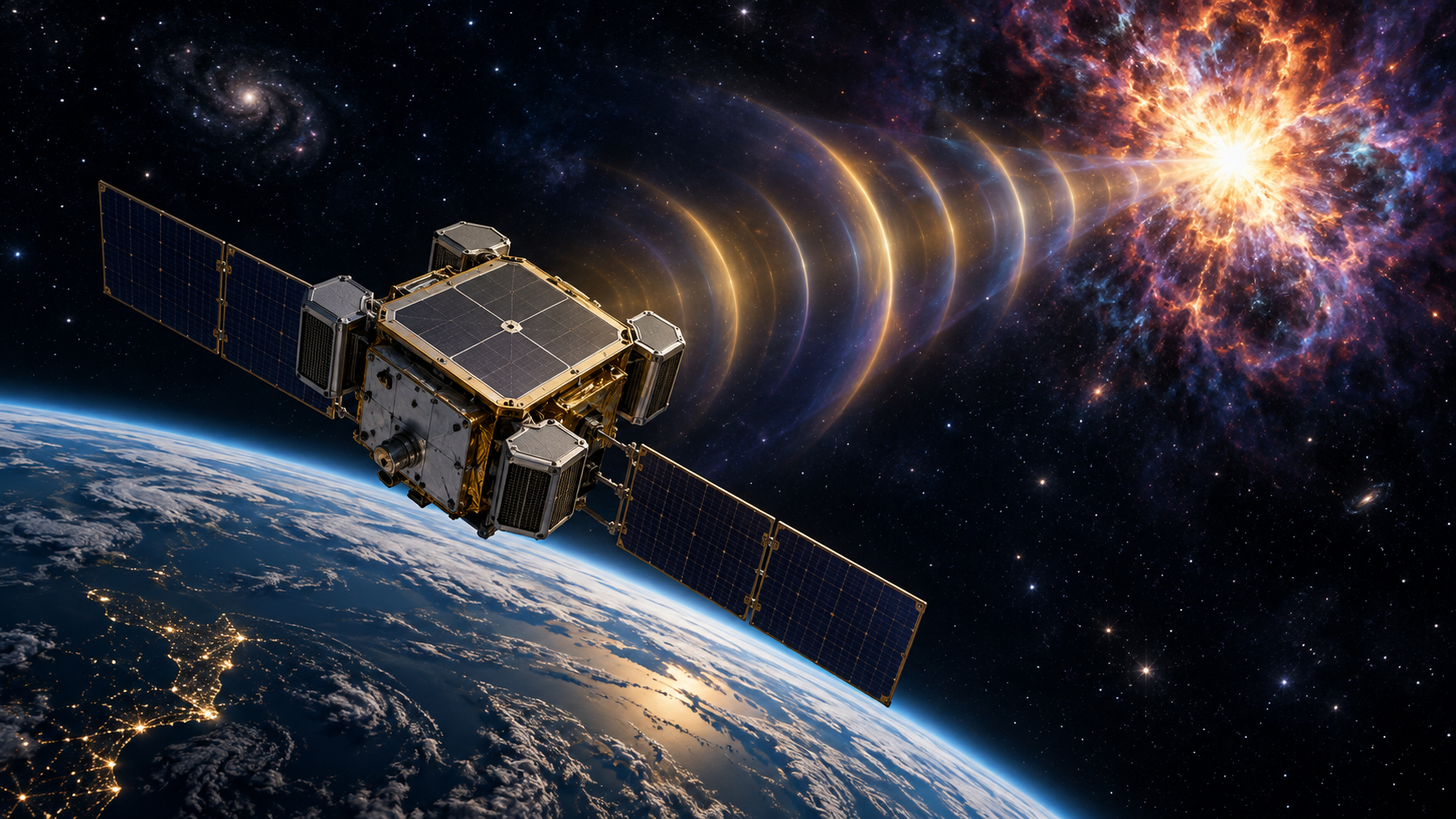
Featured image: original conceptual illustration of a future space telescope, not a photograph or an engineering rendering of COSI.
What changed this week
On September 18, NASA published an image of engineers and managers at the University of California, Berkeley watching the detector assembly for the Compton Spectrometer and Imager, or COSI, being lifted from a table. The photograph itself was taken July 8, 2026. The distinction matters: NASA has reported an assembly scene, not a launch or the start of scientific observations. Four silver covers visible on top protect flex circuits that carry detector signals to readout electronics, NASA explains in its image article.
COSI is planned as a wide-field gamma-ray telescope. These high-energy photons carry information about processes invisible to ordinary cameras. The mission remains in development, and NASA lists 2027 as its planned launch year. A 2024 launch-services announcement named a Falcon 9 and an August 2027 target, but schedules can change as integration and testing proceed.
Why this telescope exists
One of COSI’s central goals is to examine the Milky Way’s positrons, the antimatter partners of electrons. When an electron and positron annihilate, they create a recognizable gamma-ray signal. Astronomers have detected a broad glow associated with that process, yet the origins and movement of the positrons remain active questions. COSI aims to map the emission more precisely and test competing explanations.
The observatory is also designed to study where heavy atomic nuclei are made, how energetic sources polarize gamma rays, and which electromagnetic signals accompany events first noticed by gravitational-wave detectors. Those are mission goals, not discoveries already made by COSI. If successful, it would connect several kinds of cosmic evidence that are often analyzed separately.
How a gamma-ray telescope works differently
A visible-light telescope can focus light with mirrors or lenses. Gamma rays are much harder to focus that way. COSI instead uses a detector that records how a gamma-ray photon scatters and deposits energy. From those interactions, scientists can constrain where in the sky it came from; many events together build a map. NASA’s high-energy astrophysics archive describes a germanium detector system designed for this Compton-imaging method.
Its broad field of view is as significant as its sensitivity. A wider look at the sky can help catch transient events and connect their gamma rays with observations from other instruments. Still, the eventual scientific performance will have to be demonstrated after launch and commissioning; a laboratory assembly photograph cannot establish it.
What to watch next
Integration, environmental testing, launch readiness and on-orbit calibration all stand between a detector assembly and a working observatory. NASA’s mission page is the best place to check updated timing rather than treating an older target date as a promise. For now, the Berkeley photograph offers a concrete sign of construction and a reminder that the biggest science claims are still predictions to be tested.
Sources: NASA image article, September 18, 2026; NASA COSI mission page; NASA HEASARC instrument overview. Assembly photo date: July 8, 2026.