


Count Eliminations Before Counting Tournament Rounds
By OnelROR Editorial Team · November 17, 2026 · 3 min read
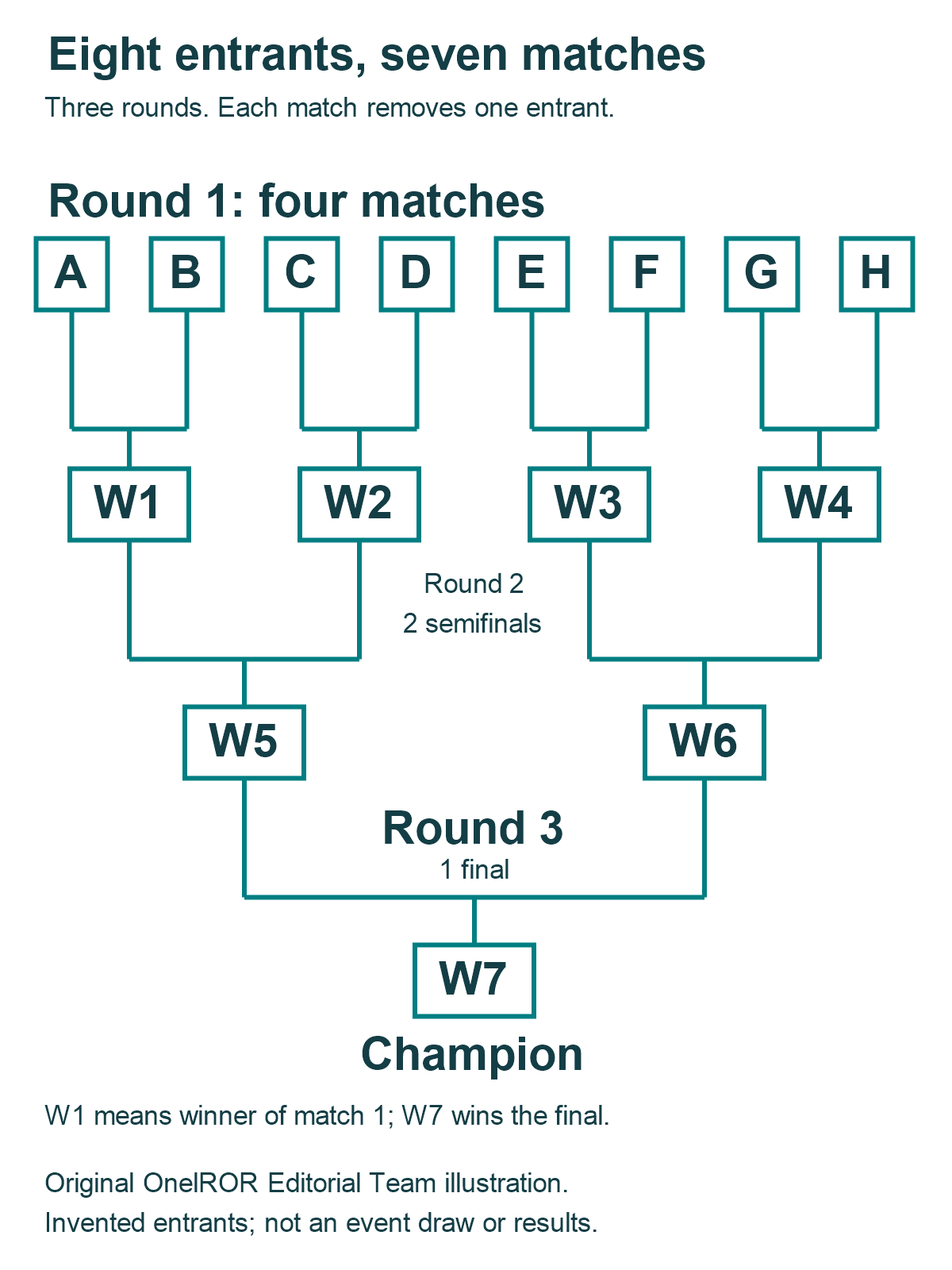
An eight-player knockout bracket has three rounds, but it takes seven matches to produce a champion. Counting the rounds answers a different question from counting the contests. To check the match total, follow the players who leave the competition.
Diagram key: Eight invented entrants A through H play four opening matches. Winners W1 through W4 play two semifinals, producing W5 and W6. Their final produces W7, the champion: seven matches in three rounds.
One match, one elimination
NRICH describes single elimination as a format in which one defeat removes a team. Its tournament-scheduling article also explains how preliminary rounds and byes can bring a field into a suitable bracket. [1]
For a simple counting model, assume every scheduled contest is played and produces one winner and one eliminated entrant. Begin with N entrants and finish with one champion. That requires N – 1 eliminations. Because each match supplies exactly one of them, the championship requires N – 1 matches. This is a deduction from the model, not a result from a real event.
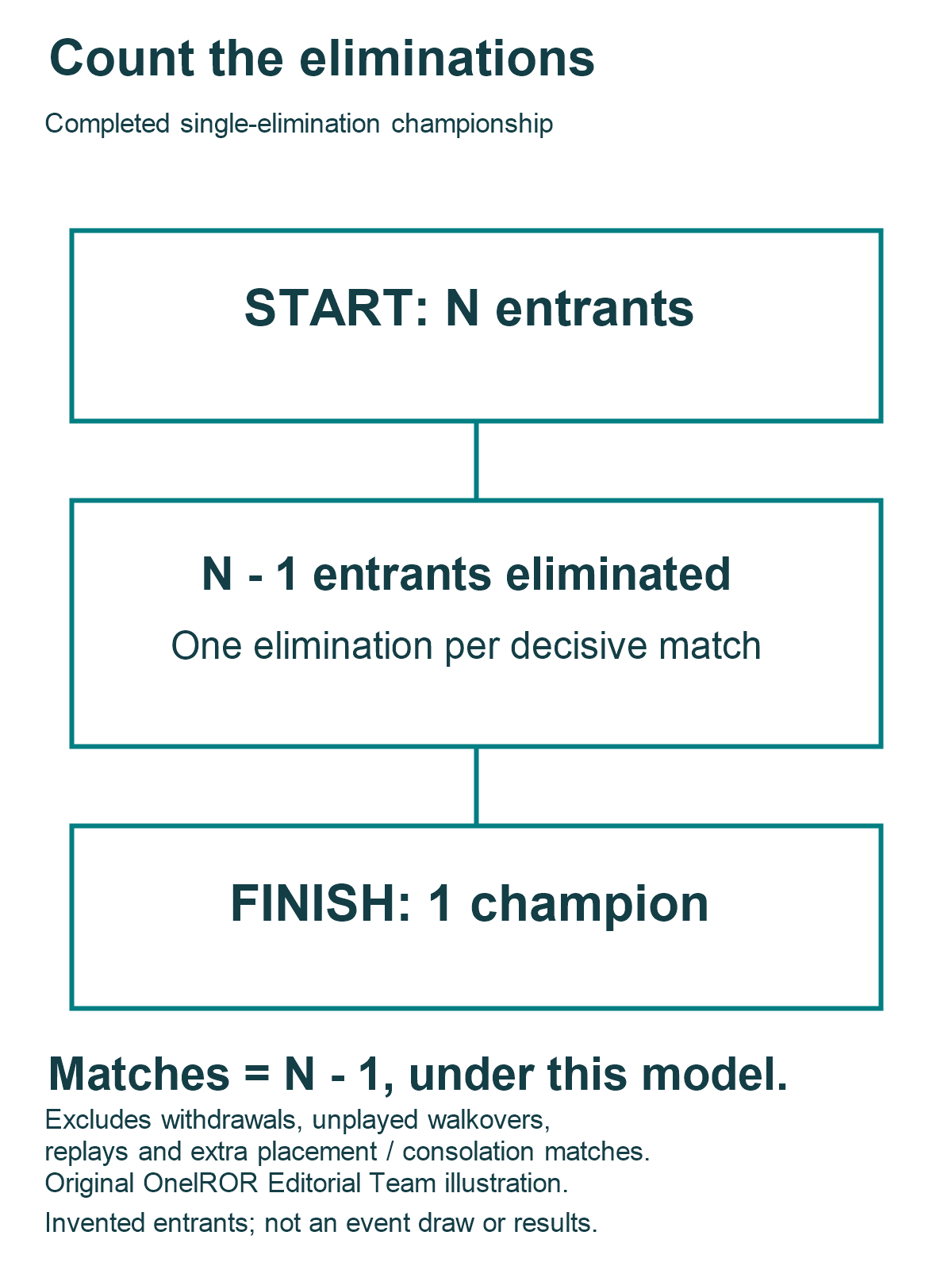
Diagram key: Start with N entrants and finish with one champion. Exactly N minus one entrants must be eliminated. If every played decisive match eliminates one entrant, there are N minus one matches. The stated exclusions remain essential.
With eight entrants, four opening matches leave four players. Two semifinals leave two, and the final leaves one: 4 + 2 + 1 = 7 matches across three rounds. Several matches can belong to the same round; a round is not one contest.
A bye is not an extra match
Imagine six entrants labelled A through F. A and B receive byes while C plays D and E plays F. The two winners join A and B in the semifinals. Two opening matches, two semifinals and a final make five matches, agreeing with 6 – 1. The byes advance entrants without adding contests.
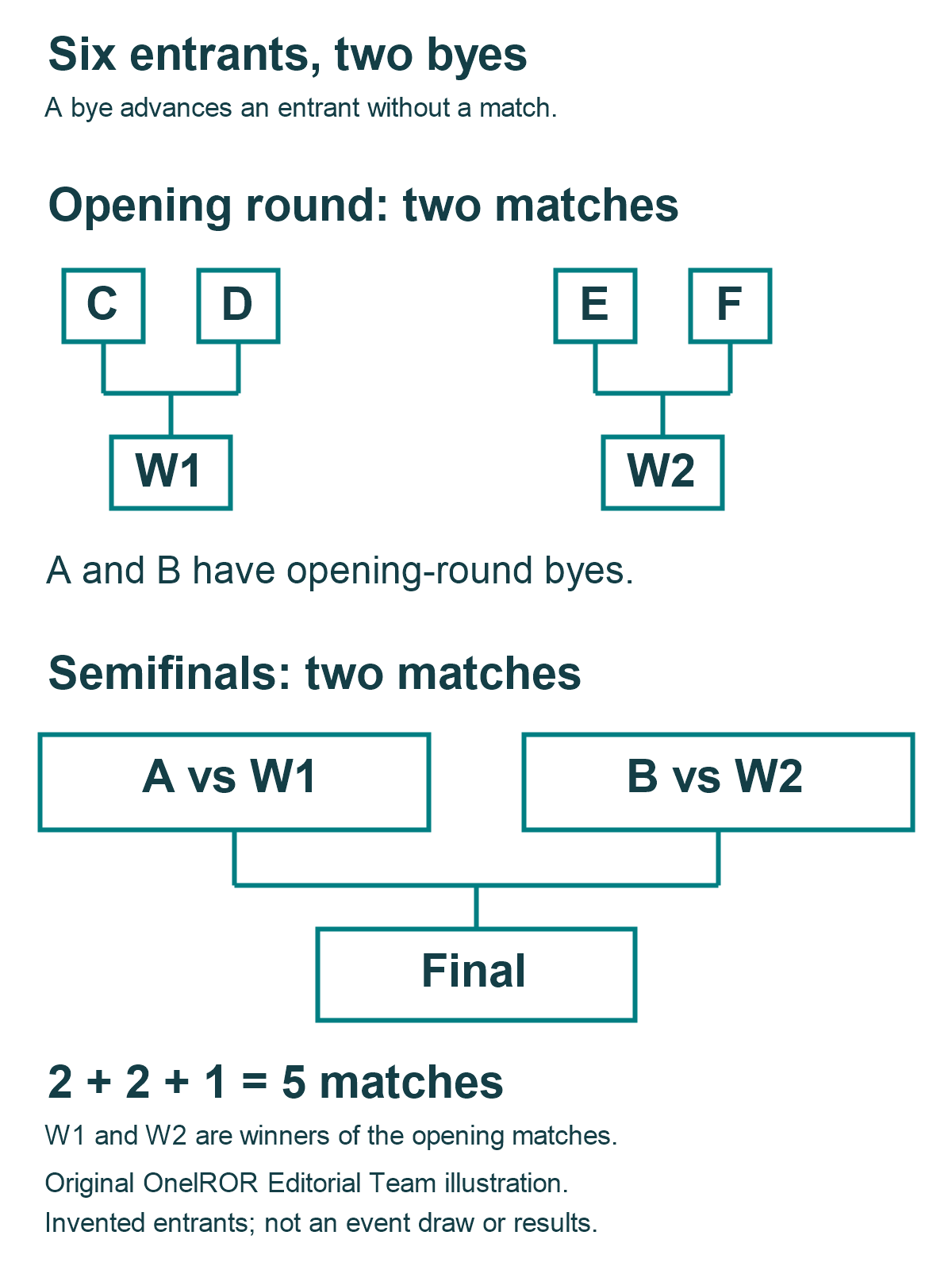
Diagram key: C plays D and E plays F in two opening matches. A and B have byes and join winners W1 and W2 in two semifinals. The semifinal winners play one final. Total: two plus two plus one equals five matches.
Keep the counting unit clear
This model excludes withdrawals, unplayed walkovers, replays and extra placement or consolation matches. Double elimination and round robin require different accounting. A team encounter may itself contain several individual matches, so decide which unit you are counting before applying the rule.
A useful bracket check is therefore simple: identify the format, count the entrants, and state what counts as one match. The diagram alone cannot settle all three.
Source
- NRICH: Tournament Scheduling, University of Cambridge. Arunachalam Y, February 1, 2011. Single Elimination Tournaments section. Consulted November 17, 2026.
The bracket examples and elimination-count proof are original teaching illustrations under the assumptions stated above.