





I-220A Court Victory: Judge Rejects Government Bid to Dismiss Mark Prada Lawsuit
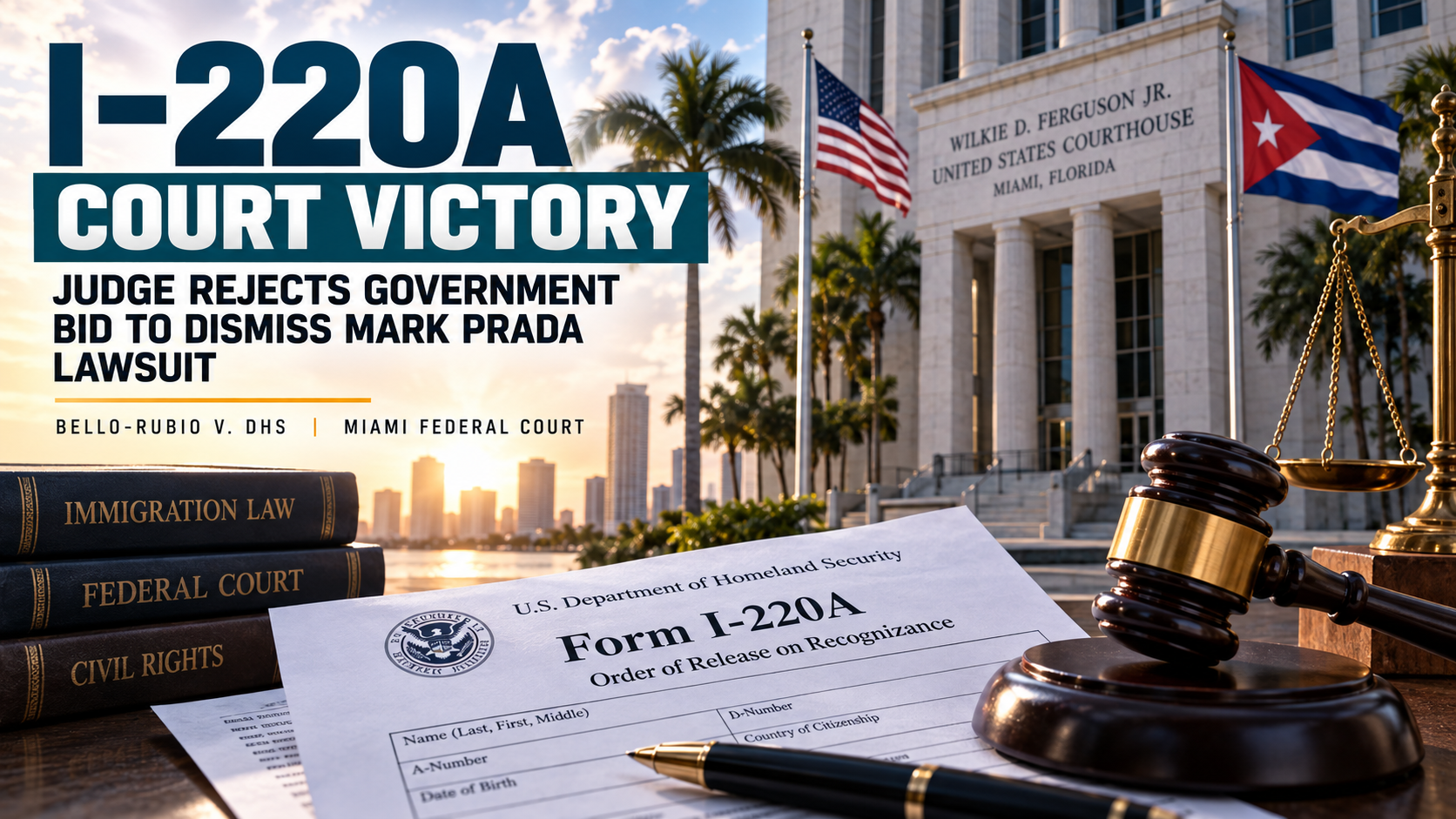
BREAKING NEWS | IMMIGRATION | I-220A
I-220A Court Victory: Judge Rejects Government Bid to Dismiss Mark Prada Lawsuit
A federal judge in Miami has rejected the U.S. government’s attempt to dismiss a closely watched lawsuit involving Cuban migrants released with Form I-220A, allowing the Bello-Rubio litigation to continue.
By OnelROR News Desk • September 11, 2026 • Miami, Florida
DEVELOPING STORY: The ruling keeps the I-220A litigation alive, but it does not automatically convert I-220A documents into immigration parole or grant permanent residency.
MIAMI — A closely watched federal lawsuit involving Cuban migrants released into the United States with Form I-220A has cleared an important legal hurdle after a federal judge rejected the government’s effort to have the case dismissed.
The development came in the federal case known as Bello-Rubio v. United States Secretary of the Department of Homeland Security, litigation that has attracted significant attention among Cuban immigrants and their families because of the potentially broader questions surrounding I-220A releases.
Immigration attorney Mark Prada is among the attorneys representing the plaintiffs in the litigation.
What Did the Judge Decide?
The immediate question before the court was not whether every Cuban carrying an I-220A document should receive permanent residence.
Instead, the federal government had sought to dismiss the lawsuit before the plaintiffs could continue pursuing their central legal claims.
Following arguments in federal court, the government’s motion to dismiss was denied, allowing the case to continue.
Why this matters: The lawsuit has survived a significant preliminary challenge. The plaintiffs can continue pursuing their claims concerning how they were processed and released by U.S. immigration authorities.
That distinction is extremely important for I-220A holders following the case.
The court has not issued a blanket ruling declaring every I-220A legally equivalent to parole.
The court also has not ordered U.S. Citizenship and Immigration Services to automatically grant green cards to I-220A holders.
What happened instead is procedurally important: the government’s attempt to end the litigation at this stage was unsuccessful.
What Is the Bello-Rubio Case?
The lawsuit is known as Bello-Rubio v. United States Secretary of the Department of Homeland Security and is being heard in the U.S. District Court for the Southern District of Florida.
The case centers on Cuban migrants who were processed by U.S. immigration authorities and subsequently released with Form I-220A. Case Detail Information Case Bello-Rubio v. United States Secretary of DHS Federal Case 1:25-cv-23665 Court U.S. District Court for the Southern District of Florida Judge Jacqueline Becerra Key Attorney Mark Andrew Prada Latest Major Development Government motion to dismiss denied Current Status Litigation continues
Why Is Form I-220A So Important?
Form I-220A is formally known as an Order of Release on Recognizance.
Many migrants, including a significant number of Cubans who entered through the southern border, were released from immigration custody with this document while their immigration proceedings continued.
For Cuban migrants, however, the distinction between release with an I-220A and formal immigration parole can have major consequences.
The Cuban Adjustment Act provides an important pathway through which qualifying Cuban nationals may seek lawful permanent residence after satisfying the requirements established by U.S. immigration law.
One of the central legal problems affecting many I-220A holders concerns whether the circumstances surrounding their entry and release satisfy requirements connected to being admitted or paroled into the United States.
What Mark Prada’s Legal Team Is Arguing
The plaintiffs’ legal theory goes deeper than simply asking a federal judge to replace the words “I-220A” with “parole.”
The litigation focuses on the legal authority immigration officials used when processing and releasing the migrants.
The plaintiffs contend that the circumstances under which certain migrants were processed and released require the federal court to examine whether immigration authorities used the correct statutory mechanism.
The central issue: The case is not simply about the name printed on an immigration document. It concerns the legal authority under which certain migrants were processed and released into the United States.
What Is the Government’s Position?
The federal government has taken a substantially different position.
Government attorneys have maintained that release under an I-220A is legally different from immigration parole.
Under that interpretation, an individual released on recognizance while immigration proceedings continue does not automatically become a person who has been paroled into the United States for purposes of immigration law.
Questions concerning the federal court’s authority to review aspects of immigration detention, release and parole have also played an important role in the litigation.
Why the Latest Decision Matters
Before the plaintiffs can ultimately prevail on their broader legal arguments, their lawsuit must first survive procedural challenges.
The government’s motion to dismiss represented one of the most important early obstacles facing the plaintiffs.
With that effort unsuccessful, the litigation can move forward.
That does not mean the plaintiffs have won the entire case.
It means they remain in court and can continue pursuing the underlying claims that brought the case national attention.
What Has — and Has Not — Happened
- YES: The government’s effort to dismiss the Bello-Rubio lawsuit was rejected.
- YES: The federal litigation can continue.
- YES: The plaintiffs can continue pursuing their legal arguments.
- NO: Every I-220A has not automatically become immigration parole.
- NO: The ruling does not automatically grant permanent residency.
- NO: I-220A holders should not assume that they can immediately obtain a green card solely because of this development.
The Next Major Question: Class Certification
Another major issue surrounding the litigation is whether the case can eventually provide relief beyond the individuals directly involved in the lawsuit.
That is where the question of class certification becomes especially important.
The way different migrants were processed at the border could play an important role because not every person carrying an I-220A necessarily has the same immigration history.
Some individuals may have entered under different circumstances or been processed under different immigration authorities.
Those distinctions could become critical as the litigation progresses.
Could the Case Eventually Affect Other I-220A Holders?
Potentially, but such an outcome is not guaranteed.
The possibility that the litigation could eventually have consequences beyond the current plaintiffs is one of the primary reasons the case has generated so much interest in South Florida and within Cuban communities throughout the United States.
Any broader effect would depend on future court decisions, the scope of any class that might be certified, the legal circumstances of the individuals involved and the ultimate resolution of the underlying claims.
Can I-220A Holders Apply for a Green Card Now?
The latest court development by itself does not create an automatic right to permanent residence.
Individual immigration cases can depend on numerous factors, including the person’s manner of entry, immigration history, pending removal proceedings, prior orders, criminal history and other circumstances.
IMPORTANT FOR I-220A HOLDERS:
The latest court development should not be interpreted as an automatic grant of parole, lawful immigration status or permanent residence. Individuals should continue complying with immigration court hearings, ICE reporting requirements and other existing legal obligations unless a court or qualified immigration attorney advises otherwise based on their specific case.
Why the Case Could Have Broader Significance
The importance of Bello-Rubio extends beyond the document itself.
The litigation asks a federal court to examine the legal framework immigration authorities used when processing and releasing certain migrants.
If the plaintiffs eventually prevail on the underlying legal questions, the reasoning used by the court could become important for other migrants whose immigration histories are substantially similar.
That possibility explains why immigration attorneys, I-220A holders and Cuban families are closely following each new development in the case.
What Happens Next?
The denial of the government’s motion to dismiss is not the end of the Bello-Rubio litigation.
Instead, it allows the case to proceed into additional stages in which the court may consider other procedural and substantive questions.
Issues surrounding the scope of the litigation, the plaintiffs’ claims and possible class certification could become increasingly important as the case progresses.
Additional court filings and orders will provide a clearer picture of what comes next.
Why I-220A Families Should Follow the Case Carefully
The uncertainty surrounding I-220A has affected Cuban families for years.
Many people released with the document have been waiting for clarity about whether their particular immigration circumstances could eventually allow them to pursue permanent residence under the Cuban Adjustment Act.
The latest development does not resolve that uncertainty overnight.
But it ensures that one of the most closely watched federal challenges involving I-220A holders will continue.
The Bottom Line
The latest development in the Bello-Rubio case represents an important procedural victory for the plaintiffs because the federal government’s attempt to dismiss the lawsuit was unsuccessful.
However, it is equally important to understand what the decision does not do.
It does not automatically convert every I-220A into parole, and it does not automatically make every I-220A holder eligible for permanent residence.
The case continues, and future decisions could be even more significant than this one.
OnelROR News will continue monitoring the Bello-Rubio litigation and major federal court developments affecting I-220A holders.
Last updated: September 11, 2026. This is a developing legal story. The article may be updated as additional federal court orders and filings become available.
Sources & Editorial Note
This report was prepared by the OnelROR News Desk using information from the federal court proceedings in Bello-Rubio v. United States Secretary of the Department of Homeland Security, U.S. District Court for the Southern District of Florida, Case No. 1:25-cv-23665, together with reporting surrounding the litigation.
OnelROR News distinguishes between procedural court developments and final immigration relief. The denial of a motion to dismiss should not be interpreted as a final ruling granting immigration status or permanent residence.
Legal Disclaimer: This article is published for news and informational purposes only and does not constitute legal advice. Immigration cases depend on individual circumstances. Readers should consult a qualified immigration attorney regarding their individual situation.