

NASA Picks SpaceX for StarBurst: The Small Satellite Hunting Neutron-Star Mergers
Science & Space | Mission Watch
NASA has booked a Falcon 9 rideshare for StarBurst, a compact gamma-ray observatory built to catch a fleeting signal when two neutron stars collide. The launch is planned no earlier than 2028.
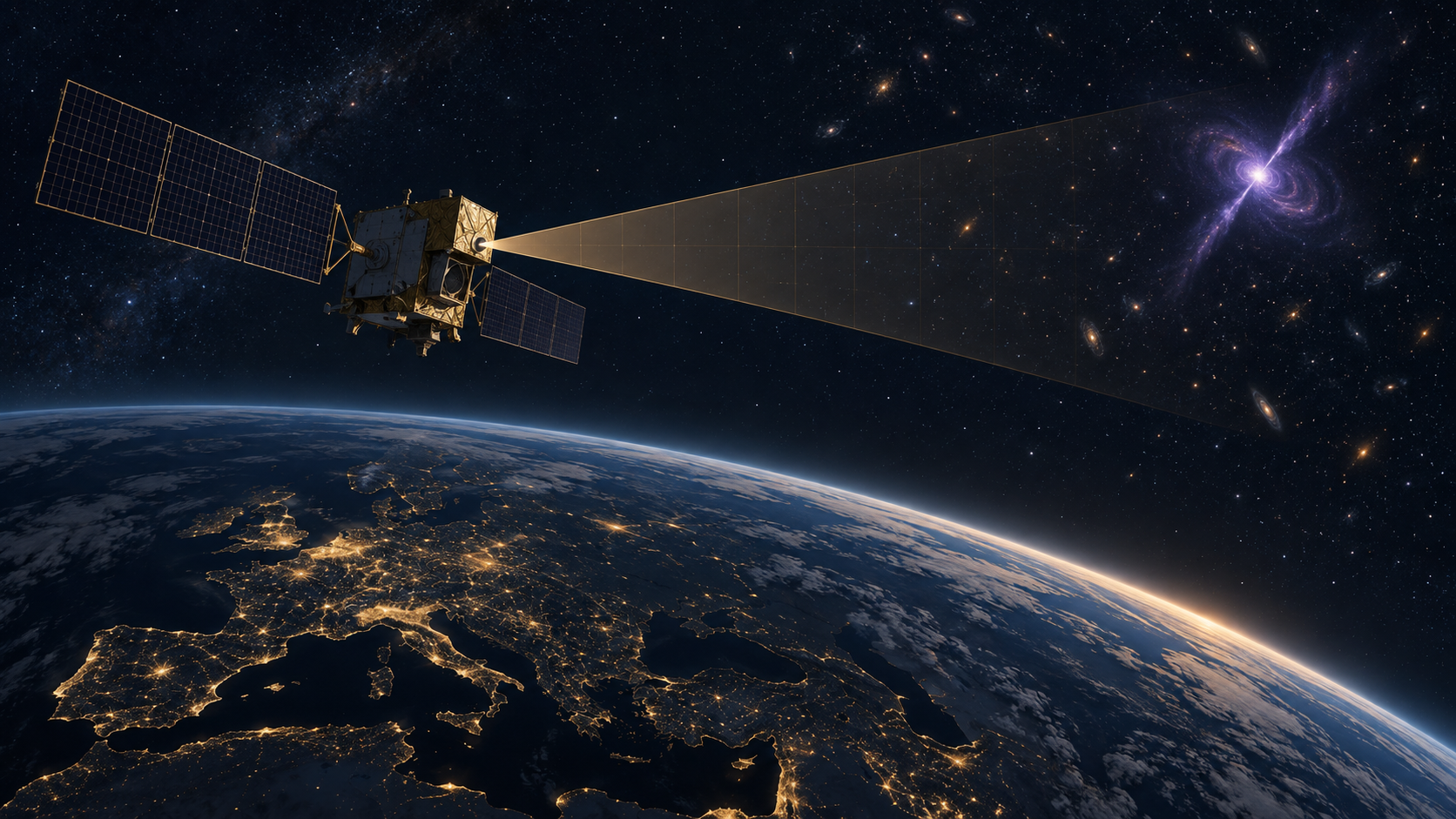
The featured image is an original editorial illustration, not a photograph of the StarBurst spacecraft or an observed merger.
What NASA actually announced
On September 17, NASA selected SpaceX to provide launch services for StarBurst. The spacecraft is slated to ride on a Bandwagon mission aboard a Falcon 9 from Space Launch Complex 40 at Cape Canaveral Space Force Station in Florida, no earlier than 2028. The launch award is a firm-fixed-price task order under the agency’s Venture-Class Acquisition of Dedicated and Rideshare, or VADR, contract. NASA did not give a StarBurst-specific task-order price in its announcement; the stated $1 billion is a maximum across the broader contract, not the cost of this one satellite.
This is a launch-services selection, not a launch or a scientific discovery. The schedule can change as the spacecraft, rocket manifest and mission readiness progress. A NASA mission overview still describes a 2027 plan; the newer, dated launch award specifies no earlier than 2028, so the later announcement is the better current scheduling reference.
Why a short gamma-ray flash matters
Neutron stars are extraordinarily dense remnants of massive stars. When a pair spirals together and merges, the event can produce gravitational waves and, under the right geometry, a short gamma-ray burst. The gamma-ray flash may last only briefly. An instrument that surveys a wide area of sky improves the chance that astronomers can spot the high-energy signal and alert other observatories to look for the event’s changing aftermath.
StarBurst is designed to monitor the portion of sky Earth does not block. NASA describes it as a wide-field SmallSat in the Astrophysics Pioneers Program. Its job is to detect the initial high-energy emission from short bursts, while gravitational-wave detectors and follow-up telescopes provide complementary measurements. Matching different signals from one event is called multimessenger astronomy: each messenger reveals something the others cannot easily show.
What scientists could learn—and what remains unknown
A well-observed merger can help researchers study the behavior of extremely dense matter and locate the source for later observations. A burst alone does not prove that every detail of a merger is understood. Orientation matters: narrow jets can be hard to see when they are not pointed toward Earth, and Earth itself blocks part of an orbiting detector’s view. Coordinating StarBurst with gravitational-wave alerts and ground or space telescopes is central to the mission’s value.
The new launch plan makes that observing strategy more concrete, but readers should distinguish potential science from results. StarBurst has not yet reported detections from orbit. NASA’s mission page offers the broader scientific objectives; the September 17 release is the source for the current launch-service award and its no-earlier-than date.
What to watch next
The next meaningful milestones are spacecraft testing, a firmer rideshare manifest and a confirmed launch date. Once in orbit, the question will be how often its gamma-ray alerts can be paired with independently detected gravitational waves and timely follow-up observations. Those operational results, rather than a launch booking alone, will show how much this small observatory adds to the worldwide network studying cosmic collisions.
Sources: NASA launch-services award, September 17, 2026; NASA StarBurst mission overview.