





NASA’s Moon Orbiter Found a Once-in-a-Century Crater—Why It Matters
Science & Space | Lunar Discovery
A newly identified scar on the Moon is giving scientists an unusually clear look at how a major impact reshapes the lunar surface—and what future explorers may encounter beyond the crater rim.
By OnelROR Editorial Team | September 22, 2026 | 6 min read
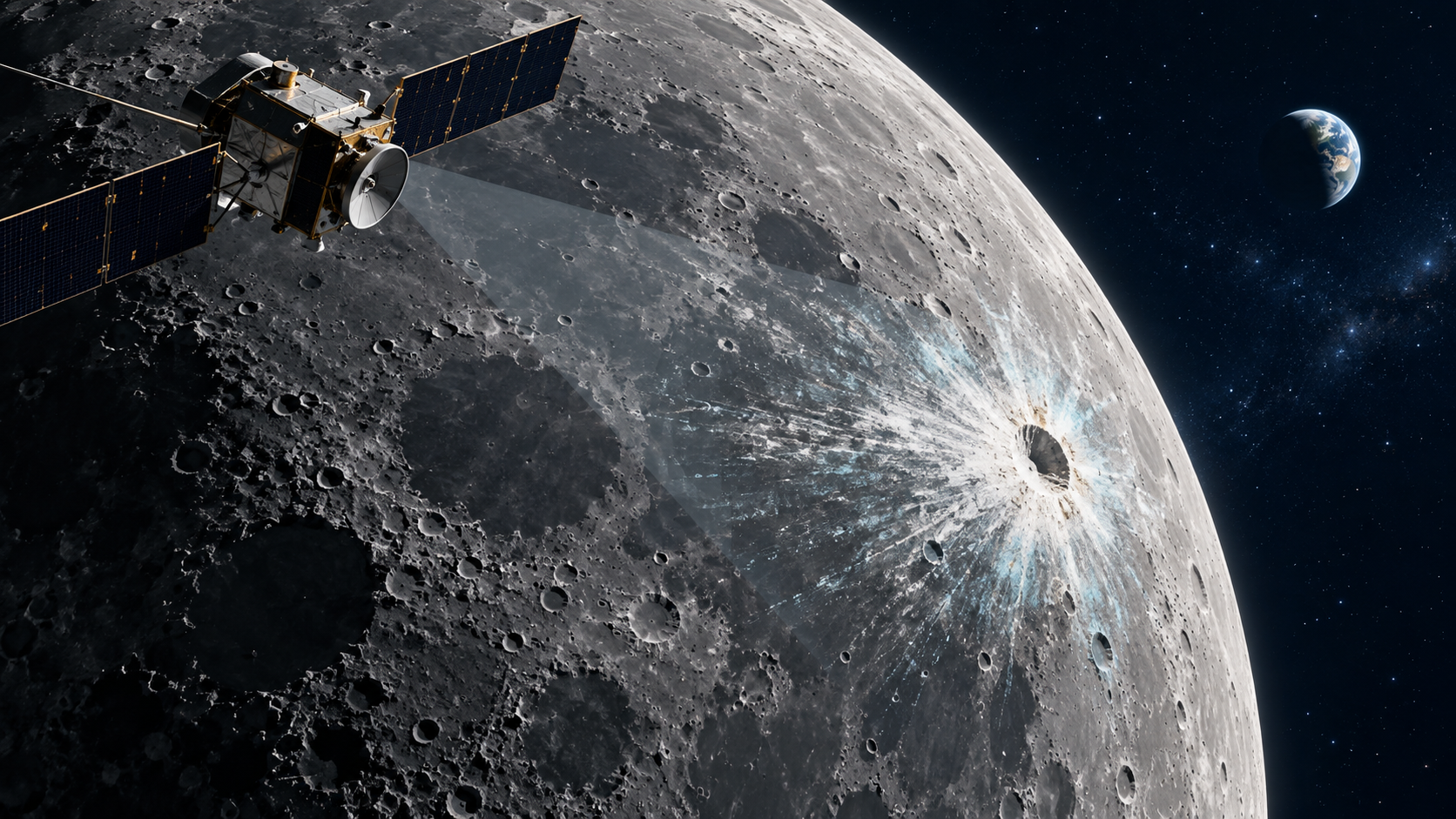
NASA’s Lunar Reconnaissance Orbiter has helped scientists identify the largest newly formed impact crater yet found in the solar system. The crater, officially named McGetchin, is about 728 feet wide and 141 feet deep. Researchers concluded that it formed when an asteroid or comet struck the Moon sometime between April 11 and May 22, 2024.
The discovery was announced by NASA on September 16, 2026, alongside research published in Science Advances. Scientists estimate that an impact of this scale may occur on the Moon only once a century—or even less often. The finding is significant because researchers can compare images taken before and after the collision, turning one dramatic event into a natural experiment on how the lunar surface changes.
A routine check revealed something extraordinary
The discovery began during a data-quality review. Robert Wagner, an image-processing specialist working with the Lunar Reconnaissance Orbiter Camera system, was comparing global maps assembled from images captured years apart. Software highlighted areas that had changed, and one unusually large bright patch surrounded by a dark halo stood out.
The bright area was not the crater itself. It was material thrown outward by the impact. NASA says the incoming object may have been comparable in size to a three- to six-story building. Later observations with the orbiter’s sharper Narrow-Angle Camera revealed the crater’s dimensions and the extensive pattern of disturbed terrain around it.
The timing of the impact was narrowed down by comparing images: the crater was absent in imagery taken on April 11, 2024, and present by May 22. That before-and-after evidence is especially valuable because most lunar craters formed long before modern instruments could observe the process.
The impact changed more than the visible ground
Visible images showed the fresh crater and its ejecta, but a second instrument revealed a broader effect. The Diviner radiometer detected a “cold spot” roughly four miles wide around McGetchin. At night, that area was about 16 degrees Fahrenheit cooler than nearby terrain.
Researchers attribute the difference to regolith—the Moon’s layer of loose dust and broken rock—being churned and made less dense by the impact. Looser material holds heat differently. That means a collision can alter the physical properties of the ground far beyond the obvious crater.
A Moon that is still changing
The Moon can look frozen in time, but it remains exposed to constant bombardment. Without a substantial atmosphere to slow or burn up incoming objects, rocks can reach the surface at high speed. During more than 17 years in lunar orbit, LRO teams have identified at least 1,000 new impact craters and flagged about 100,000 additional surface changes linked to impacts and their debris.
Most new craters are much smaller than McGetchin. NASA estimates that impacts capable of producing craters around 30 feet wide occur roughly 140 times a year across the Moon. Many other projectiles are microscopic and leave marks too small for orbital cameras to resolve.
McGetchin is different because its scale made it unmistakable in global comparison maps. Its fresh ejecta pattern extended across hundreds of pixels, allowing researchers to follow up with higher-resolution cameras and thermal data. That combination provides a rare opportunity to connect an impact’s visible effects with less obvious changes in the soil.
How scientists verify a new lunar crater
- Build comparable maps: Researchers combine many wide-angle images taken under carefully considered lighting conditions.
- Highlight change: Software compares older and newer mosaics, turning differences into bright or dark patches.
- Reject false alarms: Human reviewers separate real surface changes from shifting shadows, lighting variations and alignment errors.
- Revisit the site: High-resolution cameras examine the suspected crater at about three feet per pixel.
- Use other instruments: Thermal measurements test whether surrounding regolith was disturbed beyond what visible images show.
This process also shows why the discovery was not instantaneous. The impact occurred in 2024, Wagner noticed it in global mapping data in October 2025, and scientists then gathered follow-up observations and completed their analysis before publication in September 2026.
What researchers still need to learn
The evidence establishes when the crater formed, its dimensions and the broad thermal disturbance around it. Researchers are still refining estimates of the impactor’s size and energy. NASA says additional details derived from the close-up images are expected in future research.
The phrase “once-in-a-century” describes the estimated frequency of an impact of this magnitude on the Moon; it is not a prediction that such events arrive on a regular schedule. Impact rates are statistical, and long quiet periods can be followed by events closer together.
For lunar exploration, McGetchin offers a timely reminder that the Moon is an active environment on human timescales. Detailed orbital monitoring does more than update maps: it helps mission planners understand how impacts redistribute soil, change local temperatures and create conditions that hardware and crews may eventually face on the surface.
Image note: Featured image is an original OnelROR editorial illustration and is not documentary imagery of McGetchin crater.
Sources: NASA Science: McGetchin crater discovery; NASA-linked research reports in Science Advances.