


Compare Electricity Bills Without Confusing Use and Cost
USEFUL THINGS | HOUSEHOLD RECORDS
Compare Electricity Bills Without Confusing Use and Cost
Start with the service period and the energy used. Then examine how the charges were calculated—before treating a changed total as evidence of changed habits.
By OnelROR Editorial Team · October 11, 2026 · Miami · 5 min read
Cover illustration — OnelROR Editorial Team. Original conceptual diagram, not a utility bill or screenshot; no customer information or actual tariff is depicted.
Put two complete statements side by side
A higher electricity bill does not, on its own, tell you whether you used more energy, paid a different price or carried a balance from another period. Begin with the complete current statement and a comparison statement, including their detailed pages. Your first task is to identify which numbers describe the same thing. This guide provides a reading method, not a tariff quote or a prediction of savings.
Check that the statements concern the same service and meter. Note the service-period dates, billed energy, reading basis, rate schedule and current electricity charges. Keep the amount due in a separate field. If the statement combines services or includes a prior balance, do not silently treat that entire amount as the cost of electricity used in the current period. Copy unfamiliar labels exactly rather than guessing what they mean.
Read the unit beside the number
The U.S. Energy Information Administration distinguishes power from energy used over time. Kilowatts, written kW, measure power; kilowatt-hours, commonly written kWh on bills, measure energy. A constant one-kilowatt load operating for one hour uses one kWh. A billing-period energy total is therefore different from an instantaneous power reading or an appliance's power rating.
Put the unit in your comparison notes. A column headed only 'usage' can become misleading if one entry is kWh and another is money. If your statement lists a demand charge in kW, consult that charge's definition and measurement window. The Department of Energy's utility-bill training separates consumption and demand; its industrial examples should not be assumed to describe the tariff on a household account.
Compare the length of the periods
Use the number of billing days stated on each bill. The month when a statement arrives is not necessarily the month covered by its service dates. For a first comparison, divide the period's billed kWh by its billing days. DOE's training uses daily consumption when allocating billing-period energy to calendar months. Here, the same arithmetic is simply a way to avoid comparing unequal periods as though they were equal.
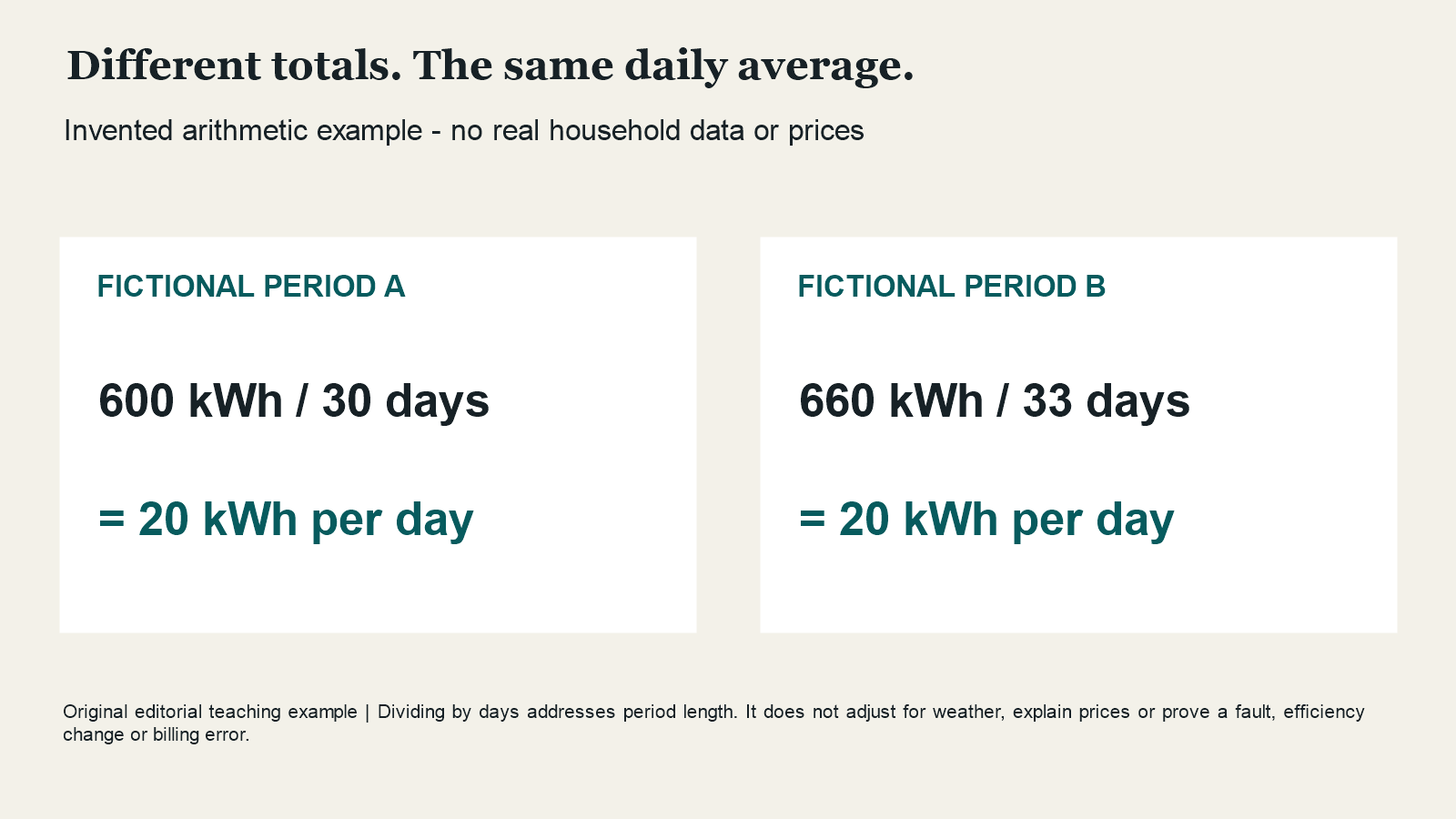
Consider a deliberately fictional example: 600 kWh across 30 days is 20 kWh per day; 660 kWh across 33 days is also 20 kWh per day. The second period has more total energy but the same daily average. These numbers are invented for arithmetic, not measured household usage or a typical bill. The comparison says nothing yet about the price, weather, occupancy or equipment responsible.
Check whether consumption was measured or estimated
Look for the bill's explanation of actual or estimated readings. Pennsylvania's Public Utility Commission explains that an estimated bill can be based on previous usage and that a later actual reading can lead to an adjustment upward or downward. That is useful context for a comparison, but the booklet's Pennsylvania procedures are not universal rules for every utility. Ask your provider how the reading basis and any correction apply to your statement.
If you compare with the same season last year, also note changes in weather and household activity. The Pennsylvania guide recommends comparing consumption rather than only the total amount due and considering such changes. A daily average removes one difference—the number of days. It does not adjust for temperature, prove that an appliance is faulty or establish that a bill is wrong.
Separate the charge bases
For each charge, identify whether its calculation uses kWh, a fixed amount, a percentage or another basis. DOE's training distinguishes consumption charges from fixed charges and other fees. Do not infer the calculation solely from a label such as 'delivery': the Connecticut Office of Consumer Counsel's explanation includes both a fixed monthly customer charge and usage-related local-delivery charges. The applicable schedule, units and effective dates determine how a line is calculated.
If a line shows an energy quantity and a per-kWh rate, check that line using those numbers, allowing for displayed rounding. Keep separate blocks or time periods separate when different rates apply. Total current electricity charges divided by total kWh is a summary ratio; it is not automatically the listed energy rate or the price of the next kWh. Fixed charges, credits and other components can change that ratio.
Use another utility's example as a lesson, not your tariff
Silicon Valley Clean Energy's public bill explainer illustrates generation charges alongside PG&E delivery charges, credits and locally varying taxes. It concerns that particular California arrangement. Its value here is showing why the detailed pages matter, not supplying a rate or savings promise for Miami or any other service area. Follow the explanations and schedule for the company actually named on your own statement.
Dates matter as well as place. A Connecticut consumer alert dated May 22, 2026 discusses Standard Service supply-rate changes effective July 1, 2026 and makes the bill impact depend on usage. The announcement date and the effective date serve different purposes. When examining a change, check whether a notice concerns your provider, service type, rate schedule and the period being billed. A headline about a rate change is not a complete explanation of your total.
Turn the unexplained difference into a specific question
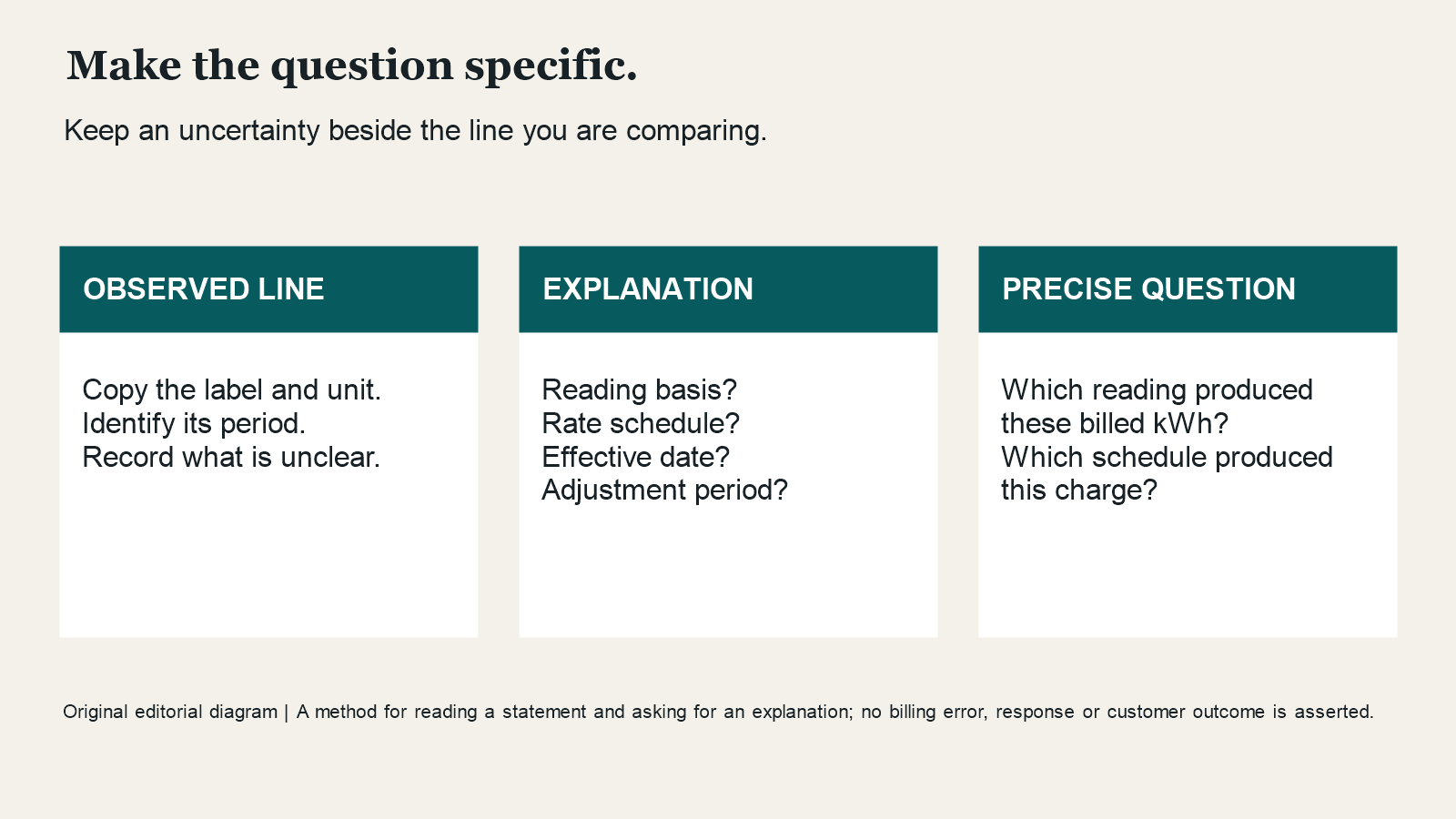
Keep an uncertainty column beside the comparison. It might say 'reading basis not explained,' 'credit relates to earlier period' or 'new rate date needs confirmation.' Then ask a question tied to the statement: which reading and service dates produced the billed kWh, or which schedule and effective date produced a particular charge? Record the explanation so a later comparison does not depend on remembering a conversation.
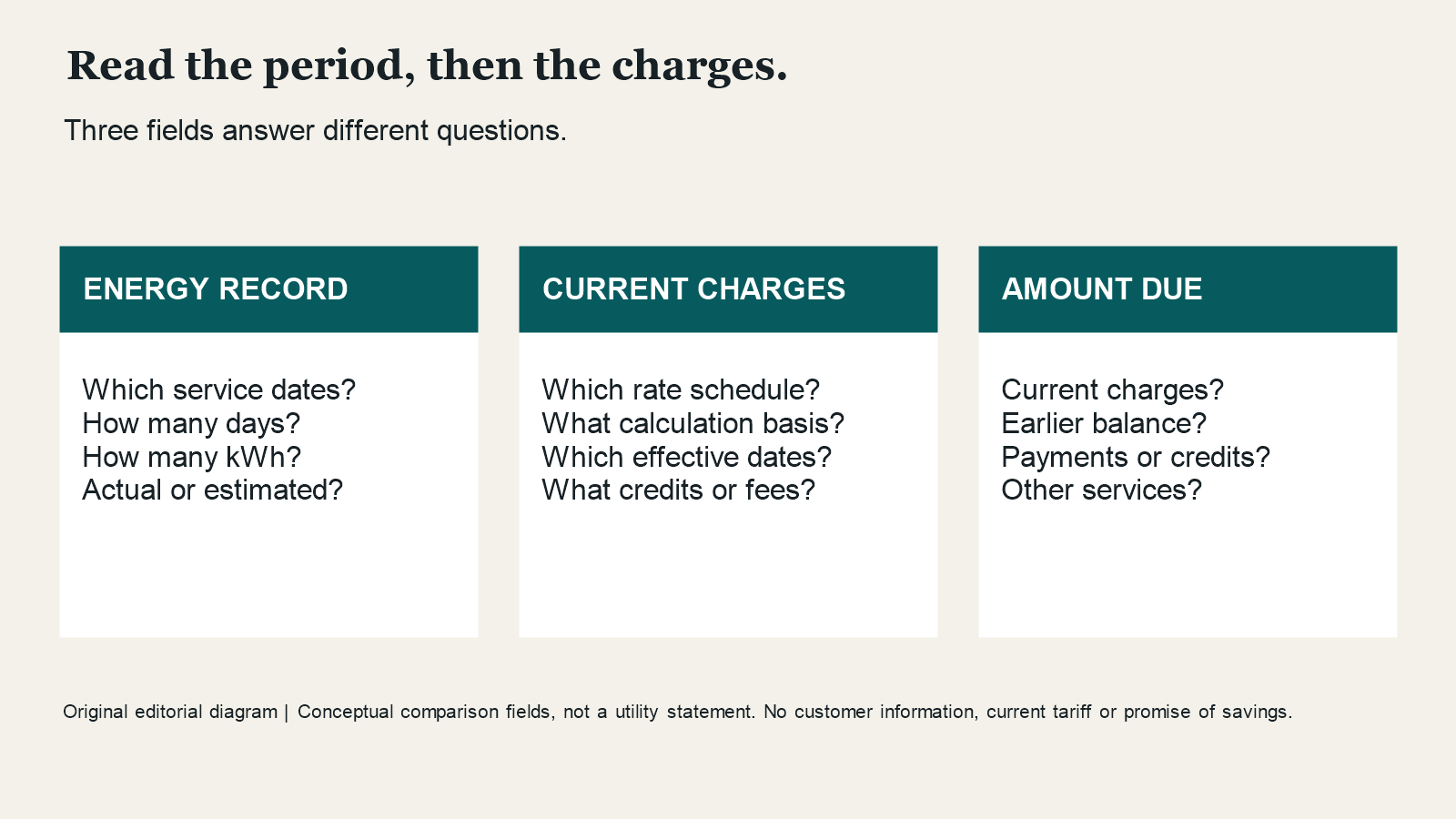
Your finished comparison should distinguish three things: the energy recorded for a defined period, the way current charges were calculated and the amount due on the account. Keep those distinctions even when the bill's total falls. You will have a clearer basis for deciding what changed and what still needs an answer, without claiming that a quick calculation proves efficiency, a fault or a billing error.