


Finding a Hidden Water Leak Starts With the Meter
Reviews & Guides · Useful Things · Home
Finding a Hidden Water Leak Starts With the Meter
A higher bill is a clue, not a diagnosis. Clear readings, quiet observations and careful records can turn an unexplained water increase into a useful next step.
By OnelROR Editorial Team · October 9, 2026 · Miami, EDT · 24-minute read
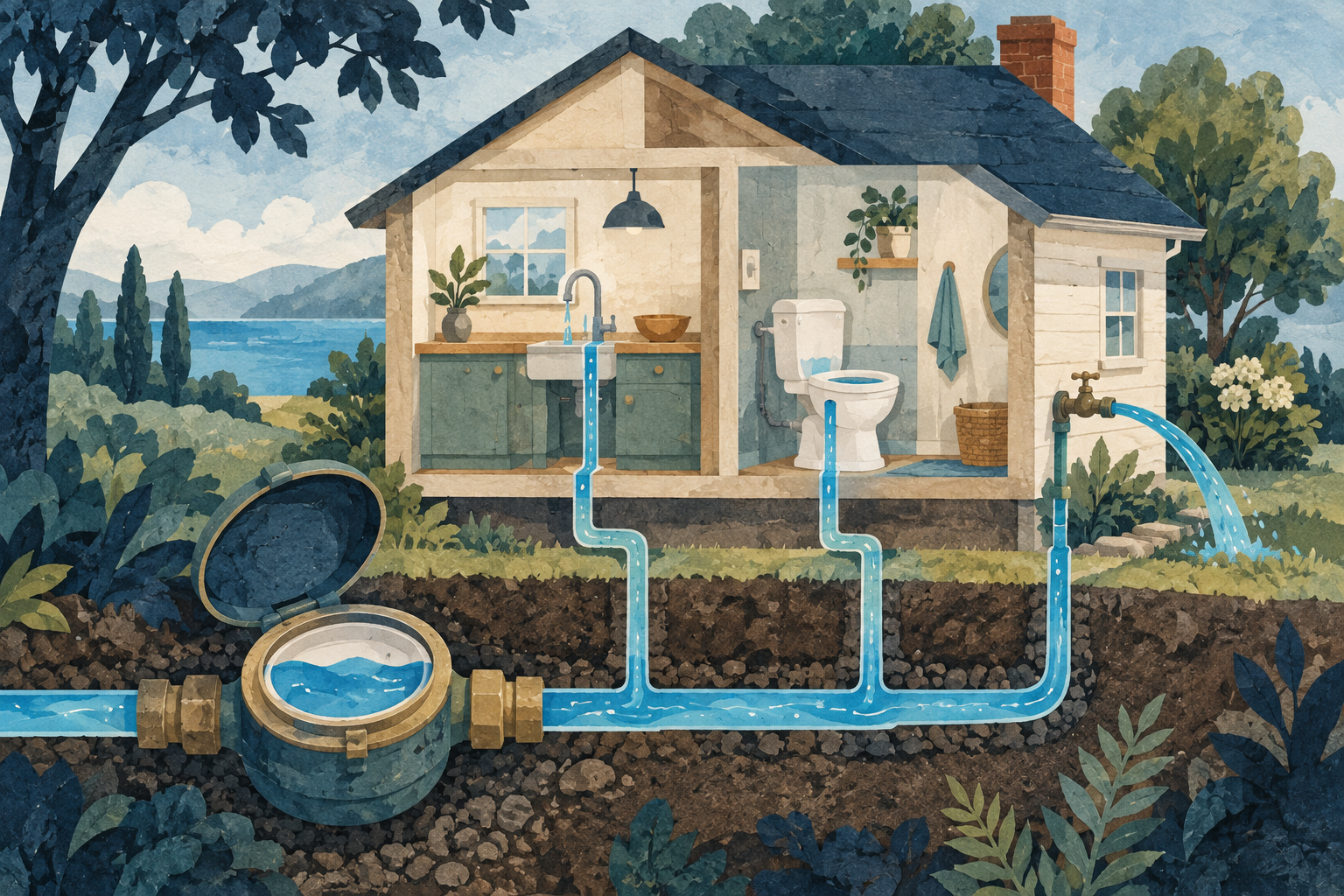
Opening image: original AI-generated editorial illustration of an imagined home and water meter; not a photograph or an installation diagram.
A higher bill is the beginning of a question
An unexpectedly large water bill often sends a household straight to the bathroom, listening for a running toilet. That is a reasonable place to look, but the bill and the toilet answer different questions. The bill describes a period of recorded or estimated consumption and a set of charges. A toilet inspection describes one fixture at one moment. A useful investigation connects those observations without treating either as a complete explanation.
Start by writing down what changed. Was it the dollar total, the reported water volume, the number of billing days, or several of those together? A household that begins with this distinction can ask a much more precise question than why the bill is high. It can ask whether more water crossed the meter, when that happened, and whether there is an explanation that matches the timing.
This guide is about building that chain of evidence. It does not promise that a quiet meter proves every pipe is sound, that a wet patch proves a buried supply line has failed, or that one appliance is responsible for an entire bill. It offers a way to organize accessible observations, recognize uncertainty and decide what information a water utility, property manager or plumber needs next.
The arithmetic examples below are invented to demonstrate comparisons. They are not readings from a real customer account, estimates of your household’s normal use or promises of savings. Keep your own readings, units and dates attached to every calculation. When those details remain visible, the record can survive a change of theory without becoming misleading.
Make the first decision about urgency
Before studying a bill, look at the present situation. Water actively spreading through an occupied room requires a different response from a statement that arrived higher than usual while the property remains dry. Do not delay urgent help to complete a two-hour observation. If the area is unsafe, keep people away and contact the appropriate emergency or maintenance service. A record is helpful only when collecting it does not add risk.
A damp ceiling, water near electrical equipment or an inaccessible flooded meter enclosure is not a reason to move closer for a better photograph. Document from a safe position if possible. Describe what you can see, where you are and whether the condition is changing. Avoid naming the cause before someone qualified has assessed it. Water visible in one room may have travelled from somewhere else.
For a quiet billing concern, the next step can be deliberate. Gather recent statements and plan an observation when ordinary household activity can pause. For a renter, report visible leakage promptly to the property manager and follow the building’s maintenance process. Do not operate shared valves or alter equipment serving other apartments merely because a general household guide describes an isolation test.
It helps to separate immediate containment, technical diagnosis and billing questions in your notes. Different people may handle each. The person answering an account question may not be able to locate a hidden pipe leak, while the plumber repairing a fixture may not determine whether a sewer adjustment is available. Keeping those requests distinct makes a later conversation clearer and reduces the chance that a completed repair is mistaken for a resolved account issue.
Compare water volume before comparing money
The EPA’s Understanding Your Water Bill page, updated March 4, 2026, explains that utilities can combine fixed charges with charges based on consumption. It also describes several rate structures. Consequently, a change in the amount due is not automatically a proportional change in the water used. Read the usage line and the charge breakdown separately. EPA’s billing guide provides the underlying distinctions.
Make a small comparison using two or three statements. For each, record the service period, billing days, reported volume, unit and total charge. Keep a separate note for fees or adjustments rather than folding them into your consumption calculation. If a statement provides beginning and ending meter readings, copy those too. Preserve the bill itself so the transcription can be checked later.
Consider a hypothetical household whose reported use rises from 6,000 gallons over 30 days to 7,000 gallons over 35 days. Both periods average 200 gallons a day. The later volume is larger, but the daily comparison does not show an increase. This is a calculation about two invented periods, not evidence that 200 gallons is appropriate for a particular home or that the bill is correct.
Now change the second period to 7,000 gallons over 28 days. The daily average becomes 250 gallons. That establishes a difference worth explaining. It does not identify the reason. A visitor, an outdoor watering change, a leak or a reading issue could each lead to a different investigation. The calculation narrows the question by removing unequal period length; it does not replace the investigation with a diagnosis.
Keep the units attached to the numbers
A meter register and a bill may not present volume in the same format. EPA identifies gallons and hundred cubic feet among common billing units and gives 748 gallons as the conversion for one hundred cubic feet. Copy the printed unit exactly before converting anything. A number without its unit is difficult to interpret and remarkably easy to compare with the wrong number on another page.
Suppose one invented bill reports eight hundred-cubic-foot units and another reports 6,200 gallons. Using that stated conversion, eight units represent 5,984 gallons. The difference is 216 gallons, before considering period length and reading type. Comparing eight with 6,200 directly would create a dramatic but meaningless impression. The example demonstrates the importance of scale; it is not a claim about a utility’s rounding method.
Photograph or copy the register with enough context to retain the unit and decimal places. Do not silently discard the smaller digits because they look unlike the bill. Conversely, do not assume every displayed number is part of the cumulative volume. An electronic meter may show a rate, a status symbol or a different screen. Your utility’s instructions for the actual model are more useful than guessing from a generic illustration.
Keep the original number beside any converted value in your notes. That allows another person to retrace the calculation. If you discover later that a multiplier was missing, you can correct the comparison without losing the underlying observation. A tidy spreadsheet is optional. Two legible photographs and a clear explanation of which digits were read may be more useful than a beautifully formatted table whose units cannot be reconstructed.
Separate reading dates from the date you received the bill
The day a bill arrives is not necessarily the day the meter was read. A photograph taken today therefore need not match the ending reading on a statement describing an earlier period. Put the reading date, issue date and your observation date on separate lines. When a number is higher simply because time has passed, an apparent contradiction may disappear without any plumbing work.
Miami-Dade’s public leak-detection guidance recommends comparing the register with the bill and contacting the department when the live reading is lower than the billed reading. That is a useful prompt to ask for an explanation, particularly after checking the meter identity and units. It is not a universal rule covering every replacement meter, rollover or estimated account. The county’s guidance also describes local service responsibilities.
Imagine a bill ending on Monday and a photograph taken on Friday. Ordinary use during those four days belongs to the later register total. Write that interval down before trying to explain the difference. If the bill says estimated, ask the utility how that estimate was calculated and when an actual reading is expected. Do not treat a guessed consumption figure as though someone observed it at the meter.
A useful question is specific: which reading, taken on which date, produced this billed volume? That gives the account representative something concrete to review. Include any notice of a meter replacement or service visit. Those events may matter to the comparison, but let the utility explain the account record. Reconstructing an unfamiliar billing system from one screenshot can produce a confident story that the underlying dates do not support.
Confirm which meter serves the home
A meter check is meaningful only when you know what the meter measures. The Saving Water Partnership advises matching the meter number to the bill when the identity is uncertain and asking the utility for help locating the meter. That matters especially in buildings with several nearby boxes, shared supply arrangements or separate outdoor meters. Its meter-check guide explains the basic observation and its limits.
Do not assume that the nearest box belongs to your address. Use the information your utility supplies, and stop if identification remains unclear. In an apartment building, a register may represent many homes rather than yours alone. A moving register while your own faucets are closed could then describe another resident’s ordinary use. The observation is real, but the conclusion changes with the boundary being measured.
Access is another separate question. A lid may be heavy, damaged or in a place where reaching it is unsafe. You do not need to open every enclosure to demonstrate that you tried. Ask the utility or property manager for the approved way to obtain the reading. Leave seals, wiring and utility-owned components alone. A household check should not become an improvised service operation.
Once identity and access are settled, create a short meter note: address or unit served, meter identifier, displayed unit, location and source of the identification. Keep account details private when sharing photographs outside the people handling the problem. The goal is not to publish a map of your property. It is to make sure that every later statement about movement or volume refers to the same, correctly identified measurement point.
Plan a genuinely quiet observation period
The EPA’s Fix a Leak Week page, updated March 13, 2026, recommends comparing meter readings before and after two hours when no water is used. Its 2026 campaign ran March 16 through 22; the check remains useful outside that week. The instruction is simple, but arranging a period without water use deserves attention. EPA’s current leak guidance is the source of that suggested interval.
Tell everyone at home what the observation is for and when it begins. Account for automatic equipment rather than thinking only about faucets. A laundry cycle already running or a scheduled irrigation event can make the meter move even though nobody opens a tap. If you cannot suspend a device safely or do not understand its schedule, note that limitation and ask for help instead of pretending the period was quiet.
Record the starting time and the full reading. Photograph the same display at the end with the time recorded separately if the image does not contain it. Note any interruption: a toilet flush, someone washing hands, an appliance cycle or a person entering the building. An interrupted observation is not useless. It simply cannot support the same conclusion as an uninterrupted one.
Choose a time that is practical for the people living there. A test requiring everyone to ignore essential needs is a poor plan. Reschedule, use a different observation approach offered by the utility or ask for professional assistance. The quality of the record comes from knowing the conditions, not from completing an interval at all costs. An honest note about an interruption is better than a precise-looking calculation based on water use nobody recorded.
Read movement as evidence of flow, then ask why
If a correctly identified meter records more volume during a period when all water use has truly stopped, water has crossed that measurement point. That is a valuable finding. It does not, by itself, locate the destination. The immediate question is whether any normal or automatic use was missed, and then whether further investigation is needed to identify unwanted flow.
Write the result in observational language. For example: the displayed register increased between these two photographs, and the household reports no intentional use during that interval. That statement gives a professional a starting point. Saying the underground pipe is broken goes beyond what the photographs establish. The difference is practical: an accurate observation remains useful even if the first proposed cause turns out to be wrong.
A moving low-flow indicator can also be a clue, but use the utility’s explanation for your meter. Do not infer a flow rate from the speed of an unfamiliar symbol. A cumulative reading, an instantaneous rate and an alert icon are different kinds of information. If the display changes between screens, document which screen you observed rather than combining numbers from several screens into one invented register total.
Conversely, a register that appears unchanged describes the period and resolution you observed. It should not erase reports of occasional refilling, a previous wet patch or an unexplained usage pattern. Share both pieces of information. A good handoff can say the meter was quiet during a specific interval and the bathroom makes a refilling sound on other occasions. Those observations can coexist; neither needs to be exaggerated to make the case for a further check.
Understand what a negative check can miss
The Saving Water Partnership explicitly warns that intermittent leaks, including some running toilets, may not appear during a meter check if they are not occurring at that time. This is a useful contrast to the shorthand that a still indicator means there is no leak. A limited observation can help rule out detectable continuous flow during that observation; it cannot certify the whole property for every future moment.
Think of the record as a sequence of windows rather than a final verdict. One quiet window may be followed by a period of unexpected refilling or an overnight usage pattern. When there are repeated concerns, note their timing. The most useful next observation may be the one that overlaps the suspected event, provided it can be made safely and without disrupting other people.
There are also problems that do not begin as metered supply leakage. Water entering after rain, condensation or a drainage problem asks a different question from unexplained water crossing the supply meter. Do not assume a meter check will explain every damp surface. Describe the weather, location and timing alongside the meter result, leaving the cause open until the appropriate person has inspected it.
Avoid a cycle of endlessly repeating the same quiet test and expecting it to explain an intermittent event. After a reasonable, documented observation, ask what additional evidence would change the next decision. That may be a fixture inspection, the utility’s interval data or a professional visit. A test becomes useful when its result affects a next step. It becomes less useful when it merely produces another reassurance that does not address the original symptom.
Give the toilet its own observation
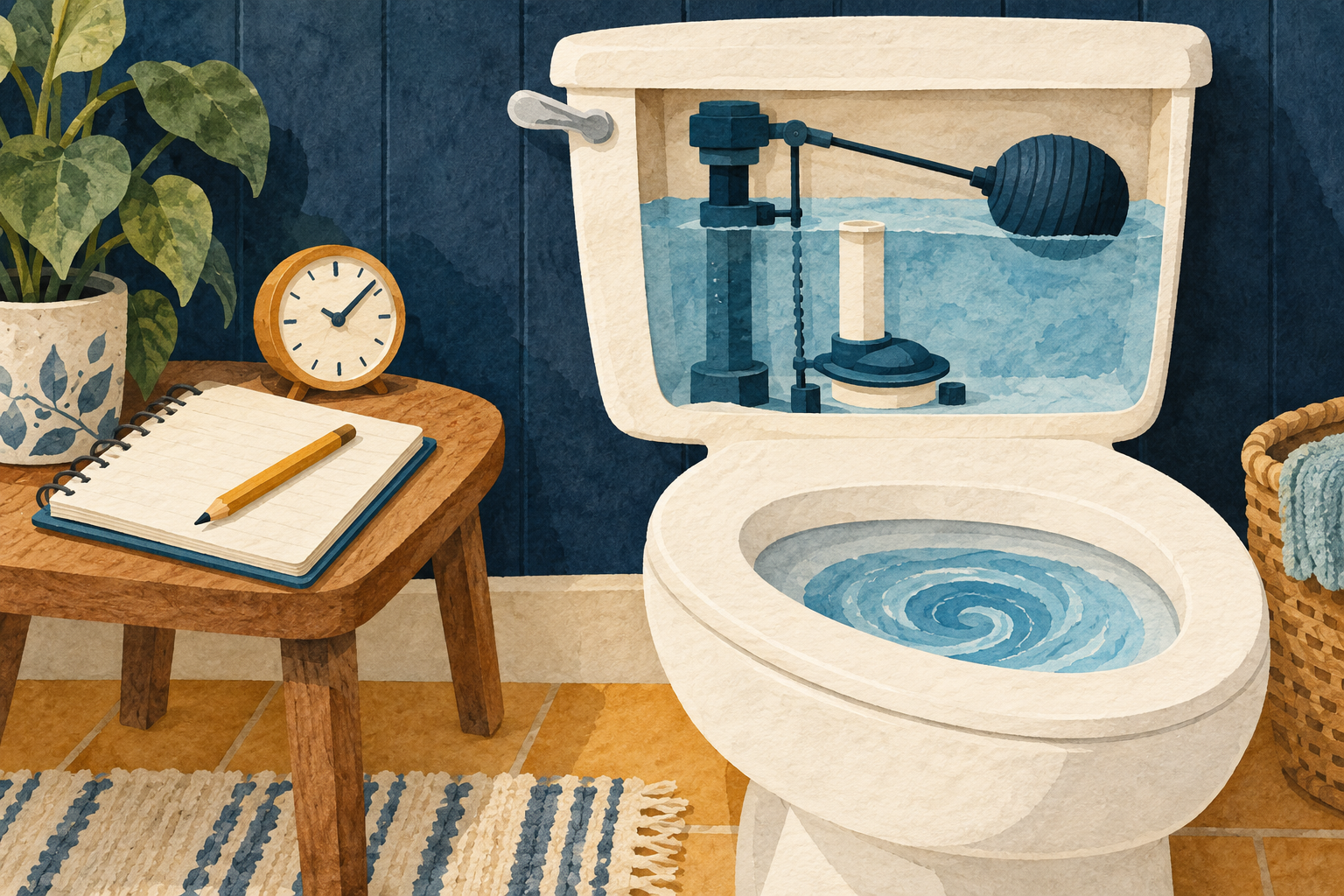
A toilet can lose tank water into the bowl without making the surrounding floor wet. EPA describes adding a few drops of food coloring to a conventional tank, waiting ten minutes without flushing and checking whether color reaches the bowl. It advises flushing afterward to avoid staining. Miami-Dade’s guide specifies twenty minutes. Follow the instructions appropriate to your fixture and local guidance rather than assuming the differing intervals are interchangeable requirements.
A positive color observation is about movement from the tank to the bowl during that test. It does not quantify the monthly volume or identify every part that might need attention. The Saving Water Partnership lists refilling between flushes, visible dribbling and a handle that must be jiggled among useful signs. Its toilet guidance also notes that worn flappers can seal inconsistently after different flushes.
Record which toilet you checked and what happened. In a home with several bathrooms, the phrase the toilet was tested is too vague for a repair visit. Use a simple location such as downstairs hall bathroom. If a lid is awkward to handle, the fixture is unfamiliar or access belongs to maintenance staff, ask for assistance. There is no benefit in breaking a lid to complete a low-cost observation.
Do not buy a replacement part solely because the symptom resembles a familiar online story. Retain the model information and use the manufacturer’s instructions or a qualified repairer to select and fit the correct component. After a repair, the follow-up should address the same symptom. A receipt proves that work occurred; a documented recheck helps establish whether the observed problem actually stopped.
Inspect accessible surfaces without turning clues into causes
A visual walk-through can be organized by location: bathroom, kitchen, laundry area, utility space and outdoor connections. Look at accessible surfaces and note water appearing where it is not expected. Keep the observation specific. A damp cabinet base, a drop at an exposed joint and a faucet dripping into a basin are three different findings even if they occur in the same room.
Start with what is visible without moving heavy appliances, opening walls or entering confined areas. An inspection that requires dismantling an unfamiliar system is no longer a simple household observation. If an accessible surface is wet, describe whether the water is new, recurring or present after a particular activity. Do not dry everything and lose the timing record before noting what happened, unless cleanup is needed for immediate safety.
A hypothetical kitchen illustrates the value of restraint. A cabinet is damp after dishwashing, but the meter stays quiet during a later no-use period. That combination does not prove the supply line is sound or the drain is broken. It suggests that the timing of ordinary activity matters. A maintenance professional can use that information to choose an inspection that reproduces the relevant conditions.
Keep unrelated observations separate. A dripping outdoor tap should not become the automatic explanation for a stained ceiling. Both may deserve attention, but the fact that one problem is easy to see does not establish a connection with the other. A location-based note helps preserve this distinction. It gives the repairer a list of observations to evaluate rather than a single theory into which every symptom has been forced.
Include outdoor use and automatic schedules
The phrase nobody used water can overlook equipment operating outside the home or while occupants sleep. Before interpreting a meter change, list any irrigation, pool-related equipment or other automatic water use you actually have. Do not add equipment merely because it appears in a generic checklist. The purpose is to describe this property, including what is known and what still needs clarification.
For irrigation, ask whether the schedule changed, who manages it and whether a recent maintenance visit altered settings. A household may know that watering occurs but not which nights or zones are involved. That uncertainty belongs in the record. A usage increase coinciding with a schedule change deserves investigation, but coincidence alone does not distinguish intended watering from a faulty component.
Make accessible observations during normal operation only if it is safe and permitted. Note unusual water accumulating, a connection leaking or an area staying wet after the scheduled event. Do not excavate a suspected buried line, change shared equipment or experiment with a controller you do not understand. Ask the person responsible for the system to review the observations and explain the next safe check.
In a hypothetical record, Monday’s meter increase might overlap a watering event while Tuesday’s quiet period does not. That helps explain why the two observations differ. It does not establish whether Monday’s use was appropriate. The next question is whether the event’s volume and operation match the property’s intended plan. Keeping schedule information beside meter information allows that comparison without treating every nighttime reading as a hidden household leak.
Treat isolation tests as a map question
Public utility guides sometimes describe closing a house shutoff and checking whether meter movement stops. The Saving Water Partnership and Miami-Dade both use this idea to help distinguish areas for investigation. Such a comparison depends on knowing what lies on each side of the valve. It also depends on the valve actually closing and on the layout being the one the guide assumes.
Do not operate utility-owned controls or an unidentified valve. If you are authorized to use a clearly identified household shutoff, follow the property’s instructions and consider whether shutting it affects equipment or other occupants. A valve that is seized, leaking or unfamiliar is a reason to involve a professional. For shared buildings, the property manager should coordinate any test affecting common supply.
Imagine a branch serving an outdoor fixture before the house valve. Closing the house valve would not isolate that branch. Continued meter movement could therefore have an explanation different from the broken buried line a reader initially suspects. A general illustration cannot establish where your branches run. Ask the plumber or utility what the proposed valve comparison would include and what it would leave outside the test.
Record the exact control used, who identified it and the readings observed. Avoid presenting the result as a precise location unless the system layout and test conditions justify that conclusion. The test can still be valuable when it narrows the possibilities rather than naming one damaged component. Its best use is often to direct a qualified person’s next inspection, especially when the alternative would be destructive searching based on a guess.
Turn an observed difference into a clearly labeled calculation
If the meter’s units and register are understood, a difference over a measured interval can be expressed as an average rate. In an invented example, a register increases by six gallons over two hours. Dividing six by two gives three gallons per hour during that interval. The calculation is straightforward; the interpretation depends on whether the period contained ordinary use and how precisely the register was read.
Multiplying three by twenty-four gives 72 gallons over a hypothetical day at the same constant rate. Multiplying again by thirty gives 2,160 gallons over thirty such days. Those are projections under an explicit assumption, not measurements of a month. If the flow starts and stops, the actual total may differ. Label projected figures so they cannot be mistaken later for volume the utility recorded.
Do not turn that projection into a dollar saving without the applicable tariff and billing rules. A fixed charge may remain unchanged, and water and sewer charges may be calculated differently. A household can ask the utility what an observed volume would mean on its account. The arithmetic should help frame that question rather than invent an answer that looks precise because it includes a currency symbol.
Retain enough detail for someone to challenge the estimate constructively. Write the two readings, elapsed time, unit and assumption of constant flow. If a digit was hard to read, say so. A modest calculation with visible uncertainty is easier to use than a dramatic monthly loss presented as fact. It can help prioritize investigation while leaving room for better measurements and the repairer’s explanation of what was happening.
Use interval data without treating every alert as a verdict
Some utilities provide more frequent readings than a monthly statement. San Antonio Water System’s November 1, 2025 article described hourly account data and a local alert criterion: at least five gallons per hour continuously for more than 48 hours. Those are details of that published SAWS program, not a universal leak threshold. The dated article is useful precisely because it makes the local criteria visible.
An alert is an invitation to investigate the pattern it describes. Ask your own utility what triggers its notices, what period the graph represents and whether recent data may be delayed or incomplete. Absence of an alert does not establish absence of a leak. A concern might fall outside the program’s threshold or timing, and a household may not have that monitoring service at all.
When a portal provides a graph, keep the date range, unit and interval beside any screenshot. A bar representing an hour differs from a bar representing a day. Look for changes that line up with known activity, then keep unexplained observations separate. Do not infer appliance identity from a pattern alone unless the system or a qualified analysis actually supports that identification.
For an invented household, a repeated overnight baseline may motivate a quiet-period check, while a single daytime spike may coincide with a known activity. Neither pattern is automatically a fault. The useful question is whether the timing is explained and whether additional observation could clarify what remains. A graph expands the record; it does not replace the need to understand the property, verify the measurement boundary and investigate the suspected source.
Prepare a useful conversation with the water utility
A first contact becomes easier when it has one clear request. If the concern is a reading discrepancy, ask for an explanation of the reading history. If the concern is unexplained continuous use, ask what data or approved meter checks are available. If the concern is responsibility for a visible leak near the meter, describe its location and ask who should inspect it. Avoid combining those into an accusation that the bill must be wrong.
Have the account information ready through the utility’s normal channel, along with the bill periods and any dated photographs. Explain what you checked, what you could not check and what automatic use was present. If a quiet test was interrupted, say so. The representative can use an imperfect but accurate record more effectively than an unqualified claim that every possible source has been eliminated.
Ask about the next step and its conditions. Does the utility offer a reread, a meter test, account data or an inspection? Is there a charge, and what determines it? What documentation is needed if a repair-related adjustment exists? Do not assume that a policy mentioned by another utility applies to your account. Request the applicable public guidance or a clear explanation from your own provider.
Write down the contact date, reference number if supplied and the action agreed. A conversation that ends with someone will look into it leaves uncertainty about timing and scope. A record saying the utility will review these dated readings, and the household should provide these photographs, is more useful. Follow-up can then refer to an agreed task rather than requiring the next representative to reconstruct the entire situation from memory.
Give a repair professional observations, not a predetermined answer
A plumber or maintenance technician benefits from the same disciplined record. Describe the symptom, its location, when it occurs and any meter findings. Include model information for the affected fixture if available. State whether the property has shared supply, outdoor branches or automatic equipment that may matter. The purpose is to help the professional choose a diagnostic approach, not to dictate a repair based on an internet illustration.
Ask what the proposed visit includes. Locating an unexplained source, repairing an identified fixture and replacing a component are different scopes of work. Clarify which is being offered and what happens if the first inspection does not find the cause. Before authorizing destructive investigation, ask what observations justify the proposed location and whether another diagnostic step would be appropriate.
This is especially valuable when one obvious problem has already been repaired but usage remains unexplained. Tell the professional what changed after that work. A positive toilet test followed by a quieter meter is different from a new part followed by the same unexplained register increase. Preserve both the repair history and the follow-up rather than discarding the original findings when the first theory changes.
For a tenant, coordinate access and authorization with the property manager. A useful maintenance report can include the bathroom location, dates of refilling sounds, photographs of accessible leakage and whether the issue is ongoing. Avoid sending unrelated household records. Share enough information to support the task, while keeping personal schedules and account details limited to people who actually need them. Clear observations make the handoff efficient without making the resident responsible for proving a technical diagnosis.
Verify the repair against the original symptom
When work is finished, return to the question that started the investigation. If the toilet was sending colored tank water into the bowl, an appropriate recheck should address that movement. If the concern was meter change during a controlled period, a comparable observation can help determine whether that change remains. If the symptom occurred only during an appliance cycle, a quiet meter alone does not answer the original question.
Keep the conditions comparable where practical. Record what was repaired, when the water service was restored and what ordinary use occurred before the follow-up. Do not compare a busy household interval with an earlier quiet one and attribute the difference entirely to the repair. The more closely the observation addresses the original symptom, the easier it is to interpret the result.
A later bill is useful, but it may include days before the repair and may use a different period length. Divide the reported volume by the billing days before drawing a conclusion about daily use, and note the repair date within that period. Do not declare the repair unsuccessful solely because the total remains high on a statement covering earlier consumption. Equally, do not use a lower bill as proof that every source has been resolved.
Retain the invoice and the follow-up record together. If the utility requests repair documentation, the invoice describes the work while the observation describes the outcome you can actually report. When an issue returns, the same record helps explain whether the symptom is identical or different. Verification is therefore more than a closing formality. It turns an intervention into a documented change and leaves a useful starting point for any further investigation.

Build a small record that remains usable
A household does not need a complicated monitoring project to retain useful evidence. One folder can hold the relevant bills, meter photographs, a short observation note, contact references and repair documents. Use filenames or captions containing dates and locations. The person opening the folder should be able to distinguish the downstairs toilet check from an outdoor observation without relying on the memory of whoever took the photographs.
A practical note answers five questions: what was observed, where, when, under which conditions and what happened next. For example, an invented entry might describe a meter comparison on a particular evening, note that irrigation was suspended by the responsible person, record an interruption and identify a planned utility contact. The interruption belongs in the entry because it affects the interpretation; it is not an embarrassment to edit away.
Keep original images when possible and make annotations on copies. If you circle a digit or crop a display for discussion, retain the wider image showing the unit and meter identity. Do not overwrite an uncertain reading with the number you later expect it to show. Mark the uncertainty and let another person review it. Records are most useful when they preserve the observation rather than improving its appearance.
Choose a review rhythm suited to the problem. An active unexplained change needs a next action, while a resolved fixture issue may simply need its documents retained for future reference. Avoid collecting endless data without a decision it could inform. A small, reliable record can help a household notice a recurring pattern, answer a utility’s question and explain previous work. Its value comes from clarity and continuity, not from the volume of screenshots accumulated.
The useful result is a better next decision
A household investigation may end with a confirmed fixture leak, a billing explanation, a professional visit or a clear statement that more evidence is needed. Those are different outcomes, and each can be useful. What matters is that the conclusion matches the record. A quiet test should be described as quiet during its stated interval. A repair should be described as completed and followed by the observations actually made.
Return to the distinction between price, volume and cause. A bill can motivate investigation without proving a leak. Meter movement can establish flow without identifying its destination. A fixture test can reveal one problem without explaining every gallon in a monthly statement. Understanding these relationships helps prevent a plausible first answer from becoming the only explanation the household is willing to consider.
The next step should follow the remaining uncertainty. A question about an estimated reading belongs with the utility. A recurring fixture symptom belongs with the responsible maintenance person. An unexplained meter change after accessible checks may require a professional assessment of the actual plumbing layout. If the property is shared, coordinate the inquiry with the people who manage it. The record supports those conversations; it cannot substitute for access or technical authority.
Start with the bill, identify the meter, plan an honest observation and keep the result in context. Then act on what the evidence supports. This approach does not require buying a device or claiming expertise in every pipe behind the wall. It requires careful dates, readable units and a willingness to distinguish a clue from a conclusion. That is what makes a household water check useful long after the first surprising bill has been put away.