


Joshua Tree’s October Night Sky Festival: Protecting the Darkness Beyond the Telescope
ONELROR • ENVIRONMENT
Joshua Tree's October Night Sky Festival: Protecting the Darkness Beyond the Telescope
The October 9–10 gathering offers a reason to look beyond the eyepiece: how purposeful lighting and thoughtful visits help care for a shared night landscape.
By OnelROR Editorial Team · October 4, 2026 · 26 min read
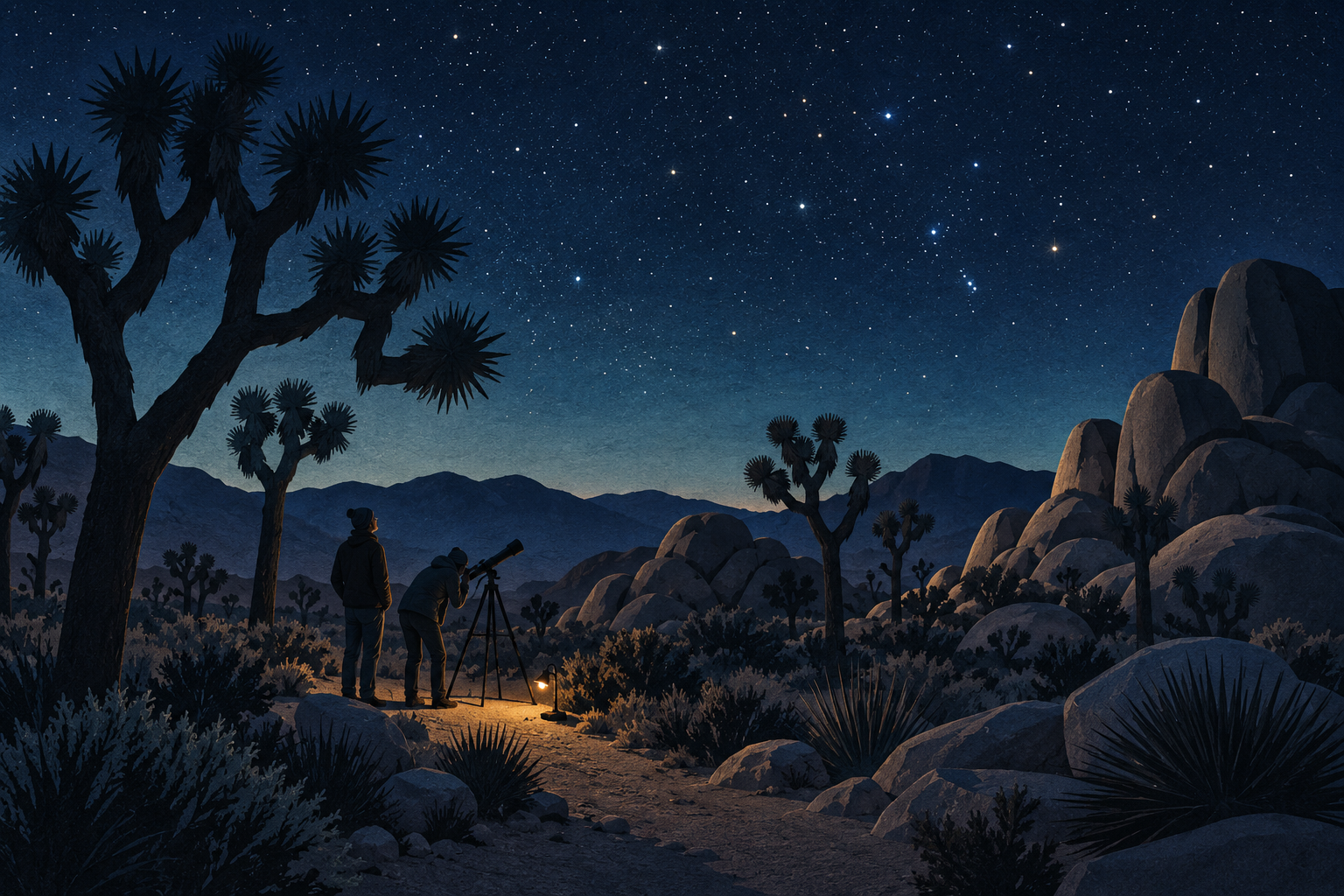
Featured image: original OnelROR editorial illustration, not an event photograph or a prediction of the visible sky.
Joshua Tree's 2026 Night Sky Festival is scheduled for October 9 and 10. The gathering offers a timely reason to examine the environmental resource behind every observing session: darkness. A useful night-sky trip combines realistic plans for the event with attention to the light visitors bring, the landscape they enter, and the lighting choices they make after returning home.
The National Park Service confirms the dates on its festival page, last updated August 18, 2026. The announcement concerns an upcoming event, not a completed gathering. This article was prepared on October 4, before the festival. It does not report attendance, observing results, weather outcomes, or statements from participants. Those distinctions matter when an appealing announcement circulates before an event actually happens.
The environmental question extends beyond whether a visitor can see a particular constellation. A night landscape includes ground, vegetation, buildings, moving vehicles, people, and sky. Light introduced in one part can change the experience elsewhere. A successful evening therefore involves both looking upward and paying attention to the effects of ordinary choices at eye level.
What is confirmed for the festival
The organizer, Sky's the Limit Observatory and Nature Center, describes the gathering as the eleventh annual festival, cohosted with the Joshua Tree National Park Association's Discover JTREE education program. Its published schedule places activities at venues in Twentynine Palms outside the national park. That is a useful distinction for anyone who assumes every event associated with a park happens inside its boundaries.
The announced program includes a Friday telescope clinic, Saturday daytime activities and lectures, and a Saturday evening star party at Sky's the Limit. The organizer lists the star party from 7 to 11 p.m. on October 10. Use the organizer's current event page for detailed locations, registration, admission arrangements, and any revisions rather than treating a summary as a ticket or reservation.
A practical itinerary should identify which activity matters most before arranging the rest of the day. Someone interested in learning how equipment works may value the clinic differently from a family seeking daytime activities. A person arriving only for evening observing should not assume they can also fit earlier programs into that arrival. Separate the desired experience from the list of everything offered.
Keep a record of the organizer's latest instructions shortly before departure, but recognize that a saved copy can become outdated. Recheck the live page if plans change. A calendar entry should include the actual venue and the relevant activity, not simply the words Joshua Tree. That small planning step reduces the chance of navigating to a park entrance when the intended destination is an outside venue.
A festival is an invitation, not a guarantee of a particular sky
An announced observing session cannot guarantee clear weather, an unobstructed horizon, or a specific view through a telescope. The distinction is useful even when organizers have extensive experience. A visitor can commit to attending a program without knowing the conditions that will exist at the moment of observation. Good expectations leave room for learning when the sky does not cooperate.
Plan around more than a photograph. A conversation about how a telescope is aimed, a demonstration of an eyepiece, or an explanation of why objects look different through different instruments can be valuable. An evening is less likely to feel unsuccessful if its purpose includes understanding the observing process rather than reproducing an image encountered online.
Avoid using an attractive illustrated sky as evidence of what will be visible on October 10. The featured artwork for this article is an original editorial illustration. It depicts a desert observing scene and shielded lighting as an explanatory image; it does not document the festival, a measured sky condition, or a predicted arrangement of celestial objects.
Before setting a viewing goal, ask the organizer what is appropriate for that particular session. Equipment access, staffing, queues, and the program may affect what visitors can do. An independent visit to the park is a separate activity with separate rules. Keep the two plans distinct so that a change to one does not silently create a new and unprepared outing in the other.
Darkness belongs to the whole landscape
The National Park Service treats natural night conditions as a resource, with ecological, cultural, and visitor value. Its night-sky resources material explains that protecting darkness is part of caring for a place rather than simply improving an astronomical photograph. A landscape can lose some of its night character even when the brightest stars remain visible overhead.
Consider a hypothetical viewpoint with a dark horizon, a quiet parking area, and a single very bright lamp beside the path. A visitor looking away from the lamp may still notice many stars. Another visitor facing it may struggle to perceive the nearby ground. The sky and the immediate surroundings are different parts of the experience, and improving one does not automatically improve the other.
This helps explain why conservation cannot be reduced to a single impressive number or a single wide-angle image. A photograph might omit the troublesome lamp. A measurement pointed directly overhead might miss glare along the path. A resident could experience light through a bedroom window even while an observer elsewhere reports a good sky. The question is always what condition is being described and where.
For a festival visitor, the implication is practical: notice the environment around the observing area as well as the objects in the eyepiece. Where do people walk? What lighting serves that movement? Which surfaces receive it? Where does it spill? These are useful questions to bring home because they concern familiar spaces, including porches, shared courtyards, small business entrances, and neighborhood sidewalks.
Separate skyglow, glare, and unwanted spill
The Park Service's light-pollution explanation describes skyglow as artificial light scattered through the atmosphere. Its lighting-source guidance also explains how upward and sideways emissions contribute to the problem. Skyglow can therefore involve more than a lamp located immediately beside an observing site. Local experience and a wider illuminated landscape are connected, although they are not identical.
Glare is a different problem: a conspicuously bright source can interfere with comfortable seeing. Unwanted spill concerns illumination reaching an area that was not the intended target. Imagine a porch light intended to show a step. If its source shines toward someone's eyes, that is a glare concern. If it illuminates a neighboring window, that is a spill concern. The same fixture can create both.
Naming the problem carefully makes an improvement easier to evaluate. If the issue is a glaring lamp, simply reducing its operating hours may leave the glare unchanged whenever it is on. If the issue is light reaching a neighbor, changing the color alone may leave the direction unchanged. A proposed fix should address the observed problem rather than rely on a general claim that a fixture is better.
A useful conversation begins with a description such as the entrance lamp is visible directly from this bench, or the beam extends across this boundary. That is more actionable than saying the entire property is too bright. Specific descriptions also make it easier to compare before and after conditions without treating everyone who uses lighting as an opponent of dark-sky protection.
Five principles provide a starting framework
DarkSky International and the Illuminating Engineering Society jointly developed five principles for responsible outdoor lighting: useful, targeted, low level, controlled, and warm colored. The online guidance, updated in September 2026, calls for a clear purpose, careful direction, no unnecessary brightness, appropriate operating controls, and limiting shorter-wavelength light. These are related considerations rather than interchangeable labels.
An original way to apply the framework is to write a one-sentence job description for each light. For example: this light helps a visitor identify the single step at the entrance during arrival. The description gives a target, an activity, and a relevant time. A much vaguer description, such as this light makes the property look bright, provides little basis for deciding whether its output is appropriate.
Next, compare the installed light with that job description. Does the beam reach the step, or does it mostly illuminate a wall? Does it remain on long after arrivals stop? Can someone use the entrance without facing the exposed source? The answers need not require a purchase. They may reveal an operating setting, an aiming problem, or a feature that deserves professional review.
The framework is not a substitute for applicable requirements or competent design. A shared public route, an emergency exit, or a workplace can involve responsibilities beyond an individual preference. Use the principles to structure questions for the responsible operator or designer. A well-defined question is more productive than changing a critical installation without understanding who uses it and what function it must perform.
Begin with purpose before shopping for hardware
For a household, a lighting review can begin on paper. Draw the entrance, steps, driveway, and paths that are actually used after dark. Mark where people need to perform a task. Do not begin by filling every blank space with a symbol for another fixture. An empty part of the drawing may represent an area where no routine illumination is needed.
Then distinguish frequent use from occasional use. A door used every evening has a different pattern from a side passage opened twice a month. The distinction does not establish a universal specification, but it raises a useful question: should both spaces operate under the same schedule? Without that question, a property can accumulate lighting based on convenience during installation rather than the pattern of everyday use.
Write down the uncertainty as well. Perhaps a visitor has difficulty finding the correct entrance, but no one has checked whether a clearer address sign or a better arrival message would help. Perhaps a path is confusing because objects block it. Lighting may be part of the solution, yet an observation about the actual difficulty should come before the assumption that additional brightness is the answer.
For a business, the same exercise can be discussed with staff rather than imposed from a desk. Ask which tasks occur at closing, where deliveries arrive, and who uses the rear entrance. Those details help separate a useful operational need from a decorative habit. The review becomes more credible when it recognizes the work people actually do and gives them a way to identify a problem.
Direction can matter as much as output
The Park Service explains that shielding can reduce direct upward and sideways light, while light reflected from the ground can still contribute to the sky. That distinction prevents a common misunderstanding: hiding the bulb from above does not make every amount of illumination harmless. The surface receiving the light remains part of the design question.
Imagine two entrance arrangements serving the same step. In one, an exposed source spreads illumination broadly across the yard. In another, a carefully directed source concentrates on the approach. The comparison is an illustrative design question, not a tested claim about a particular product. Ask which arrangement makes the intended task clearer while exposing fewer unrelated areas to direct light.
View the installation from the positions people actually occupy. A fixture can look acceptable when examined directly beneath it but feel very different from a neighboring window or a seated position. A standing adult's viewpoint also differs from that of a child or someone seated in a mobility device. Record those viewpoints before declaring that a change solved the problem for everyone.
Do not improvise a cover that traps heat, affects electrical safety, or changes a fixture beyond its instructions. The useful action may be asking the owner or qualified installer about an appropriate shield or a different installation. Responsible direction concerns the functioning light as a whole. It should not create a new maintenance or equipment problem in the process of reducing an old environmental one.
Schedules turn intention into an operating habit
A fixture's nightly behavior can differ from the purpose described when it was installed. A useful audit therefore asks when it turns on, when it turns off, and who can change that schedule. If no one knows the answer, the issue is partly operational. Even a carefully selected fixture needs a clear responsibility for its settings.
Take a hypothetical small shop that closes at nine. Staff still need to leave safely, and an occasional delivery may arrive later. Instead of assuming that every exterior lamp must follow the same overnight schedule, list those activities separately. The resulting discussion can identify which area remains necessary, which timing needs flexibility, and which decorative lighting has completed its job by closing.
For a home, make operating instructions understandable to guests. A control that only one resident knows how to use is likely to be overridden or left in an unintended state. A short note beside a switch can explain what it serves and how the setting works. Clarity is useful because a conservation goal must survive ordinary human behavior, including tired arrivals and visitors unfamiliar with the property.
Check a schedule after changes in occupancy or seasonal routines. A control that worked during one household's daily pattern may be inappropriate when someone begins returning later. Treat that as an adjustment to investigate, not proof that controls never work. A lighting plan should retain enough flexibility to support real use while avoiding an indefinite default simply because the default is easy to forget.
Color is one consideration, not a complete solution
Warm-colored lighting is part of the joint DarkSky and IES framework, but it should not become the only thing a buyer checks. A warmer lamp can still be aimed at a window or operate when no one needs it. The practical question is how color, direction, output, and timing work together for the intended task.
Avoid a discussion that jumps directly from a color description to a universal ecological claim. Wildlife responses depend on context and species. The Fish and Wildlife Service's bird-conscious lighting guidance supports limiting unnecessary illumination, including attention to timing, direction, and color. That does not establish that a particular warm-colored installation is harmless to every organism in every environment.
An understandable evaluation might ask four separate questions: what does the lamp illuminate, how much is necessary for the task, when does it operate, and what is its spectral or color characteristic? Keeping the questions separate prevents one attractive answer from concealing three unanswered ones. It also helps compare options when someone must explain the reasoning to a property owner or shared building committee.
If professional design is involved, ask for the explanation in terms of the intended use rather than marketing language alone. A product label cannot describe every possible installation height, aiming angle, neighboring surface, or operating schedule. Those are decisions about the place where the light will be used. The real result comes from the installation and operation, not merely the wording on a package.
Wildlife gives darkness another purpose
The U.S. Fish and Wildlife Service explains that artificial light can attract and disorient night-migrating birds, increasing the risk of collisions and wasting energy. Its guidance identifies spring and fall migration as particularly relevant periods for reducing unnecessary lighting. This is a reason to consider nighttime conditions beyond the human ability to see stars.
Do not convert that national guidance into an unverified prediction about a particular species at this festival. This article has not surveyed the venue, counted migrating birds, or assessed a local collision risk. The supported point is broader: lighting decisions can affect wildlife, and an observing event provides an opportunity to discuss that environmental relationship without claiming local results that have not been measured.
For a school discussion, ask students to distinguish an observation from an explanation. Seeing insects near a light is an observation. Identifying a population-wide effect requires additional evidence. Seeing a bird near a building does not by itself establish that light attracted it or that it will collide. Careful language keeps an environmental lesson scientifically useful instead of turning every nighttime sighting into proof of a predetermined story.
A practical question for any property operator is whether unnecessary illumination extends into vegetation or habitat around the occupied space. The next step is to identify what can be assessed responsibly and which expertise is needed. The presence of an ecological concern is a reason to investigate and improve decisions. It does not justify inventing a precise biological benefit for an unmeasured change.
Visitor lighting is part of the shared experience
Joshua Tree's stargazing guidance recommends red lights and avoiding bright white phone illumination, allowing time for eyes to adjust, and considering moon conditions. These are park recommendations for an observing visit. Festival participants should also follow the organizer's instructions at the venue, especially where staff need to coordinate movement around equipment and other people.
Before joining a group, learn how your own device behaves. A phone may illuminate when a notification arrives or when a map opens. A flashlight may begin on its brightest setting. Trying the controls in advance is easier than experimenting beside someone using an eyepiece. The point is courtesy and preparation; it does not require bringing a complicated collection of specialized accessories.
Ask before directing a light toward a telescope or another person's observing position. If you need help finding a route, tell a staff member what assistance is needed. Do not interpret a low-light environment as an instruction to move through an unfamiliar space without support. A shared event works best when people can communicate about both the observing conditions and the practical difficulty they are experiencing.
For a family, agree on a simple gathering point and a way to ask for help before the evening activity begins. That arrangement reduces the temptation to solve confusion by repeatedly sweeping a bright beam around the crowd. The environmental etiquette becomes part of a workable plan rather than a list of prohibitions that children or first-time visitors have no clear way to follow.
Plan the ground-level visit carefully
The park's stargazing page reminds visitors to bring water and food, expect evening temperature changes, avoid trampling vegetation, and watch uneven terrain. It identifies designated observing parking areas and distinguishes observing from camping. Consult the current park page for the exact location rules relevant to an independent visit. An event outside the park does not automatically give permission for a later activity inside it.
Choose a route and return plan before darkness rather than deciding after the festival ends. Someone tired after a long program may be less prepared for an unfamiliar stop than they were at the beginning of the day. Make the later stop optional. A plan that allows a straightforward return can be more useful than one that treats every attractive location as an obligation.
Keep supplies organized so that retrieving a layer or water does not require unpacking everything in a crowded space. Consider what can be prepared while there is still light. A simple arrangement of belongings can improve the evening experience without adding equipment. It also helps a group leave efficiently without scattering objects or illuminating the area repeatedly to search for a missing item.
Accessibility should be part of planning from the outset. Ask the organizer about the actual surfaces, seating, distances between activities, and assistance available. Do not infer those details from the event's name or a general photograph. A visitor can make a better decision when the practical questions are answered before travel, and organizers can respond more effectively when the requested information is specific.
Observing together requires patient communication
A public star party can place beginners beside experienced observers, each with different expectations. Some visitors may not know where to put their eye or whether touching a telescope is appropriate. A short instruction from the operator can prevent an awkward moment. Ask for that instruction instead of assuming that every instrument works like a camera or a pair of binoculars.
An organizer's explanation also helps visitors understand why a view may be brief or why a telescope needs adjustment. Patience is easier when the reason is clear. A queue is an opportunity to listen, but it is not evidence that a particular object will be offered to everyone. Keep the actual program separate from a personal wish list based on equipment seen at another event.
For a group leader, discuss turn-taking before arrival. A child may need extra explanation or assistance, and an adult may be uncertain too. The aim is not to rush people through an unfamiliar experience. It is to make room for learning while acknowledging that equipment and staff are shared. Helpful communication avoids turning curiosity into a competition over who knows the most astronomical vocabulary.
After a view, write down what the operator identified and what you actually noticed. Those may be different things. A brief note such as a bright point with a smaller point beside it can be more honest than borrowing a detailed description from an image online. Distinguishing identification from personal observation creates a better learning record and reduces the temptation to embellish an experience later.
A home lighting audit can stay small and concrete
The first home review need not involve an entire neighborhood or a large budget. Select one troublesome location and describe its current behavior. For example, an entrance light may illuminate a shared fence long after the entrance is no longer used. Record the time, viewing position, and intended purpose. A focused case is easier to discuss and reassess than a sweeping claim about all nearby lighting.
Use a simple before-and-after record: what was observed, what changed, and what remains unresolved. If an operating schedule changes, record the schedule. If an installer adjusts direction, record the resulting position. The record should describe a real change rather than declare success in advance. It can include an improvement in one viewpoint and a remaining issue in another.
A neighbor conversation should begin with the effect experienced and a request to examine it together. Someone may not realize that their lamp reaches a different property. Avoid photographing private interiors or making assumptions about the resident's motives. A description of the visible beam and the affected location provides a basis for solving the problem without turning an ordinary lighting question into a personal accusation.
Renters can document concerns and ask the responsible owner about permitted adjustments. Shared spaces may have rules about who can alter equipment. A useful request includes the location, the observed problem, and the task the light appears to serve. That allows the owner to consider an appropriate solution while preserving responsibilities for maintenance and other users of the building.
Measure the right thing for the question
An observation project begins by deciding what it wants to know. Is the question whether a lamp is visible from a path, whether light crosses a boundary, or whether the sky appears different at two locations? Those questions require different observations. Collecting a dramatic photograph does not necessarily answer any of them, especially if the camera changes its exposure automatically.
For a simple personal record, note location, time, cloud conditions, nearby lights, and the viewing direction. If photographs are used for comparison, keep the settings and framing as consistent as practical and document any changes. Even then, treat them as a limited record. An image is not a universal measurement of human vision, ecological effects, or every part of the sky.
The International Astronomical Union's astroEDU Globe at Night activity guide describes comparing a visible constellation with magnitude charts and recording cloud cover. It offers an example of a structured observing method rather than relying on an impression alone. Follow the current project's instructions if participating; this article does not assign a campaign date or claim that every constellation is suitable on every night.
A student can learn something valuable even from an inconclusive comparison. Different cloud cover, moon conditions, or viewing obstruction may prevent attributing a change to lighting. Record that limitation. The goal is to make the interpretation fit the observations. A result that says the conditions were not comparable is more useful than a confident environmental conclusion drawn from a comparison that cannot support it.
Avoid confusing different kinds of evidence
The Park Service discusses both satellite observations of lighting and reports of visible stars made by people. These methods describe different aspects of nighttime conditions. Treating them as interchangeable can produce misleading claims. A measurement from one method, period, and location should retain that context when it is used in an article, presentation, or community discussion.
For example, a reported change in an overhead observation does not automatically quantify the glare experienced beside a specific entrance. A photograph of a glowing horizon does not reveal the exact contribution of each individual property. Those observations can motivate further investigation, but they do not provide all the answers. The next question should be what additional information would distinguish the competing explanations.
Avoid presenting an old global statistic as a new local finding. State the period studied and what was measured if using a number. For this article, the practical recommendations do not depend on assigning a percentage change to Joshua Tree in 2026. No such local measurement has been established here. The verified event and the primary lighting guidance are sufficient to frame the decisions discussed.
This discipline also helps evaluate proposals. If someone promises a precise improvement from replacing fixtures, ask what baseline, method, and follow-up will be used. If the proposal concerns glare, the evaluation should consider the affected viewpoints. If it concerns energy use, it needs operating hours and relevant electrical information. Each claim deserves evidence appropriate to the thing being claimed.
Energy calculations should make their assumptions visible
A straightforward illustrative calculation can show why operating hours matter. Imagine a lamp drawing 20 watts and operating for ten hours each night. That hypothetical use equals 200 watt-hours, or 0.2 kilowatt-hours, per night. If it operates for five hours instead, the same assumed lamp uses 0.1 kilowatt-hours. These are arithmetic examples, not measurements of a festival or a particular household.
The example does not establish an actual bill saving because a real calculation also needs the applicable electricity price, equipment behavior, and relevant period. It does not establish a specific emissions reduction either. Those conclusions require additional information. Keeping the assumptions visible prevents a useful demonstration from becoming an unsupported promise about an individual property.
A fixture change may affect both power and hours. If a lower-power lamp is left on longer, the total result depends on both values. A homeowner comparing options should therefore record the proposed schedule as well as the rated power. The calculation becomes clearer when each variable is stated separately, especially if someone else must check or revise it later.
Environmental assessment still extends beyond electricity. A low-power source can be annoying if directed into a window. A temporary light can affect an observing session while using little total energy. An energy calculation answers an energy question. Pair it with an examination of direction, timing, and use so that efficiency does not become the only measure of a well-functioning night environment.
Make community proposals understandable and testable
A neighborhood or institution considering lighting improvements can start with a small demonstration area. Define the problem, identify the people who use the space, and agree on what success would look like. A proposal that says improve the entrance while reducing spill toward these windows is easier to evaluate than one that promises a better nighttime environment without specifying how anyone will judge it.
Invite feedback from users with different routines. Someone arriving late, a maintenance worker, a delivery driver, and a seated visitor may notice different issues. Their observations can reveal a problem that a daytime walkthrough misses. The process should make it possible to report difficulty without being treated as opposition to conservation. Useful lighting and environmental restraint both depend on understanding the task.
Document who will maintain the settings after the initial adjustment. A demonstration can fail to persist if a control is reset and no one remembers why. Store the purpose, schedule, contact person, and review date in a place the responsible operator can access. This is ordinary maintenance information, but it connects an environmental intention with day-to-day operation.
Do not treat attendance at a festival as proof that a community has changed its lighting. An educational gathering can introduce ideas and build interest. Evidence of implementation would require actual changes and follow-up. The distinction keeps public communication honest: a successful conversation is a useful first step, while a verified improvement is a separate achievement that deserves its own record.
Give the evening a clear ending
An observing plan also needs an ending that people can follow. Decide who is responsible for collecting belongings, how the group will meet if members finish at different times, and what information is needed for the return journey. These are practical arrangements for the visitors themselves, not instructions from the festival. Confirm the venue's departure procedures with the organizer if they are unclear.
Before leaving an observing position, check the immediate area for items that were set down during the session. Ask for help if locating something would otherwise require disturbing people still observing. A deliberate departure can reduce repeated searching and confusion. It also prevents the group's attention from shifting abruptly from careful participation to a hurried effort to find missing keys or equipment.
Once home, review notes while the distinction between explanation and observation is still clear. Record any question that could not be answered at the event, and identify the appropriate source for a follow-up. If discussing the trip publicly, avoid attributing comments to a person unless the wording and context are accurate. A thoughtful account can describe what was learned without implying an interview, a measured result, or a scientific conclusion that the evening did not establish.
Leave with a useful next question
The Joshua Tree festival offers a near-term occasion to think about darkness as something people share. The October 9 and 10 dates are confirmed, but the value of attending need not end with an evening's viewing. A visitor can leave with a better understanding of an instrument, a more careful observing habit, or a specific question about lighting in a familiar place.
Choose one next question that can be answered. Does the porch lamp serve an occupied route all night? Can the entrance be made easier to identify without illuminating a neighboring area? Who controls the timing at a shared building? What observation would help distinguish glare from a change in sky conditions? A precise question creates a manageable next step and a way to recognize what remains unknown.
For the visit itself, use the current organizer page for the program and the current Park Service pages for independent park activities. Keep the venue distinction clear, check conditions, and prepare belongings and device settings in advance. Participate patiently, ask for assistance when needed, and distinguish what was explained from what you personally observed. Those habits support an evening that is both enjoyable and accurately remembered.
Protecting a night landscape is a continuing practice of making purposeful choices. The framework is understandable: define the task, examine the place, consider direction and timing, and check the result. The festival makes that practice visible through a shared interest in the sky. The longer opportunity is to bring the same attention to the spaces people illuminate every ordinary night.
Sources and editorial note
Sources checked October 4, 2026: NPS festival dates, Organizer program, Joshua Tree observing guidance, Lighting principles, NPS light pollution, NPS lighting sources, NPS night resources, Bird-conscious lighting, IAU observing activity. The festival is forthcoming; programs and conditions may change. Examples and planning exercises are original editorial analysis, not observations of the venue or claims of measured environmental outcomes.