


Margaret Hamilton Dies at 90: A Software Engineering Pioneer Remembered

NEWS | PEOPLE & COMPUTING
Margaret Hamilton Dies at 90: A Software Engineering Pioneer Remembered
MIT's October 7 remembrance and subsequent reporting look back at the computer scientist who led Apollo flight-software work, championed reliability and helped software earn recognition as engineering.
By OnelROR Editorial Team · October 12, 2026 · Miami · 4 min read
Cover illustration — OnelROR Editorial Team. Original chronology diagram; not a photograph of Margaret Hamilton or a reconstruction of an event.
The death and the reports have different dates
Margaret Hamilton, the computer scientist who led Apollo flight-software work at MIT's Instrumentation Laboratory, died on September 30 at the age of 90. MIT published its institutional remembrance on October 7, 2026; Smithsonian Magazine followed with an independently reported account on October 8. Those publication dates should not be confused with the date of her death.
The new accounts revisit a career that helped establish software engineering as a serious discipline. Hamilton's contribution included leadership, the design of reliable systems and the effort to give software work its due place alongside hardware. Remembering that breadth is more useful than reducing her career to a single photograph or saying that one person wrote an entire space program.
A career that reached Apollo through earlier computing work
MIT's account describes Hamilton's early programming work in weather prediction with Edward Lorenz and her later role on the SAGE air-defense project at Lincoln Laboratory. She joined the Apollo software effort at the Instrumentation Laboratory in 1965. These were different projects, but they place her lunar-program work within a longer career in computing rather than at an isolated moment of inspiration.
She went on to lead work on onboard flight software for crewed Apollo missions. The historical distinction matters: software was part of a larger guidance-and-control system, developed by teams with different responsibilities. Recognizing her leadership does not require erasing the engineers, programmers, mission-support staff and astronauts whose work also shaped the missions. The current MIT remembrance identifies both her individual contribution and that collective setting.
Reliability was part of the design
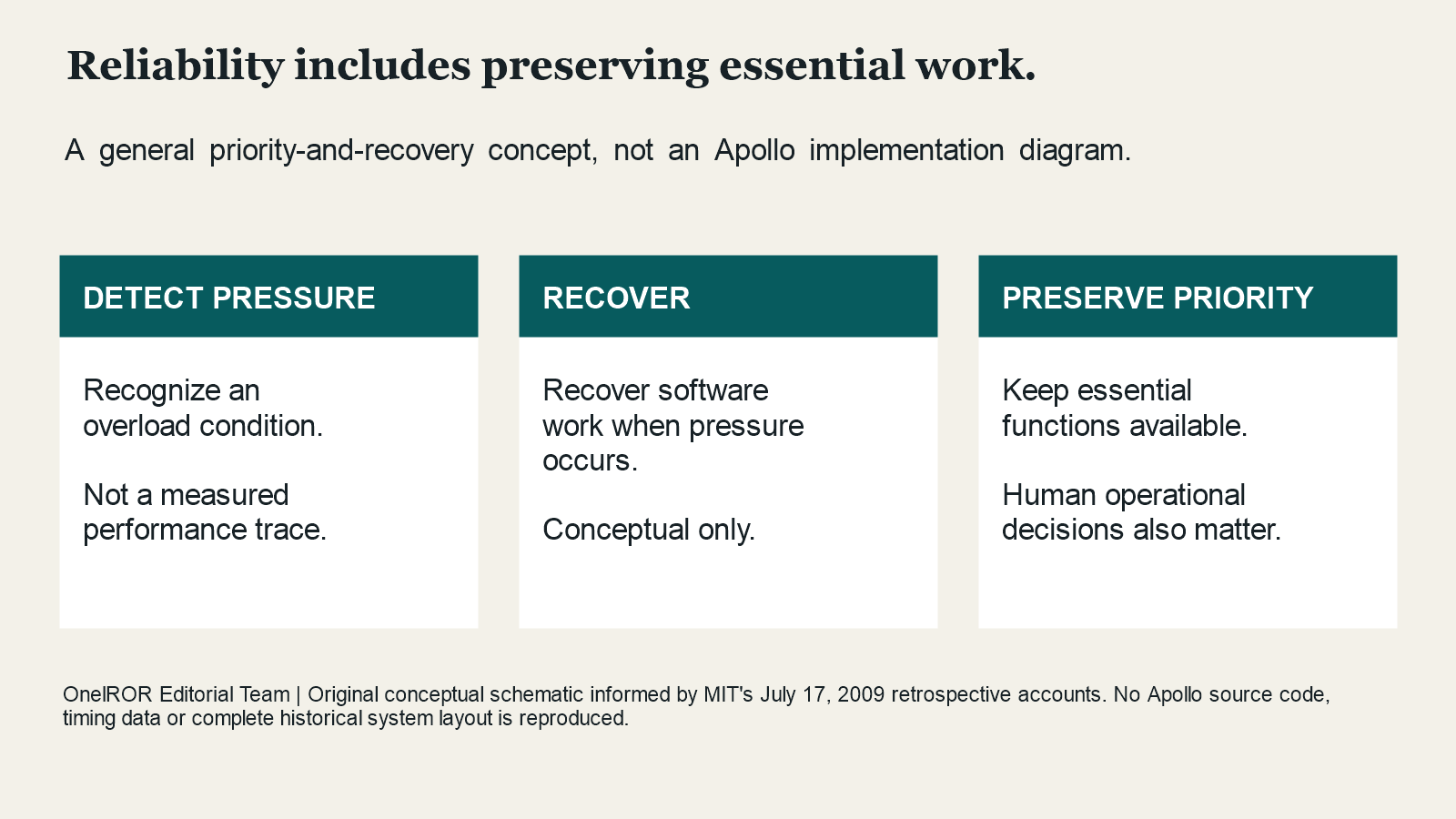
A primary account published by MIT in July 2009 preserves Hamilton's own recollection of the Apollo 11 landing. She described the computer's approach to overload and the software's recovery mechanisms, which allowed the highest-priority functions to continue. Her account also records the decision to proceed with landing. Software behavior and human operational decisions belong together in that history.
The same collection includes recollections from other participants, giving readers a way to understand the event beyond a single heroic retelling. Its accounts describe alarms, recovery and the effort to keep essential calculations going. They are retrospective testimony, published forty years after the landing, rather than a new experiment or a claim that this article has reproduced the Apollo computer's behavior.
The general engineering idea is understandable without recreating that computer: a system under pressure needs a way to preserve the work that matters most. The illustration below explains that priority concept. It is deliberately a conceptual schematic, not an Apollo program listing, a measured performance trace or a diagram of the historical computer's complete implementation.
Recognition beyond the lunar program
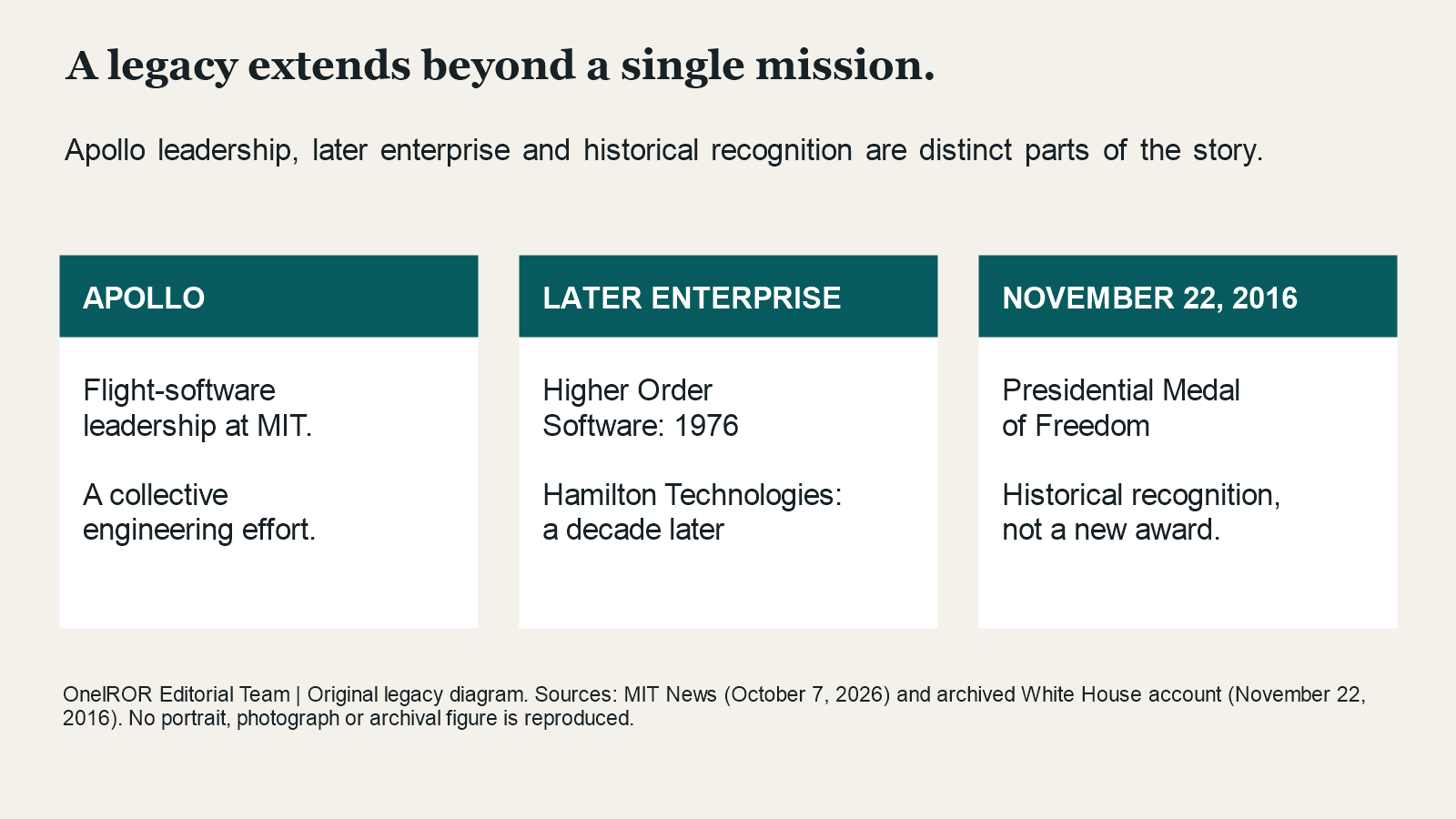
Hamilton's career continued after Apollo. The MIT remembrance records that she founded Higher Order Software in 1976 and Hamilton Technologies a decade later. The current Smithsonian report also places entrepreneurship and problem-solving within her legacy. Her later work belongs in the story alongside the lunar missions, rather than being treated as a footnote to a famous early achievement.
On November 22, 2016, President Barack Obama presented Hamilton with the Presidential Medal of Freedom. The archived White House account identifies her among the science and technology recipients and credits her software-engineering work. This is historical recognition, not a newly announced award: the frozen archive's publication date and the 2026 remembrance describe different events.
How the new reporting broadens the remembrance
Smithsonian Magazine's October 8 report includes an assessment from a computing curator at the National Air and Space Museum, connecting her influence with software practices beyond Apollo. That adds a museum perspective to MIT's institutional account. It helps explain why her death is news for the history of computing as well as for people who follow space exploration.
A careful remembrance can hold several ideas together: an individual can lead important work; a mission can depend on many people; and technical achievement can include anticipating failure, not just delivering a visible success. The dated accounts provide ways to explore each of those ideas without needing to invent a new benchmark, an undisclosed technical result or a quotation that the sources do not contain.
Hamilton's death closes an extraordinary life, while the record of her work remains available to study. Read the October reporting for the news, the older first-person accounts for historical perspective, and the award archive for its own documented event. Together they show a pioneer whose legacy includes the teams she led and the engineering discipline she helped advance.