




NASA’s Roman Telescope Has Left Earth. Its Real Work Is Still Ahead.
Space • The next view of the universe
Roman has left Earth.
Its real work is still ahead.
NASA’s newest space observatory promises a wider view of the cosmos. Understanding what it can discover starts with understanding what it is still preparing to do.
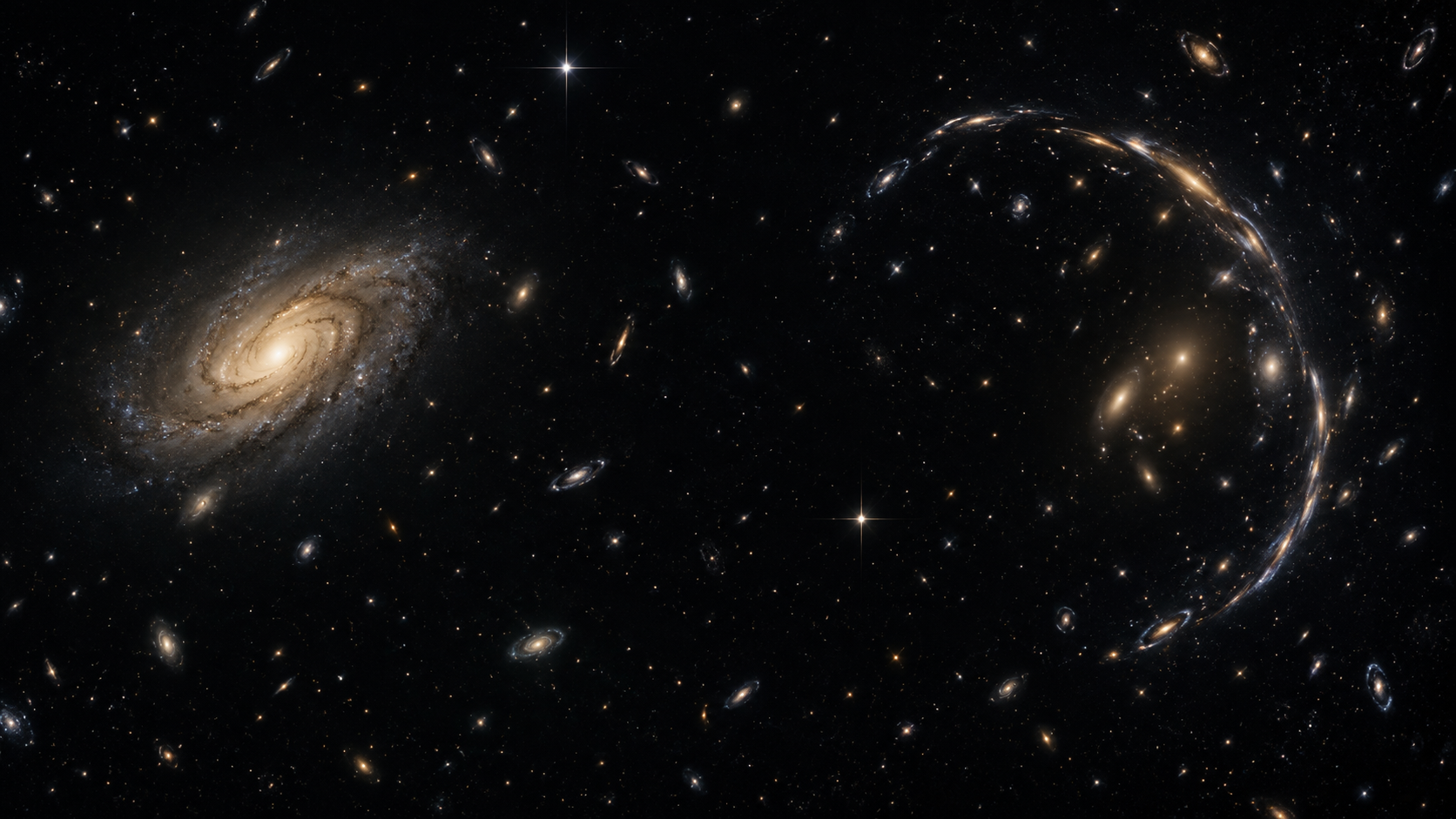
The unseen universe · Original AI-generated conceptual illustration for OnelROR. Not a Roman telescope photograph or scientific dataset.
A rocket launch is a moment. A scientific mission is a much longer argument with the unknown. NASA’s Nancy Grace Roman Space Telescope has begun that second story: the careful work of turning a spacecraft into a dependable observatory.
Roman launched on August 30. On September 1, NASA reported that its planet-imaging instrument had powered on successfully. Those are consequential milestones. They are also the beginning of a commissioning process, with testing and calibration still ahead.
The distinction matters for anyone waiting for spectacular new pictures. NASA anticipates releasing Roman’s first images by early 2027. Until then, its most important progress may be measured in instruments behaving as expected, rather than in discoveries ready to transform astronomy.
A wider view changes the questions
Much of astronomy’s public appeal comes from looking closely at something extraordinary: a nebula, a distant galaxy, a planet. Roman’s opportunity is also about scale. NASA describes its field of view as at least 100 times Hubble’s.
That comparison concerns how much sky it can capture at once. It should not be read as a promise that every image will have 100 times more detail. A wider field is valuable because researchers need large, consistent samples to study patterns that no single beautiful object can reveal.
Think of the difference between a portrait and a census. Both can teach us something, but they answer different questions. Roman’s broad surveys are intended to help astronomers move from individual objects to the behavior of large populations across space and time.
The mystery behind cosmic acceleration
The universe is expanding, and that expansion is accelerating. Dark energy is the name given to the still-unexplained cause of that acceleration. Naming it has not settled what it is.
Roman will approach the problem through several kinds of measurement. Supernovae can help establish distances. Patterns in the distribution of galaxies provide another way to track cosmic expansion. The subtle bending of light around matter helps reveal how structure has grown.
These methods matter together. If different measurements point toward the same account of the universe’s history, confidence grows. If they disagree, researchers must investigate whether the tension comes from measurement problems, assumptions or something missing from the explanation.
Roman is therefore better understood as a way to test competing ideas than as a machine with a guaranteed answer waiting inside it. A more demanding test of a theory can be a major scientific result even when it does not produce a simple headline.
Two very different ways to find planets
Roman’s exoplanet work combines approaches that are easy to confuse. One looks for a planet’s effect on light from a more distant star. Another tries to isolate light reflected by the planet itself.
The first approach, gravitational microlensing, relies on a temporary alignment. When one star passes in front of another from our viewpoint, gravity can magnify the background star’s light. A planet around the foreground star can add a smaller signal to that brightening.
This method can help build a statistical picture of planets, including worlds that are difficult to find through other techniques. It does not produce a conventional photograph of each planet. Researchers infer a planet’s presence from a changing signal and the models that explain it.
The coronagraph takes a different route. It uses masks and precisely controlled mirrors to suppress a star’s overwhelming glare, giving much fainter reflected light from nearby planets a chance to emerge.
Its role is a technology demonstration. The target is progress toward directly imaging worlds such as Jupiter-sized planets around Sun-like stars, and toward techniques that future missions could extend. It is not a promise that Roman will photograph another Earth or establish that life exists there.
Why switching on is only a first step
Powering on the coronagraph established an early operational milestone. NASA says months of calibration and testing precede full operations, and plans to spread its demonstration observations across the first 18 months of operations.
For readers, the useful question after each update is specific: what capability has actually been demonstrated? An instrument turning on, an instrument producing a calibrated observation and scientists validating a finding are different stages. Treating them separately makes the mission more understandable.
- Launch. Roman begins its journey from Earth.
- Instrument milestone. NASA reports that the coronagraph has powered on.
- Commissioning. Teams test and calibrate the observatory and its instruments.
- First images anticipated. NASA’s stated expectation, subject to mission progress.
The discovery may be in the pattern
The first released images will be an occasion to look. The deeper value of Roman may come later, when many observations can be compared, checked and interpreted together.
That is a less immediate story than a launch, but a richer one. Roman’s success will depend on how convincingly it helps answer questions about cosmic expansion and planetary populations—and on whether those answers survive careful scrutiny.