


NIST’s New OT Security Draft: What Zero Trust Can—and Can’t—Change in Industrial Systems

OnelROR • Technology
NIST’s new draft gives operational technology security a sharper place for zero trust. The hard part is translating an access principle into safeguards that protect a real process, people, and continuity.
By OnelROR Editorial Team · October 9, 2026 · 26 min read
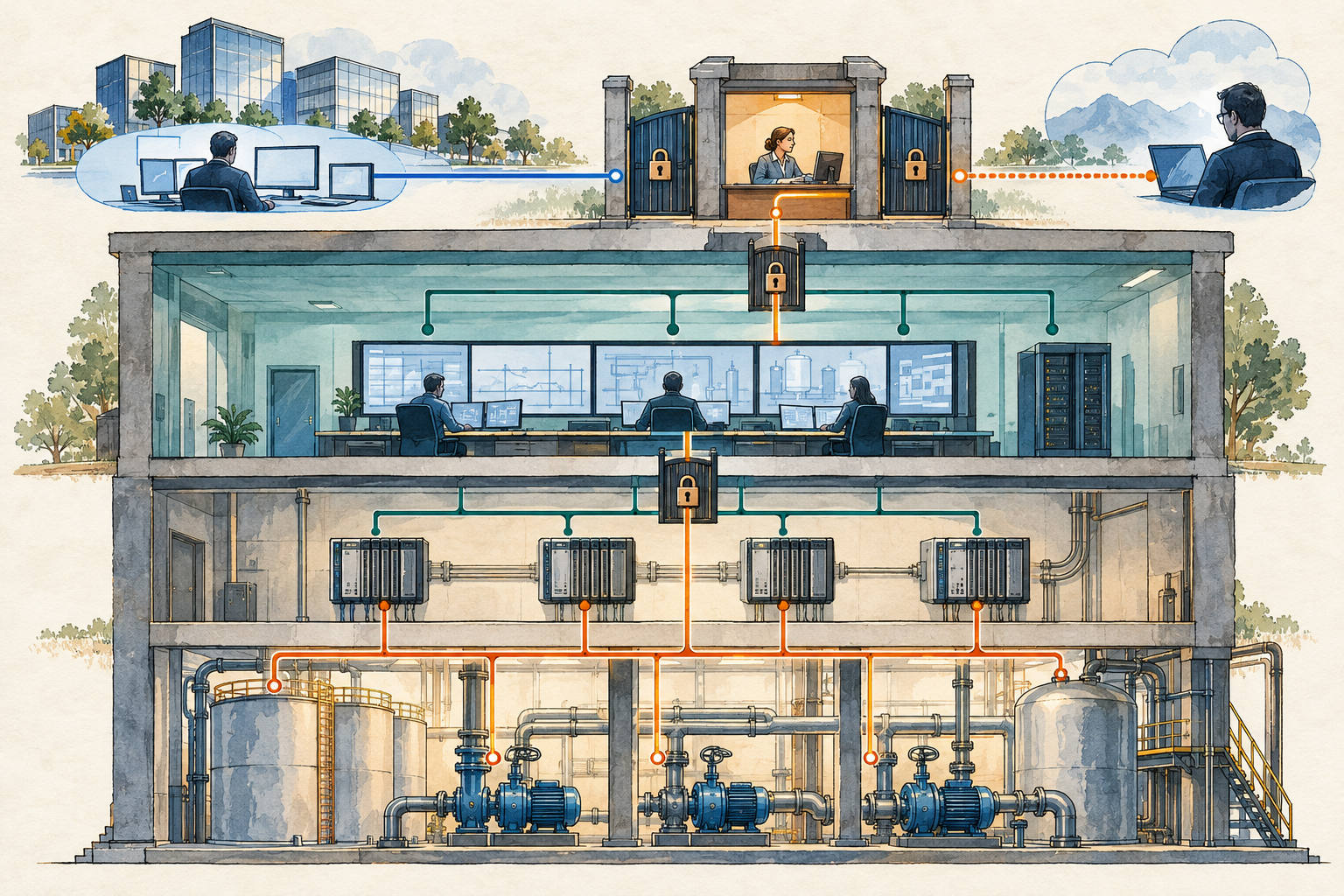
Illustration: A conceptual water-treatment control room links human oversight to the physical process; it is not a photograph of an actual facility.
A new draft, an old operational question
On September 21, 2026, the National Institute of Standards and Technology (NIST) published an initial public draft of the fourth revision of its Guide to Operational Technology (OT) Security, SP 800-82. The revision is open for comments through November 30. Its announcement puts several changes in view: more OT sectors, closer alignment with the Cybersecurity Framework (CSF) 2.0, expanded guidance on asset management and monitoring, and architecture guidance that includes zero-trust principles. Those details make the draft timely, but they do not make it a final standard or a deployment recipe.
On October 8, the National Security Agency released a separate Cybersecurity Information Sheet on applying zero-trust principles to critical operational technology environments. The NSA says the sheet is aimed primarily at National Security Systems, the Department of War, and the Defense Industrial Base, while also being relevant to technical leaders and IT and OT managers. Read together, the two announcements point to a practical problem: organizations want to reduce unjustified access, yet their systems move water, power, materials, vehicles, air, heat, or safety signals. A control that improves a network diagram but makes a physical process less safe is not a successful control.
This article explains the shift without treating «zero trust» as a product category or a magic switch. It draws a line between the general access principles in NIST’s completed SP 800-207 and the OT-specific context in SP 800-82 and CISA guidance. It also separates what is already published from what is still draft. The useful question is not whether a utility, factory, port, or building can announce a zero-trust program. It is whether the organization can show, for each consequential action, who or what may request it, under which conditions, through which controlled path, and how the operation remains safe if the path fails.
What counts as operational technology
NIST describes OT as programmable systems and devices that interact with the physical environment, or manage devices that do. They monitor or control equipment, processes, and events. Industrial control systems are one familiar example, but OT also includes building automation, transportation, physical-access control, and environmental measurement. The Rev. 4 draft broadens its sector discussion to water and wastewater, food and agriculture, freight rail, maritime vessels, building automation and control systems, industrial internet-of-things deployments, and cloud convergence.
That breadth matters because «industrial control system» can sound like a specialized computer network, while the system’s job is to influence a physical condition. A sensor may report a tank level. A controller may coordinate a pump. A supervisory interface may allow an operator to view alarms or change a set point. A building system may regulate temperature and ventilation. A rail system may monitor signaling equipment. The digital action is part of a chain that ends in a real-world condition, so protecting the chain requires understanding both the cyber asset and the process it supports.
NIST’s final SP 800-82 Revision 3 already emphasizes OT’s distinct performance, reliability, and safety requirements. It explains why the same security control can have different consequences in a plant than in a typical office environment. A software update that is routine for an employee laptop might require a tested maintenance window for a controller. A new authentication step might be harmless for a reporting dashboard but disruptive for an emergency workflow if it is badly placed. A network scan can be useful in IT yet require additional planning around fragile, old, or time-sensitive devices in OT.
«OT is different» should not become an excuse to leave systems unprotected. It means that the risks, operating modes, dependencies, and fallback behavior need to be understood before controls are changed. OT teams have to protect confidentiality and integrity, but they also have to preserve availability, timing, equipment constraints, and safety functions. A credible security plan should make those trade-offs explicit, document who can accept them, and test whether the safeguards behave correctly under normal conditions as well as during a fault or incident.
Zero trust is a way to make access decisions
NIST SP 800-207 defines zero trust around a simple correction to an old assumption: a user, device, or application should not receive implicit trust solely because it sits on a familiar network or is owned by the organization. Access should be granted to a resource for a justified purpose, with authentication and authorization considered for both the requesting subject and device. The architecture uses policies and enforcement points to narrow access and limit unnecessary movement between resources. It is a set of concepts and design principles, not one appliance or software package.
That principle does not mean «trust nothing and stop everything.» It means making trust conditional and specific. A maintenance engineer may be allowed to view a read-only dashboard without permission to change a controller. A remote contractor may receive time-limited access to a particular system during an approved window, while a supervisor retains authority to approve a consequential change. A service account may be allowed to collect telemetry but not to issue commands. Those distinctions are examples of how an organization can move from broad network membership toward narrower, evidence-based permissions.
It also does not mean removing all firewalls, network segmentation, local procedures, or perimeter defenses. NIST describes zero trust as a journey that can coexist with perimeter-based controls during a transition. Network location still matters for designing protection and limiting blast radius; the mistake is treating location as proof that every request inside the boundary is safe. A well-segmented network, a secure remote-access path, identity controls, operational monitoring, and an incident plan can reinforce one another.
In OT, the question becomes more exacting: where can a decision point be placed without breaking a control loop, interfering with an operator’s situational awareness, or turning a recovery measure into a single point of failure? A policy engine cannot evaluate an action that it cannot see. An enforcement gateway cannot safely inspect every protocol if doing so introduces delay or incompatibility. A strict authentication flow cannot help if an operator has no safe fallback during a loss of service. Zero trust is useful when it makes a process’s trust assumptions visible and reduces access that is not needed; it is risky when the slogan is allowed to substitute for engineering.
Start with the process, then draw the network
The first planning artifact should not be a vendor diagram. It should be a clear account of the operational mission: what the system does, which physical process it influences, which outcomes matter, what constitutes a safe state, and what staff must be able to do in an emergency. A water operator, for example, needs to understand how monitoring, chemical treatment, pumping, storage, and distribution depend on one another. A manufacturer may need to distinguish equipment that can pause safely from equipment where interruption risks damage, waste, or injury.
From there, operators and engineers can map the system’s assets, communication paths, people, service providers, and dependencies. Include field equipment, controllers, engineering workstations, supervisory interfaces, historian systems, remote access tools, safety systems, and connections to business IT or cloud services when they are in scope. Record the function and owner of each component, the protocols and expected communication partners, the software or firmware where known, and the consequences of losing or changing it. The goal is not to publish an attack map. It is to give authorized defenders a reliable picture of what they are responsible for protecting.
CISA’s guidance on creating and maintaining a definitive view of OT architecture and its asset-inventory guidance for owners and operators reinforce this inventory-first approach. An inventory is not a one-time spreadsheet exercise. It should change with approved projects, replacement work, contractor access, new sensors, wireless links, and cloud services. Owners need a way to compare the documented design with observed reality and to identify devices or pathways that have appeared without a clear business or operational purpose.
Inventory quality can be measured through practical questions. Can the plant team identify the responsible owner for a critical device? Can they explain which system communicates with it and why? Do they know whether a device is actively used, a spare, an unsupported legacy component, or a safety-related asset? Can they find its backup and tested recovery procedure? If these facts are missing, the best first project may be discovery and documentation, not a new policy engine. A small, accurate map can support safer decisions than a sophisticated architecture built on assumptions.
Protect the management functions that can change the process
The Rev. 4 draft specifically calls out security architecture guidance focused on protecting system-management functions. That focus is important because some of the most consequential actions in OT are not ordinary operator commands. They include configuring a controller, changing an application or logic file, updating firmware, changing network settings, creating or disabling an account, modifying an alarm threshold, restoring a backup, or altering the system that distributes time or certificates. A compromised management path can affect many devices even when the attacker’s first foothold is small.
For each management function, identify the legitimate workflow: who requests the change, who reviews it, who performs it, what record proves it happened, and how the organization determines whether the result is acceptable. Separate the ability to observe from the ability to modify where the process allows. Use individual accounts for human activity when feasible, avoid shared credentials that erase accountability, and limit machine identities to the purpose they serve. If a vendor or contractor requires access, define the system, duration, permitted actions, owner, approval, and method for closing the session.
Not every legacy controller can support modern identity protocols or an endpoint agent. A compensating design may place policy and access enforcement around the device, protect the engineering workstation used to manage it, limit the network paths reaching it, and require an approved change record. In that case, the organization should record the device’s limitations, the compensating safeguards, and the conditions that would trigger redesign or replacement. «Zero trust» cannot make old equipment speak new protocols, and a retrofit can create a dangerous failure mode if it is installed without testing.
Management access should be treated as an operational dependency in its own right. If the network-based control plane becomes unavailable, can the authorized team still operate safely? If emergency maintenance is needed, what trusted fallback exists? Can a change be rolled back? Are configuration files preserved in a form that can be restored? These are design questions, not exceptions to security. A secure architecture gives the organization a controlled route to manage equipment and a safe plan for the day that route is down.
Remote access deserves a specific trust boundary
Remote work can help operators diagnose faults, maintain equipment, and reach specialists who are not always on site. It can also extend a pathway from a business network, vendor environment, or external internet connection toward a system that influences a physical process. That makes remote access a boundary to design carefully rather than a feature to turn on broadly. Start by documenting which remote workflows are essential, who needs them, what tasks they perform, and what local alternatives exist when the connection is unavailable.
CISA’s guidance for adapting zero-trust principles to OT addresses the distinctive challenges of transitioning these environments. Its secure-connectivity principles give OT owners and operators a framework for designing and managing connections into their environments. NIST SP 1800-45 offers example secure remote-access architectures for water and wastewater utilities of different capacities. These sources do not imply that one architecture fits every organization. They illustrate why remote connectivity should be bounded, visible, and shaped around the specific operational use case.
At a high level, a stronger remote-access design uses a controlled entry point, requires a verified identity and a managed device where feasible, limits privileges and destination, records activity, and closes access when the approved work is done. A remote session should not turn an entire corporate network, vendor laptop, or home computer into a trusted extension of the control environment. Access for one maintenance task should not automatically grant the ability to browse every network or write to every controller. Where the technology cannot enforce such fine-grained limits, layered network and procedural controls can reduce exposure while the organization plans improvements.
Remote access also needs a deliberate emergency policy. A process may require rapid response outside ordinary working hours. Staff should know how to verify a request, contact the right person, approve access, and revoke it without relying on an informal message or a permanent account. A process owner should define when local manual operation is safer than remote intervention. If a connection drops mid-task, the operator needs a tested understanding of the equipment’s state and the recovery sequence. Convenience is valuable only when it does not obscure who is acting or what the process will do next.
Identity includes devices, services, and people
People are only one class of actor in an OT environment. A controller may communicate with a historian. A sensor may send readings through a gateway. A service may retrieve data or deliver updates. A scheduled job may move information to a business application. Zero-trust planning therefore needs to account for human identities and non-person entities: the devices, applications, services, and workflows that request or provide access. NIST SP 800-207 describes identity, credentials, access management, operations, endpoints, hosting environments, and interconnecting infrastructure as related elements of an architecture.
For each identity, ask what it is allowed to do, where it can act, how it is authenticated, how its credentials are protected, who owns it, and how it is disabled or rotated when the system changes. A service account that has outlived its original application is a real governance problem even if nobody remembers creating it. A vendor’s named engineer account is easier to review and attribute than a shared password distributed to a team. A device certificate or key may improve verification only if the organization can issue, protect, renew, and revoke it without disrupting operations.
Privilege should follow the work. Read-only access to an operational dashboard is different from the ability to acknowledge an alarm, change a set point, load logic, or alter a safety function. Separation of duties can prevent a single person from requesting and approving a high-consequence change, but it must be designed around the workforce and emergency context rather than copied mechanically from office IT. Some sites have small teams with on-call responsibilities. Their policy can still define accountability, after-the-fact review, and timely removal of elevated access.
Authentication is not a substitute for authorization, and a verified person does not automatically make a safe change. The system should connect identity evidence to a specific resource, task, and operating condition. A staff member’s account may be valid while the particular action is not approved, safe, or timely. A device may be managed but out of its maintenance window. A workflow may be authorized but require a second person because it affects a high-consequence process. The point is to make those distinctions visible and enforce them where they add security without increasing operational risk.
Segmentation should follow function and consequence
Segmentation is often presented as the answer to lateral movement. It can reduce the number of routes available to an intruder and limit how far a compromised system can reach. But a set of arbitrary network zones can also hide unsafe dependencies or interrupt legitimate communications. A useful design begins with observed and documented workflows: which systems need to exchange which information, in which direction, at what frequency, and with what operational consequence if the flow is interrupted or altered.
Once the organization understands those flows, it can decide where to place boundaries, which communications are necessary, and which should be denied, monitored, or mediated. Management networks, business systems, safety-related functions, remote-access paths, and equipment that performs different roles may warrant distinct safeguards. A boundary is only meaningful when rules are understood, approved, reviewed, and tested. A diagram that shows several zones but allows broad any-to-any connectivity between them is not a strong segmentation plan.
Industrial protocols and old equipment complicate the design. Some devices cannot authenticate peers or encrypt communications. Some use broadcast behavior or fixed addresses. Some require highly predictable timing. A security gateway may have limited visibility into a protocol or could introduce delay. That does not mean the organization has no options. It can restrict which assets can communicate, protect the pathway, monitor expected patterns, reduce remote exposure, and plan lifecycle changes. But each mitigation has to be checked against the actual process and its failure modes.
Consider a system that supports routine operation and an independent system that protects a hazardous process. They may exchange information, yet the safety function should not quietly inherit every trust assumption from the business network. Staff should know which component can issue a command, which can only report status, and what happens when their connection is lost. Security review needs process engineers, safety personnel, network staff, and operators at the table because the objective is not simply to block traffic. It is to preserve the required operation while ensuring that only justified traffic can influence it.
Monitoring should help operators understand the process
Visibility is a prerequisite for confident decisions. The NIST Rev. 4 draft expands discussion of network monitoring and detection, while CISA’s OT inventory and architecture resources underline the value of knowing what is present and how it is connected. Monitoring can help an organization notice a device communicating with an unexpected peer, a configuration change outside a normal window, a remote session that remains open, or a request that does not fit an established workflow. It also gives incident responders evidence when they need to understand what changed.
Good monitoring begins with a baseline of ordinary behavior, not a list of every event that a tool can capture. The baseline should be informed by operators who understand start-up, shutdown, shift changes, maintenance, seasonal patterns, abnormal conditions, and manual work. An alarm that appears every day without a meaningful response becomes noise. A rare event may be normal during an approved maintenance window but significant at other times. Security teams need enough context to distinguish those cases, and operators need a clear route to report when the system’s view does not match the physical process.
Monitoring itself can carry risk. A collection device that probes equipment, an agent that consumes limited resources, or a new inline gateway can change system behavior. Passive observation may be preferable in some cases, while other uses may be safe after an engineering review and controlled test. The precise approach depends on the device and process. Before deployment, document what the sensor will observe, whether it will communicate with the control equipment, how it is segmented, and what the team will do if it malfunctions or produces misleading alerts.
Detection must connect to a response that the people on duty can carry out. Who receives the alert? Who can distinguish a cyber anomaly from a process fault? Which actions are safe to take without waiting for a manager? When should remote access be suspended, and what happens to ongoing maintenance? Who has authority to isolate a device or switch to manual operation? These questions should be answered in a playbook and exercised with the same staff who would use it. An alert is a sensor; without a practiced response, it does not change the outcome.
Safety and governance are part of the architecture
NIST CSF 2.0 gives governance its own function: organizations set and monitor strategy, expectations, policy, responsibilities, and priorities in light of their mission and stakeholder expectations. The Rev. 4 draft reorganizes its risk discussion around that Govern function and calls out enterprise risk management. For OT, this is a practical alignment. A cybersecurity team can propose a control, but operations, engineering, safety, executives, and business owners need to determine how it fits the mission and who owns the residual risk.
Governance makes decision rights explicit. It clarifies who can approve remote access, who may authorize an emergency configuration change, who decides whether to isolate a system, and who communicates with regulators, customers, or the public after an incident. It also ensures that security exceptions are recorded with an owner, a reason, an expiration or review date, and compensating safeguards. An undocumented exception is likely to become a permanent assumption. A documented, reviewed exception lets the organization see where it has accepted risk and decide whether it can reduce it.
Safety review must be integrated before implementation, not called in after a security change causes a conflict. Controls can influence equipment behavior indirectly: by interrupting communication, hiding an alarm, delaying a command, blocking a technician, or preventing recovery. A joint hazard and cybersecurity review should examine those interactions, consider how failure propagates, and identify what is safe to do under degraded conditions. The review should include the personnel who work with the process and the engineers responsible for its design.
Governance also shapes what «success» means. A project that reduces the number of accounts but makes incident response slower may have shifted risk rather than reduced it. A tool that records every session but has no one assigned to review the logs creates a visibility claim without oversight. A remote-access control that is bypassed by an emergency shared account has not solved the access problem. Leaders can ask for evidence: updated asset ownership, tested access workflows, reviewed exceptions, safe rollback plans, measured restoration times, and exercises that demonstrate how teams coordinate.
Resilience means planning for failure and recovery
No access architecture can guarantee that every incident will be prevented. NIST’s SP 1339 OT Backup Quick Start Guide treats backups as vital for recovery from reliability or cyber incidents and advises integrating them with change management, creating them regularly, testing them, and reviewing them in recovery exercises. That is a reminder that prevention is only one part of a system’s security. An organization also needs to know how it will restore safe operation if equipment is corrupted, a service becomes unavailable, or a change has to be reversed.
In OT, a backup is useful only if the team can restore it under realistic conditions. A configuration file may depend on firmware, licenses, hardware revisions, specialized software, or external services. A copy stored on the same network as the running system may not remain available after a destructive event. Recovery plans need to identify the files, hardware, credentials, people, sequence, and approvals required to return to operation. They should state how operators will confirm that restored values are safe and how the site will operate if restoration takes longer than expected.
Recovery must also account for the operational state at the time of disruption. A plant may be online, in startup, undergoing maintenance, or already using a backup process. A system’s safe state is specific to its mission. The people who design the response should know which actions preserve safety, which could worsen the incident, and which require coordination with external partners. They should not assume that disconnecting a network is always the correct first move. Isolation, switching, shutdown, or manual control may have different effects in different systems.
Exercises turn written plans into usable knowledge. They can test whether operators, engineers, IT staff, security responders, leadership, and service providers know their roles when visibility is lost, a remote account is suspected, a controller is unavailable, or a backup must be restored. A tabletop exercise does not need to disrupt a live process to be useful. It can reveal missing contact information, unclear approval authority, forgotten dependencies, and procedures that depend on access to the very system that has failed. Findings should become assigned work with owners and target dates.
A measured path from principle to practice
Organizations do not need to redesign every system before they can make progress. A staged plan can reduce uncertainty while leaving safety and continuity at the center. The first stage is discovery: define the mission and boundary, confirm asset ownership, document core data and control flows, identify remote connections, and record the systems whose loss would have the greatest consequence. Include vendors, integrators, cloud services, and support pathways where they affect the environment. Mark uncertain items as uncertain instead of filling gaps with guesses.
The second stage is prioritization. Use the organization’s own consequence analysis to choose an initial workflow, site, or management function. A bounded use case might be reviewing remote support for one class of equipment, separating access to read-only telemetry from changes, or improving the review of engineering workstation accounts. Assess the cyber risk, the process hazards, the dependencies, the workforce, and the recovery options together. A small pilot is useful when it can answer a real question and when a safe rollback path is available.
The third stage is design and review. Write the access policy in ordinary language: who may perform which task, on which resource, from what kind of device, during what approved period, with whose authorization, and with which record. Map the policy to the actual protocols and enforcement points. Decide what will happen when an identity service, gateway, network, or monitoring component fails. Invite operators, safety engineers, IT and OT security staff, and the service owner to challenge the assumptions before the design is tested.
The fourth stage is controlled testing. Where possible, use a representative lab, spare hardware, a test environment, or an approved maintenance window. Confirm that normal operation continues, that denied access is really denied, that logs are understandable, and that emergency workflows still work. Test rollback and the degraded-mode procedure rather than assuming they will be obvious. Define stop conditions in advance, and empower the people running the test to stop when process behavior diverges from the expected state.
The fifth stage is operational adoption. Train the staff who request, approve, perform, and monitor the work. Update procedures, diagrams, inventory, access reviews, and incident-response contacts. Record changes and exceptions. Measure outcomes: how many remote pathways have named owners, what proportion of critical assets have known dependencies, whether stale accounts are removed on time, how often emergency access is reviewed, and how long restoration takes in exercises. These are more informative than counting products purchased or zones drawn.
Finally, repeat the cycle. OT environments change gradually and sometimes suddenly. Equipment is added; a contractor replaces a controller; a building management connection is extended; a new cloud service receives telemetry; an organization acquires a site; or a vendor alters how support is delivered. Each change can shift trust assumptions. A continuous program rechecks the architecture after important operational changes and revisits the priority use cases as the asset inventory, threat picture, and business mission evolve.
What the NIST draft changes-and what it leaves open
The new SP 800-82 Rev. 4 draft is a proposal for public review, not a final publication. The distinction matters. The draft page says comments are due November 30, 2026, and invites feedback through a comment template. It reports a wider set of sectors, greater alignment with CSF 2.0, more attention to asset management and network detection, and architecture guidance that focuses on management functions and zero-trust principles. Those are specific changes worth evaluating against real OT operating conditions.
The draft does not mean that NIST has ordered every utility, manufacturer, or building owner to implement a particular zero-trust product. NIST’s CSF 2.0 itself describes high-level cybersecurity outcomes and does not prescribe exactly how organizations must achieve them. SP 800-207 supplies general concepts, while SP 800-82 provides OT context. CISA’s OT-specific guidance and NIST’s water-sector example architectures offer additional implementation material, but those too must be adapted to the system and mission in front of the team.
That open structure is useful. A standard can describe a desired outcome without pretending that every controller, facility, and workforce has the same capabilities. Operators and engineers can examine whether the draft makes the most important OT constraints visible, whether it gives owners enough practical help to prioritize, and whether its language helps teams distinguish architecture principles from required controls. They can ask whether the management-function emphasis covers the paths most likely to change a process and whether the new examples address legacy equipment, contractors, safety constraints, and recovery.
Public comment is a technical process rather than a vote for or against security. A useful comment identifies a passage, describes a concrete operational condition, explains the consequence of ambiguity or omission, and suggests a precise revision or example. Organizations can compare the draft with their own asset map, safety and incident plans, and architecture reviews. They should avoid including sensitive diagrams or secrets in public comments. The goal is to help improve guidance while sharing only information appropriate for a public record.

Common shortcuts that deserve a second look
One shortcut is to treat «inside the network» as a trustworthy identity. A device may be compromised, misconfigured, or simply not intended to communicate with the system it has reached. A second shortcut is to believe that a new authentication step solves every access problem. Authentication establishes evidence about a claimant; it does not decide whether the requested action is permitted or safe. A third is to treat a vendor connection as a permanent utility. If the organization cannot explain its owner, purpose, scope, and review date, it has a governance gap even if the vendor is reputable.
Another shortcut is to install monitoring before confirming what the system can tolerate. Security sensors have to be evaluated as changes to the environment, especially when they connect directly to control equipment. A fifth is to add segmentation and assume that the diagram proves risk has fallen. The rules, exceptions, routes, service accounts, and shared management services determine what can actually communicate. A sixth is to define security as «deny by default» without designing safe exception and recovery pathways for urgent operational work.
The opposite shortcut is just as common: calling every legacy limitation a reason to defer action indefinitely. Old devices can be isolated from unnecessary access, protected through the systems that manage them, monitored at appropriate points, and included in a documented lifecycle plan. A limitation is a constraint that should shape the control; it should not disappear from the risk register. The important distinction is between a tested compensating measure and a hopeful assumption that the system is too obscure to attract attention.
Organizations also need to avoid letting procurement dictate the problem statement. A tool may be capable, but capabilities do not automatically translate into an operational improvement. Begin with the access or visibility problem, write down the expected behavior, test it with the people who use the system, and compare it with the process hazard review. The right design may use a mixture of technical safeguards and procedures. It should make a measurable difference in unauthorized reach, detection, recovery, or accountability without creating a bigger continuity or safety problem.
How teams can tell whether the work is helping
Progress should be visible to people outside the cybersecurity program. An operations leader should be able to see how much of the critical inventory has a named owner and verified purpose. A plant engineer should be able to identify which pathways can change a controller and which are read-only. A security responder should know who can approve emergency access. A manager should know when exceptions expire, what safeguards support them, and which systems would be affected by a proposed change.
Useful measures describe both coverage and effectiveness. Examples include the time between a role change and removal of unnecessary access; the share of remote pathways with named owners and documented task scope; the percentage of critical system backups that have been restored in a test; the number of unauthorized or unexplained connections investigated; and the time required to identify who changed a configuration. Not every organization will use the same metrics, but the measures should tie to mission outcomes and should not reward staff for hiding incidents or treating exceptions as failures.
Exercises can test whether the design works as a whole. A realistic scenario might combine a suspicious remote login with a process alarm, a missing vendor contact, or a system that cannot be updated. Participants should practice gathering facts, deciding who has authority, protecting the process, documenting actions, and restoring normal access. The exercise should be followed by a review of what people did, what information was missing, and which procedures were confusing. A list of lessons without owners and deadlines is not an improvement plan.
Over time, an organization should be able to explain why it trusts each pathway that matters. The answer should reference an operational purpose, a responsible owner, the devices and accounts involved, the permitted task, an approval or policy, the evidence captured, and the response if the arrangement stops working. A zero-trust program is maturing when those answers are becoming clearer and unnecessary access is shrinking, not when every system has been forced into the same template.
The useful promise is disciplined, bounded access
Zero trust can help OT owners question inherited access and limit the reach of a compromised account, device, or service. It can encourage teams to map assets, name owners, separate observation from modification, protect management functions, and keep remote connections tied to specific work. NIST’s new draft makes those themes more visible in an OT guide that spans more sectors and aligns its risk discussion with CSF 2.0. The NSA’s October guidance adds a current reminder that these principles are being translated for highly consequential systems.
The limit is equally clear: no architecture principle can guarantee that a physical process will be safe, available, or immune to attack. Those outcomes require engineering knowledge, operational participation, tested controls, recovery options, and clear governance. The next step for a utility or manufacturer is not to declare a transformation complete. It is to choose one consequential workflow, map what it can affect, test a bounded design with the people who run it, and use the result to improve the next decision.
That is the standard to use when reading a new draft or evaluating a security project: does it reduce unnecessary access and make the system more resilient while preserving the safe operation people rely on? If an organization can answer with evidence, it has made a meaningful move toward zero trust. If the answer is only a product name or a network diagram, there is still work to do.
Sources and further reading
- NIST SP 800-82 Rev. 4, Guide to Operational Technology Security, Initial Public Draft (September 21, 2026; comments due November 30, 2026).
- NSA, Zero Trust Guidance for Protecting Operational Technology Systems (October 8, 2026).
- NIST SP 800-82 Rev. 3, Guide to Operational Technology Security (final, 2023).
- NIST SP 800-207, Zero Trust Architecture.
- CISA, Adapting Zero Trust Principles to Operational Technology (April 2026).
- CISA, Secure Connectivity Principles for Operational Technology.
- CISA, Creating and Maintaining a Definitive View of Your OT Architecture.
- CISA, Foundations for OT Cybersecurity: Asset Inventory Guidance for Owners and Operators.
- NIST SP 1800-45, Cybersecurity for the Water and Wastewater Sector.
- NIST SP 1339, OT Backup Quick Start Guide (June 17, 2026).
- NIST Cybersecurity Framework (CSF) 2.0.
- CISA, Guide to Securing Remote Access Software.