


Read kB and KiB Before Comparing File Sizes

By OnelROR Editorial Team · November 17, 2026 · 2 min read
A number beside a file size is incomplete without its unit. Before deciding that two displays disagree, check whether they are counting the same quantity in the same units.
Two multipliers, two names
The decimal prefix kilo means a factor of 1,000. A kilobyte, written kB here, is therefore 1,000 bytes. The binary prefix kibi has symbol Ki and means 2 to the power of 10: 1,024. One kibibyte is 1 KiB, or 1,024 bytes. NIST lists these binary prefixes separately from SI prefixes. [1][2]
Diagram key: kB means kilobytes, using a factor of 1,000. KiB means kibibytes, using a factor of 1,024.
The distinction continues at the next step. One megabyte is 1,000,000 bytes; one mebibyte is 1,048,576 bytes. MB and MiB are different units, rather than two spellings of the same one. [1][3]
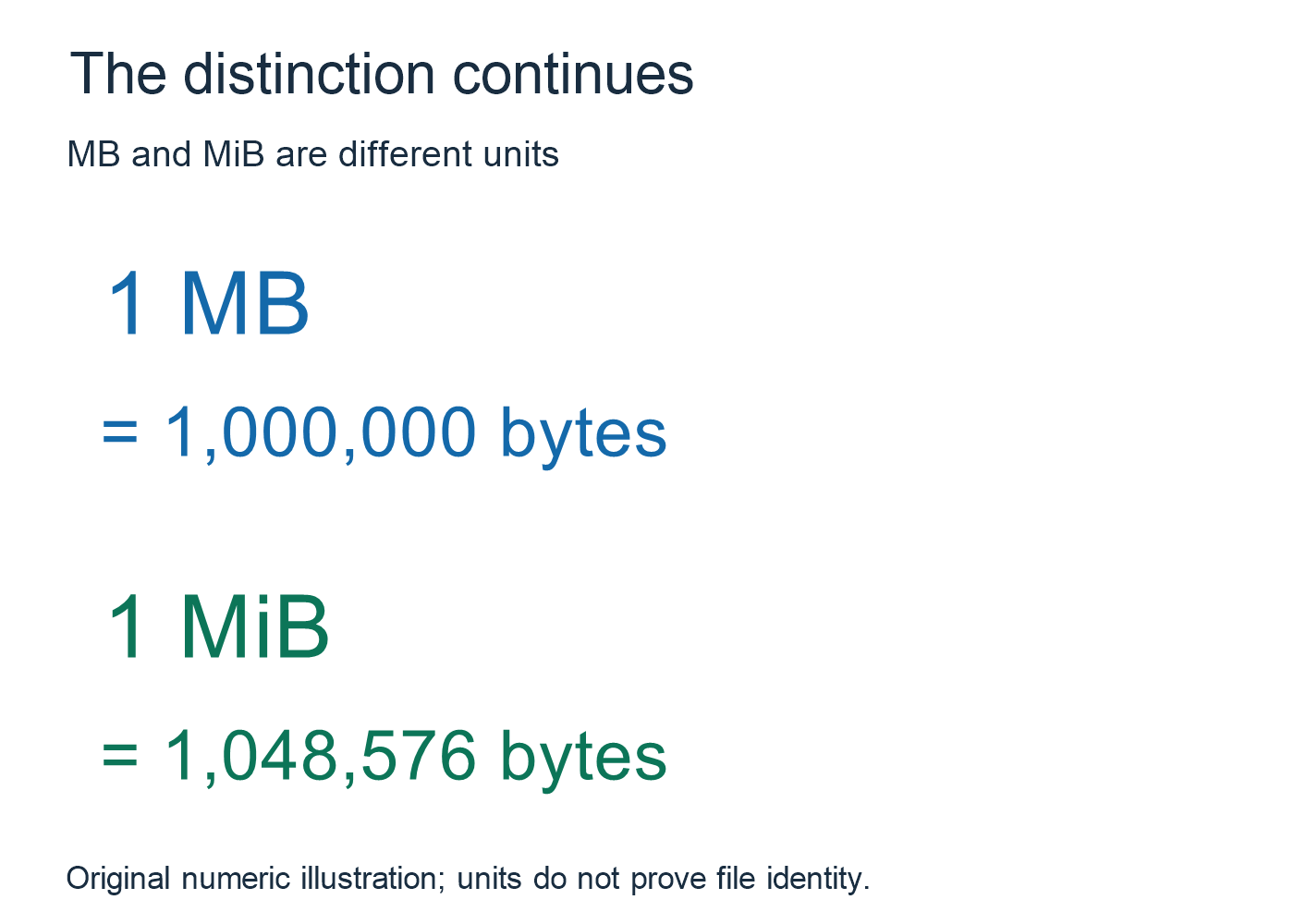
Diagram key: MB and MiB differ: 1 MB = 1,000,000 bytes, while 1 MiB = 1,048,576 bytes.
Keep the byte count unchanged
Consider an illustrative quantity of exactly 2,048 bytes. Dividing by 1,024 gives 2 KiB. Dividing the same count by 1,000 gives 2.048 kB. Nothing has been removed: only the unit used to express the quantity changed.

Diagram key: For exactly 2,048 bytes, division by 1,024 gives 2 KiB; division by 1,000 gives 2.048 kB. Only the unit changes.
This calculation is an example, not a claim about how a particular app labels its display. If a label is unclear, consult that product’s documentation before assigning it a meaning.
Make a comparison you can explain
Write down the complete number and unit, not just the largest-looking numeral. When possible, compare the underlying byte counts. Keep a question about a unit separate from a question about the file itself: a unit conversion alone does not establish whether two files contain identical data.
The small letter i is useful information. Read it before drawing a conclusion from the number beside it.
Sources
- NIST: Prefixes for binary multiples, table and Examples and comparisons with SI prefixes.
- NIST CSRC: kibibyte, Definitions.
- NIST CSRC: MiB, Definitions.