


Webb’s Little Red Dots Are Testing How the First Black Holes Grew
SCIENCE & SPACE
Webb’s Little Red Dots Are Testing How the First Black Holes Grew
A NASA assessment updated on October 9 brings a difficult question into focus: what do compact red sources really tell us about the birth of cosmic giants? The answer depends on separating the light astronomers measure from the histories they infer.
Opening illustration: a conceptual painted cosmic field, not a Webb observation or a reconstruction of a named source.
A fresh assessment of an unfinished story
NASA’s black-hole assessment, updated on October 9, 2026, puts an important qualification beside the extraordinary reach of the James Webb Space Telescope. Webb is helping astronomers investigate black holes in the young universe, but the compact sources called little red dots still resist a single, settled interpretation. Their name describes an appearance. It does not establish what powers them, how massive their central objects are, or whether every member of the apparent family shares the same history. That distinction is the starting point for understanding why these sources have attracted so much attention.
The current news is an assessment of a developing research problem, rather than an announcement that one photograph has solved it. NASA presents the dots alongside questions about black-hole seeds, their growth, and their relationship with galaxies. Separate research papers published during 2026 offer different ways to test that picture. One investigates how dense gas changes the meaning of broad spectral lines; another follows the formation and growth of large seeds in simulations. These approaches are useful together because they ask different questions. A measurement can constrain an object’s present condition while a model explores a route that might produce it.
For readers, the practical issue is how to follow the evidence without turning uncertainty into either a sensational contradiction or a reason to dismiss the work. This article distinguishes observations, estimates, and proposed histories. It also explains why changing an estimate can strengthen a scientific account. A revised black-hole mass does not make the light disappear. It changes the physical story needed to explain that light. The most interesting result may therefore be a better question: which combination of gas, gravity, radiation, and time could make the sources Webb actually detects?
What a little red dot tells us immediately
The label is deliberately modest. A source appears compact in an image and has a red appearance across the observations used to identify it. Those are properties of the detected light and of the instrument’s ability to resolve it. They are not a direct view of an event horizon. Astronomers still have to establish distance, separate competing contributions to the light, and examine how the source behaves across wavelengths. The first useful discipline is to keep the catalogue label apart from the explanation. A category assembled from appearance can contain objects with different physical engines.
Consider a familiar reasoning problem. Two distant buildings can present the same bright window to an observer while containing entirely different activities. The window is real, and its brightness can be measured precisely, but identifying the activity requires additional information. An astronomical source is considerably more difficult because the observer cannot enter the building, move around it freely, or wait for a conversation with its occupants. The available evidence is radiation that has travelled to the telescope. Shape, spectrum, variability, and surroundings become complementary clues. None is automatically a complete answer on its own.
This is why the expression little red dot should remain visible even when a proposed explanation sounds compelling. Replacing it everywhere with black hole would quietly erase a step in the argument. Keeping the original label lets readers ask whether a paper has identified the engine of one source, characterized a selected sample, or explained the entire population. Those claims differ in scope. A particularly clear object can reveal a mechanism worth testing elsewhere, but the existence of that mechanism does not mean every source selected by similar colors must work in precisely the same way.
Red light has more than one explanation
Color is informative, but it is not a unique identity card. A light spectrum can change because of the material producing it, material between the source and the observer, and the expansion of the universe during its journey. Astronomers therefore distinguish the wavelengths emitted at the source from the wavelengths measured here. For distant objects, expansion stretches the travelling light. Features originally produced at shorter wavelengths can arrive in the infrared. This is one reason an infrared observatory can investigate epochs that are difficult to study with visible-light observations alone.
The conceptual trap is to treat every use of the word red as if it described the same process. A source’s measured color, a cosmological redshift, and a reddened spectrum are related parts of an observation, but they are not interchangeable statements. Spectral features provide a way to disentangle them. Identifying the same set of features at shifted wavelengths helps establish a source’s redshift. Examining their relative strengths and the surrounding continuum addresses a different question: what conditions produced the radiation? That separation matters whenever a bright, compact object is given an early-universe interpretation.
An everyday comparison is useful if its limits are kept clear. A red lamp, a white lamp behind red glass, and a moving source whose wavelengths have shifted can all deliver relatively red light. No one would identify the lamp’s construction from color alone. In astronomy, the equivalent task is more demanding, but the reasoning is similar: look for a pattern of evidence that distinguishes mechanisms. A good account should explain how distance was established and how the observed spectrum was interpreted, rather than allowing the dramatic appearance of an image to do both jobs.
Compact is a measurement with boundaries
A dot in a telescope image can be genuinely small, insufficiently resolved, dominated by one especially bright region, or some combination of these. The word compact must therefore be read alongside resolution and distance. An unresolved source does not come with a precisely measured diameter simply because its image occupies a small area. Its apparent extent may instead establish a limit on how large the luminous region could be. That limit can be powerful, but it is a different kind of information from a detailed map of its interior.
The surroundings create a second difficulty. A bright central source can be easier to detect than the fainter galaxy around it. If that surrounding light is hard to measure, the relationship between the central engine and the host becomes uncertain. Calling the black hole unusually large relative to its galaxy requires estimates on both sides of the comparison. It is not enough to measure the central light carefully while assuming that all the host’s starlight has been recovered. The contrast between a luminous center and a faint environment can influence the story told about their relative growth.
This does not mean that every surprising ratio is an observational mistake. It means that the comparison has an evidence chain. Readers should look for discussion of how the host was separated from the central source, what could remain undetected, and how those limitations affect the conclusion. A result that survives those checks becomes more persuasive. A result that changes after better observations is also informative: it tells researchers which part of the earlier interpretation was fragile. The aim is to identify the physical relationship, not to preserve the most extreme version of an initial estimate.
Seeing an engine by the light around it
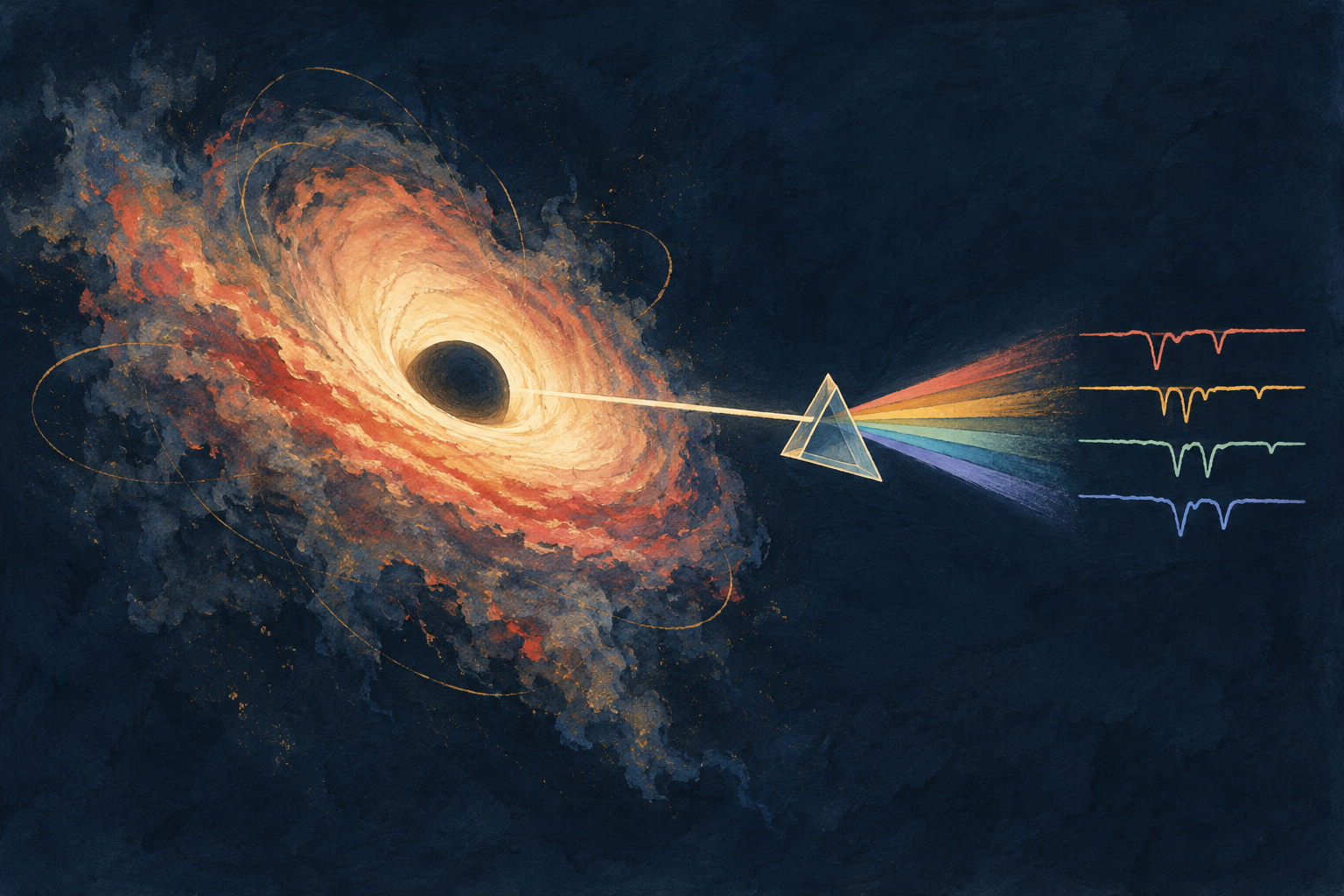
Black holes are not ordinary luminous surfaces. The radiation used to investigate an active black hole comes from its environment, including matter affected by the accretion process. The distinction is basic but easy to lose in a spectacular illustration. An event horizon is a boundary; the glowing structures shown around it represent surrounding material and a physical interpretation of that material. A bright source can provide evidence about a dark central engine without being a direct photograph of the engine’s interior. The route from light to black hole is therefore an argument grounded in physics.
That argument becomes stronger when the power source is tested against alternatives. If stars alone are proposed, the explanation must account for the luminosity, spectrum, and compactness together. If accretion onto a black hole is proposed, the surrounding gas must account for the same observed properties. A model that explains only the brightness while ignoring the shape of important spectral features is incomplete. So is a model that matches a feature but requires an environment inconsistent with other observations. The useful question is how much of the evidence one explanation can accommodate without contradictory assumptions.
Thinking in this way prevents a misleading contest between certainty and mystery. Researchers can have strong evidence that accretion powers a particular object while remaining uncertain about its mass, its seed, or its place in a wider population. Those uncertainties sit at different levels. Identifying an engine is not the same as reconstructing its entire biography. A news account should preserve that distinction so that a compelling result about one level does not become an unsupported claim about another. The emerging picture can be substantial even while important parts remain open.
Why a spectrum can be more revealing than a picture
A spectrum separates light by wavelength. Its features carry information that a combined image can hide. Emission and absorption patterns can indicate the material involved and help constrain its physical conditions. The positions and profiles of those features can also provide clues about motion. An image answers where detected light appears to come from and how it is distributed on the sky. A spectrum adds questions about what produced the light and what happened to it. Both forms of observation matter, but they should not be asked to perform identical tasks.
For a reader encountering a spectrum in a paper, a productive first distinction is between the continuum and the features laid over it. The continuum describes a broad pattern of brightness across wavelengths. Spectral lines are more localized features. A source can share a broadly red continuum with another source while differing in line profiles, ratios, or absorption. Those differences can make the physical explanations diverge. That is why two objects that look similar in small image cutouts may become less similar when their detailed spectra are examined.
The next distinction is between a detected feature and its interpretation. The feature has uncertainties associated with the observation and its processing. The interpretation adds assumptions about geometry, temperature, density, radiation, and motion. Listing those assumptions is not an admission that the observation is arbitrary. It makes the inference examinable. A persuasive study explains which aspects of the spectrum its model reproduces and which remain troublesome. Readers can then distinguish a strong match across several independent features from an attractive resemblance confined to one part of the data.
Broad lines do not read out a mass automatically
A common route to estimating a black-hole mass uses the motion of surrounding gas. The logic connects the speed of that gas and the scale of the region to the gravity needed to sustain the motion. This can be a powerful method, but the necessary quantities do not appear as a label attached to the source. They must be inferred. The width of a spectral feature is one part of the evidence, and the meaning of that width depends on the process that shaped it. Geometry and the size estimate also matter.
The 2026 paper by V. Rusakov and colleagues in Nature illustrates the issue. Published on January 14, it examines high-quality spectra and argues that electron scattering broadens lines in the studied sources, with narrower intrinsic cores. Under that interpretation, assigning the entire observed width to motion would give misleading masses. The result supports young accreting black holes in dense ionized surroundings while revising the inferred scale of their masses. That is a claim about a studied sample and a physical explanation, not a declaration that all broad lines everywhere must arise in the same way.
The broader lesson is methodological. Suppose two processes can widen the same observed feature. A mass estimate based on one process must test whether the other contributes. This is an example of an inference becoming more demanding as observations improve. The additional detail can reveal that an earlier shortcut was inadequate. The source does not become less interesting because its inferred mass changes. It becomes better constrained. For the origin problem, a less extreme mass can also change how difficult the required growth history appears, making the interpretation of line shape central to the larger cosmological story.
Why gas can change the meaning of the evidence
Dense gas is not merely a curtain placed in front of an otherwise familiar object. It can interact with radiation, alter the emerging spectrum, and influence what observers can infer about the underlying engine. An explanation involving an enshrouded black hole therefore has to treat the surroundings as part of the system. The useful question is not only what shines at the center, but how the surrounding material converts, redistributes, or obscures that radiation before it escapes. Different environments can make engines with related properties look quite different to a distant observer.
This is where vivid names such as black hole star need careful handling. They refer to proposed configurations and interpretations in the research, rather than a simple merging of two familiar textbook objects. A reader should ask what a particular paper means by the name: which material supplies the light, which process supplies the energy, and which observations distinguish the proposal from an ordinary active galactic nucleus. The name can make an unfamiliar possibility memorable, but it cannot substitute for a description of the system or the tests that support it.
ESA/Webb’s June 10 account of GLIMPSE-17775 offers a concrete example of this research direction. It discusses the source’s spectrum in connection with a dense gas-cocoon explanation and combines information from Webb and Hubble. The value of that case is its combination of clues. It does not remove the need to examine other sources independently. An especially informative case can help define a physical possibility, while a population study asks how often that possibility occurs. Keeping those tasks separate avoids treating one particularly revealing object as a complete census of the early universe.
The seed question is a question about a starting point
When astronomers discuss black-hole seeds, they are asking what initial objects began the growth histories that led to much larger black holes. The word seed should not imply a biological process or a tiny object whose future is inevitable. It describes a starting condition in a physical model. A lighter initial black hole and a heavier one face different demands if both must reach a large mass by an early epoch. The available time, supply of material, and interruptions to growth become part of the comparison.
A useful thought experiment is to start two fictional growth histories at different masses while giving them the same final target. The lighter beginning needs more growth between the starting and ending points. That arithmetic alone does not establish which beginning occurred in nature. It identifies what the explanation must supply. The smaller seed might require especially sustained feeding; the larger seed might require unusual formation conditions. Each scenario pays a different physical cost. A good comparison evaluates both costs instead of declaring the larger starting point a solution merely because it shortens the journey.
This helps explain why finding an early massive black hole is consequential without proving a single origin route. The observation constrains what a viable history must achieve. To distinguish routes, researchers need additional evidence about the surroundings, population, and growth processes. The same final mass may be accessible through different combinations of starting mass and feeding history. An origin claim becomes convincing when it explains more than the endpoint: it must also fit conditions that could plausibly exist, produce the right observable signatures, and avoid predicting a population sharply inconsistent with the data.
Fuel, timing and interruptions belong in the same account
Growth requires a supply, and a supply is not the same as unrestricted access to it. Gas can exist in a system without all of it reaching the central black hole. Motion, heating, and the response of the surrounding environment affect the route inward. An explanation that begins with a large reservoir but skips the delivery process has left a major part of the problem unresolved. This is why the language of rapid growth should be followed by a description of what makes that growth possible and how long the relevant conditions persist.
Time also enters the argument in several distinct ways. There is the age of the universe when the source emitted the observed light, the interval available since a proposed seed formed, and the duration of a particular active phase. A source seen during a luminous phase does not prove that it fed at the same rate throughout its earlier history. A temporary episode can dominate what is observed while occupying only part of the biography. Recognizing this distinction prevents the brightness of one moment from being turned into an unsupported estimate of a lifetime.
Readers can use these distinctions to examine a growth claim. Ask when the initial object is supposed to form, where the material comes from, what limits or enables its delivery, and when the observed state occurs. The answers form a sequence, rather than a collection of dramatic adjectives. If a model explains only an active interval, its scope should be described that way. If it follows several transitions, the transitions should be identifiable. The scientific interest lies in joining the steps with a physical mechanism, not in making every step sound equally extraordinary.
What the September simulations add
A Nature study by Sunmyon Chon and colleagues, published on September 16, follows heavy-seed formation and early growth in cosmological radiation-hydrodynamic simulations. The authors produce dense environments and observable signatures resembling little red dots, and propose a route from a short-lived obscured phase toward larger black holes. The calculation is significant because it links formation, environment, growth, and appearance in one physical framework. It offers a possible sequence that observations can test. It is not a direct observation of an individual source’s past, and it does not establish a unique history for every dot.
The distinction between a simulation and an observation is especially important here. A simulation begins with specified conditions and physical prescriptions, then calculates consequences. An observation begins with detected radiation and asks what conditions could explain it. Bringing the two together is a comparison between predicted and measured outcomes. If a model produces objects with the right appearance, that is useful evidence of plausibility. Stronger support comes when it also fits properties that were not used simply to tune the resemblance, and when alternatives are subjected to comparable tests.
A helpful analogy is a reconstruction of how a river channel could form. Producing the channel’s shape in a calculation shows that the proposed processes can generate that shape under the modelled conditions. It does not automatically establish that those processes alone created a particular real channel. Additional evidence might concern the surrounding deposits, timing, or frequency of similar channels. The astronomical problem follows the same logic at a very different scale. The strength of a growth simulation is the set of testable connections it supplies, rather than the attractiveness of a visual similarity by itself.
A model must face the population as well as the striking source
A theory can explain an extraordinary object yet struggle to explain how many such objects exist. Conversely, it can match a population count while failing to reproduce the spectra of individual members. These are separate requirements, and both matter for little red dots. Researchers need an account of what makes a source recognizable, how long it remains recognizable, and how often the required conditions arise. A rare environment combined with a short visible phase makes a different prediction from a common environment with a long visible phase, even if the individual objects look alike.
The reasoning resembles a photograph of a busy station. The number of people visible depends on how many arrive, how long they stay, which areas are photographed, and whether some are obscured. A large count does not uniquely determine the arrival rate. In astronomy, a visible population likewise combines formation, duration, selection, and detection. This analogy is only an aid to reasoning, not a claim that astronomical populations behave like commuters. Its purpose is to show why a count needs an explicit interpretation rather than being treated as a direct measurement of one process.
This gives readers a useful way to follow changing population claims. Ask whether the investigators changed the physical model, the selection criteria, or the observations available. A larger catalogue can reflect a broader search, improved sensitivity, a revised definition, or genuinely different conclusions about prevalence. Those changes are not interchangeable. The most informative reporting states what changed and how the comparison was made. Otherwise, an apparent disagreement about abundance may partly be a disagreement about which objects are being counted, rather than a conflict about the same clearly defined population.
The missing members matter too
The apparent concentration of little red dots in early cosmic epochs raises another question: what happens to sources with those properties as the universe matures? Several explanations can produce a decline in recognizable objects. A physical phase might become less common. Objects might evolve out of the selection criteria. Their environments might become easier to resolve, changing how they are classified. The relevant observations might sample different properties at different distances. Establishing which explanation dominates requires more than noticing that the catalogue contains fewer examples at later times.
The useful comparison is therefore not simply early dots against a blank modern sky. It is a comparison among possible descendants, analogues, and selection effects. A descendant need not preserve the same appearance throughout its history. If the luminous center changes or the host becomes more conspicuous, an object could leave the original category while continuing to exist as part of a different one. A successful evolutionary explanation should indicate what observers ought to find after that transition. Otherwise, saying that the dots disappear merely restates the catalogue pattern in more dramatic language.
It is also important to distinguish a missing detection from proof of absence. An object can be absent from a catalogue because it fails the selection rules or because the observations cannot reveal it. Researchers address this by testing how a proposed population would appear under the actual survey conditions. For readers, the key question is whether the claimed decline was evaluated using comparable criteria. The answer determines whether the result points primarily toward a change in physical prevalence, a change in visibility, or some combination that still needs to be disentangled.
A quiet X-ray signal is a constraint, not a verdict
The physical interpretation has to account for wavelengths beyond the infrared. In their January paper, Rusakov and colleagues identify weak X-ray and radio emission among the unusual properties motivating the investigation. Such a pattern is part of the evidence, not a decorative complication to mention after the main claim. An explanation built around an active central engine must say how its environment and radiation could produce the observed combination. At the same time, the absence of a strong detection must be interpreted in relation to the sensitivity and coverage of the relevant observations.
There is a difference between three statements: a signal was not detected; a source emits little of that radiation; and a proposed engine cannot be present. The first is an observational result. The second requires an interpretation of limits and distance. The third requires additional physical reasoning. Moving from the first to the third in one sentence can hide crucial assumptions. A rigorous account explains what strength of emission the observations would have revealed and whether competing models predict a signal above or below that threshold.
This is a useful general test of any astronomical claim based on silence. Silence becomes powerful when an explanation predicts something that should have been detectable and the appropriate observation fails to find it. It becomes less decisive when the predicted signal is uncertain or the observation is insufficiently sensitive. The distinction preserves the value of non-detections while preventing them from carrying more weight than they can support. For little red dots, an informative model needs to connect its infrared successes with its expectations elsewhere, rather than treating each wavelength as an unrelated puzzle.
Host galaxies and black holes need separate biographies
A black hole and its surrounding galaxy share an environment, but they do not necessarily grow in lockstep at every moment. Studying their relationship requires attention to both histories. A source observed with a bright central component and a faint stellar component may invite an argument about which developed first. That argument must distinguish the measured conditions at the observed epoch from the earlier sequence inferred from them. A snapshot can constrain a history, but it cannot display the entire sequence without a physical interpretation and supporting evidence.
The phrase overmassive also needs a comparison attached to it. It generally indicates that an inferred black-hole mass is large relative to a relationship or reference population. It should not be taken as a claim that gravity has permitted an impossible mass. The reference relation may describe nearby systems that experienced different histories. Comparing early sources with that relation is scientifically useful precisely because it tests whether the relationship developed over time. An apparent departure can motivate a better growth model, provided uncertainties in both the black hole and the host are treated carefully.
For a non-specialist, the productive question is what would change the inference. Better host measurements might alter the ratio. A different interpretation of spectral broadening might alter the black-hole mass. A larger comparison sample might change how exceptional the source appears. These are distinct routes toward a more reliable account. Listing them does not weaken the investigation; it identifies where new evidence can make the greatest difference. A headline can retain the excitement of an unusual relationship while making clear which quantities were estimated and which comparison made them unusual.
Why several instruments can improve one argument
A second observatory is valuable when it supplies information that the first cannot recover equally well. It may probe a different wavelength range, resolve a different component, or monitor a source over a different interval. The benefit is not simply that two telescope names appear in the same story. It is that the additional observations can constrain an ambiguity in the existing interpretation. A clear account should identify that ambiguity. Does the new information help separate host light from central light, test a predicted emission component, or establish how a source varies?
Combining observations also creates a responsibility to compare them correctly. Different instruments can have different resolution, sensitivity, calibration, and observation dates. A difference between two measurements is not automatically evidence that the source changed. It might arise from what each instrument sampled or how the light was measured. Researchers therefore have to make the comparison explicit. For readers, the important point is that combining evidence involves analysis, rather than placing two pictures side by side and allowing visual impressions to settle the physical question.
The useful division of labor for future work is straightforward: a broad search can identify more candidates, while deeper follow-up can examine selected ones more closely. These activities answer complementary questions about prevalence and nature. Their usefulness depends on how the candidates are selected and how representative the detailed sample becomes. Finding more objects is an important step, but the scientific payoff comes from turning a larger collection into tests that discriminate among competing physical explanations.
Four questions that make the next headline clearer
First, what was actually measured? A new image, a spectrum, a variability record, and a population analysis are different developments. Second, which inference changed? The new result might concern distance, a mass estimate, the power source, or a possible growth history. Third, how far does the result extend? One carefully studied source is different from a representative sample. Fourth, what would distinguish this explanation from an alternative? A useful result should make at least one future comparison more informative, rather than relying entirely on the appeal of its narrative.
These questions help decode familiar phrases. Evidence for a black hole is not identical to a direct mass measurement. A model reproduces an observation is not identical to a model has been proven unique. A source is consistent with a proposed scenario is not identical to every source in the category follows that scenario. A revised estimate is not identical to an observation being withdrawn. Each phrase identifies a relationship between data and explanation. Reading that relationship carefully makes it possible to appreciate a strong result without demanding a level of certainty its authors did not claim.
Readers can also watch the dates. A current assessment may discuss findings published months earlier; that does not turn those findings into discoveries made today. Conversely, older observations may acquire new significance when analysed with a better method. The date of an observation, the date of a research paper, and the date of an explanatory update can differ. This article’s immediate hook is NASA’s October 9 assessment, with January and September research providing context. Keeping those dates visible avoids the common mistake of presenting a developing argument as one sudden, universal solution.
The next decisive result may look less spectacular
A sharper constraint on a line profile, a more reliable host measurement, or a carefully defined comparison sample may do more to resolve the problem than another dramatic image. Such results can be hard to compress into a headline because they improve a link in an evidence chain rather than unveiling an entirely new object. Their value is nevertheless substantial. A good constraint can rule out a class of explanations, narrow the allowed parameters of another, or reveal that several apparent members of one family should be studied separately.
The distinction matters for expectations. The little-red-dot question may not end with a single announcement that gives every object the same identity. It could develop into a classification with several physical branches. That would be an achievement, because the original visual label was never guaranteed to describe one mechanism. Alternatively, a common configuration may explain a large fraction of the population while leaving exceptions. Either outcome requires enough evidence to distinguish similarity of appearance from similarity of physical structure. A useful synthesis must make room for both the pattern and its boundaries.
The most defensible conclusion on October 9 is that Webb has made an old origin problem more testable. Compact red sources give researchers evidence to examine, while new interpretations of that evidence change the growth histories that must be considered. The work connects light, gas, mass, and time, but the connections remain open to checking. That is why the unfinished story deserves attention. Its importance lies in the possibility of learning how the first black holes grew by finding explanations that survive several independent tests, one carefully constrained step at a time.