


Why a QR Code Needs More Than Error Correction

TECHNOLOGY | ENCODED INFORMATION
Why a QR Code Needs More Than Error Correction
A reader has to find the symbol, sample its grid and recover the encoded data. Those are different jobs—and damage tolerance is not a promise that any part of the image can disappear.
By OnelROR Editorial Team · October 11, 2026 · Miami · 3 min read
Cover illustration — OnelROR Editorial Team. Original conceptual diagram of a square symbol and its margin; incomplete layout with no encoded payload, not a scannable QR Code.
Finding a symbol is different from recovering data
A QR Code can sometimes remain readable after it becomes dirty or damaged. That capability is real, but it describes only part of the work. Before encoded information can be recovered from a photograph, the reader needs a usable representation of the symbol. This explainer concerns the familiar square QR Code Model 2; other QR families have different structures.
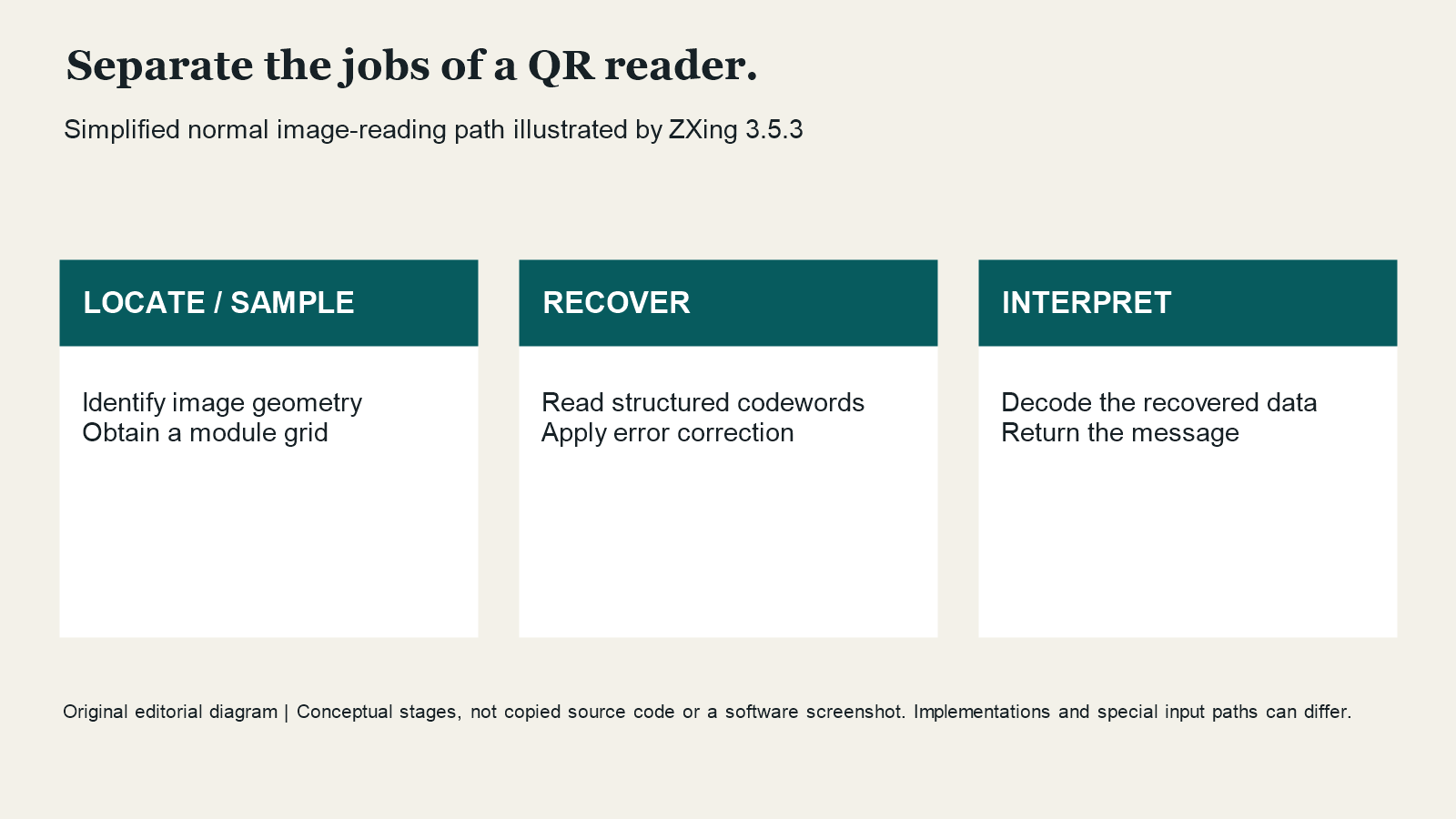
A concrete example appears in ZXing’s Java implementation, pinned here to version 3.5.3. Its normal image-reading path invokes a detector, obtains a sampled bit matrix and then calls the decoder. That separation helps explain why trouble finding a symbol is not the same failure as trouble correcting its codewords. ZXing also has a special path for a clean, unrotated barcode image; the normal path is not a universal script for every scanner.
The corner patterns help establish geometry
The three conspicuous square finder patterns occupy three corners. In the inspected detector, their positions help establish orientation, module size and grid dimensions before the image is sampled. Alignment patterns can supply further geometric information where the symbol version provides them. DENSO WAVE describes these patterns as helping Model 2 handle distorted reading images.
A module is a cell of the symbol’s grid. DENSO WAVE lists versions from 1, with 21 modules per side, to 40, with 177. Here, version means a symbol configuration, not a scanner-app release. Capacity depends on the data, its character type and the selected error-correction level. More information is therefore not simply added to an unchanged collection of squares.
The clear margin is part of the required area
DENSO WAVE specifies a clear margin, called the quiet zone, four modules wide on every side. It is additional to the symbol itself. Four modules is a grid-based measure, not a universal instruction to leave four pixels. If the printed module size changes, the corresponding physical margin changes too.
That makes the margin a design requirement to preserve when laying out a label or graphic. Treating it as spare space for another element confuses the area around the symbol with unused room inside an image. The creator’s guidance calculates the required area from the symbol, module size and surrounding margin together.
Error correction works on codewords
QR error correction adds Reed-Solomon redundancy. DENSO WAVE expresses its restoration rates in terms of total codewords and defines a codeword as eight bits. Its commonly cited Level M figure is 15 percent on that basis. The percentage is not a promise that any chosen 15 percent of a photographed symbol can be erased.
The inspected ZXing decoder reads version and format information, obtains codewords, separates them into blocks and applies error correction before interpreting the recovered bytes. This is recovery within an encoded structure. Increasing the correction level also has a size-and-capacity trade-off; it does not remove the separate need to obtain a usable grid from the image.
Read a resilience claim in its proper units
A useful claim identifies the symbol family, correction level, affected information and conditions of reading. A percentage without those qualifications leaves important questions unanswered. A decorative logo or a photograph of a damaged code is not, by itself, evidence that every symbol can tolerate the same obstruction.
For an actual deployment, keep the generated symbol’s intended settings and required margin, and check the finished version in its intended reading conditions. Record what was tested rather than turning one successful scan into a general guarantee. This article’s diagrams are deliberately non-scannable schematics; they illustrate the concepts and supply no measured success rates.

The distinction to retain is simple: first ask whether the symbol can be located and sampled, then whether its encoded data can be recovered. Error correction is valuable because it addresses the second question. It should be understood alongside the geometry and presentation that make the first question answerable.