


Why Auroras Glow Green, Red, Blue and Purple
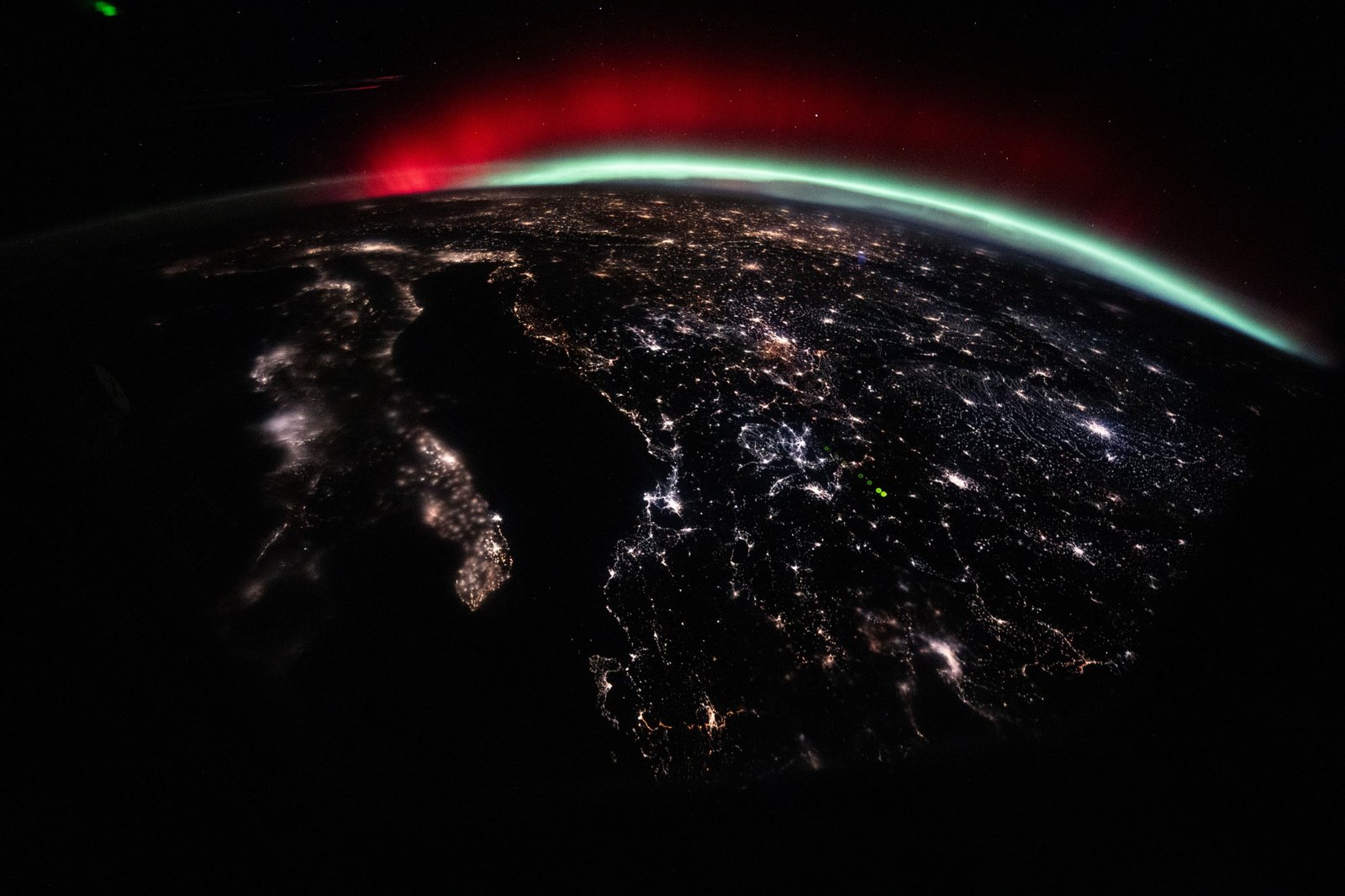
A green ribbon above Earth can share the sky with a red glow. Those colors are clues to what is happening in the upper atmosphere: energetic particles are transferring energy to gases, and the gases release light. The aurora is an interaction between space weather and the atmosphere, rather than a colored object hanging overhead.
Featured photograph: red and green aurora above Europe, January 19, 2026. NASA/Chris Williams. All photographs here are archival, not a report of current conditions.
Start with the energy, then the gas
The Sun produces a continuous flow of charged particles called the solar wind. Its interaction with Earth’s magnetic environment can store and release energy. Particles reaching the upper atmosphere collide with atoms and molecules there. NASA’s aurora overview connects those collisions to the light we see.
That sequence matters when describing a photograph. The glowing material is part of Earth’s atmosphere. A camera looking along the planet’s curved edge can show an extended luminous arc, while a person on the ground sees a different perspective on the display.
Why green and red can appear together
Oxygen can produce both green and red auroral light. Nitrogen can produce blue and purple, as NASA Space Place explains. Assigning one permanent color to each gas therefore misses part of the story. The gas involved and the conditions where particles interact with it both matter.
NASA identifies green as the most common auroral color and associates it with excited oxygen around 100 kilometers above the surface. That is an approximate context for the process, not a height measurement you can extract from the color of an individual photograph.

Several colors can form one display
The NASA guide to auroral colors describes the importance of both the gas and its location. Different contributions of red, green and blue light can combine into shades such as pink, purple or white. A curtain with several colors does not require several unrelated events.
It is useful to distinguish an explanation of emission from an interpretation of a picture. The photographs illustrate auroral shapes and colors. They are not measurements identifying every gas, altitude or particle interaction in each part of the scene.

A better way to read the next aurora picture
Look first for the shape: an arc, a curtain or a broad glow. Then notice which colors overlap, and whether the view comes from the ground or orbit. Keep the image’s date and caption alongside it. These simple checks make it easier to appreciate what the photograph shows without treating an archival image as today’s forecast.
The central idea is that auroral colors come from energized atmospheric gases releasing light. Oxygen’s green and red emissions and nitrogen’s blue and purple contributions help explain the palette; the location and combination of those emissions help explain its variety.
Official sources linked above were checked October 24, 2026. NASA’s overview is dated February 4, 2025; photo pages January 23 and June 16, 2026, and July 16, 2025. Images used factually with NASA credits under its media guidelines; no endorsement implied.
Written by OnelROR Editorial Team. October 24, 2026. 3-minute read.


