


Why Most Full Moons Do Not Bring a Lunar Eclipse
By OnelROR | November 15, 2026 | 4 min read
A full Moon is not an eclipse appointment. Lunar eclipses happen at the full Moon phase, but most full Moons remain outside Earth’s shadow. The missing condition is the right alignment in three dimensions. [1]
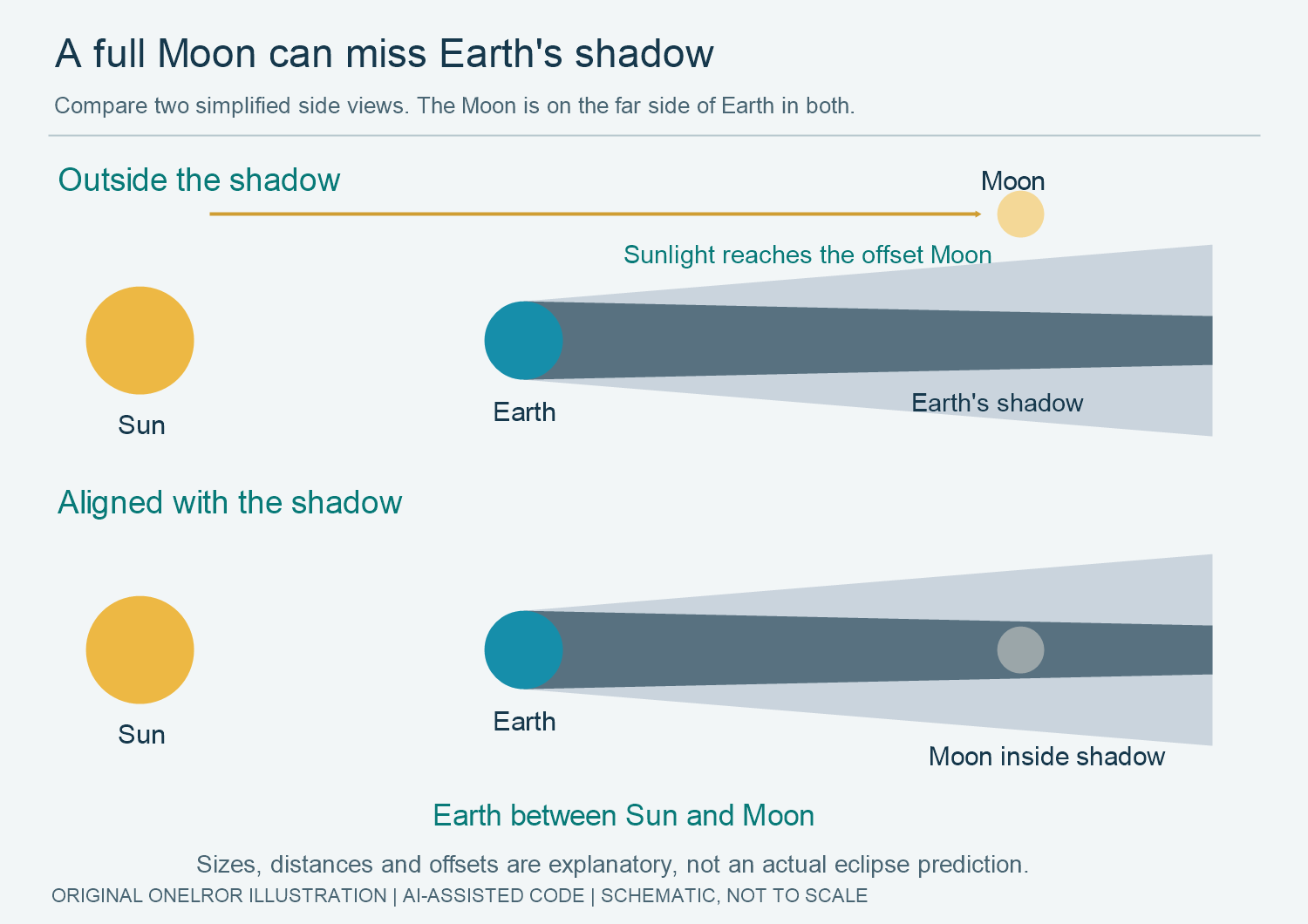
Diagram key: missing or entering the shadow
- In both side views, the Sun is on the left, Earth is in the middle, and the Moon is on Earth’s far side. Earth’s shadow extends away from the Sun.
- Upper view: the Moon passes above the outer shadow and receives direct sunlight. Lower view: the Moon is aligned inside the darker inner shadow.
- Body sizes, distances, offsets and shading are schematic, not an eclipse prediction or a forecast of the Moon’s color.
Look beyond the flat drawing
A simple Sun-Earth-Moon sketch can make an eclipse look unavoidable: put Earth in the middle and draw the Moon on the far side. But a sketch flattened onto one line hides the height of the Moon’s path relative to Earth’s orbit around the Sun.
NASA explains that the Moon can be behind Earth and still receive sunlight because its orbit is tilted. Being on Earth’s far side from the Sun is not the same as entering Earth’s shadow. [2]
Compare the two orbital planes
The Moon’s orbit is inclined by about five degrees to the plane of Earth’s orbit around the Sun. That small tilt is enough to prevent monthly lunar eclipses. At many full Moons, the Moon passes above or below the shadow rather than through it. [1][2]
In a diagram, check which plane is labeled. This comparison concerns Earth’s orbit around the Sun, not the tilt of Earth’s rotation axis. Enlarged bodies and compressed distances help make the geometry visible, but they do not reproduce the actual scale.

Diagram key: the two orbital planes
- The horizontal reference line represents the plane of Earth’s orbit around the Sun, seen edge-on.
- The sloping line represents the Moon’s orbital plane, inclined by about five degrees to that reference plane.
- The angle compares orbital planes, not Earth’s spin axis or equator. The pictured Earth and line lengths are not to scale.
Read which shadow the Moon enters
Alignment also determines the kind of lunar eclipse. A penumbral eclipse involves the faint outer shadow and may produce only subtle dimming. A partial eclipse carries only part of the Moon through the darker inner shadow, the umbra. During a total eclipse, the Moon moves fully into that inner region. [1]

Diagram key: three shadow encounters
- The lighter outer region is the penumbra; the darker inner region is the umbra. Each gold outline marks a Moon position, not its actual brightness or color.
- Penumbral: the Moon is within the penumbra but outside the umbra. Partial: only part of the Moon enters the umbra. Total: the whole Moon is inside the umbra.
- The panels show separate hypothetical maximum positions, not Moon phases or a timeline of one event. All sizes are schematic.
Those are different shadow encounters, not different Moon phases. A full-Moon date alone therefore cannot tell you whether an eclipse will occur, which type it will be, or what you can see from a particular location. Use an eclipse-specific prediction for an actual observing plan; the diagrams here explain geometry, not a dated event forecast.
Sources
- NASA Science – Eclipses and the Moon. Lunar Eclipse Basics, Types of Lunar Eclipses and The Moon’s Tilted Orbit; consulted November 15, 2026.
- NASA Space Place – Lunar Eclipses and Solar Eclipses. Lunar-eclipse explanation and monthly-eclipse question; consulted November 15, 2026. Both sources are NASA publications; no source images reused.


