


Why Old Libraries Chained Their Books—and Hid the Spines
NEWS & TRENDING · HISTORY & CURIOSITIES
Why Old Libraries Chained Their Books—and Hid the Spines
The iron was meant to stop a book from leaving, while the desk made it possible to read. Surviving libraries reveal how a surprising shelving arrangement joined custody, furniture and public access.
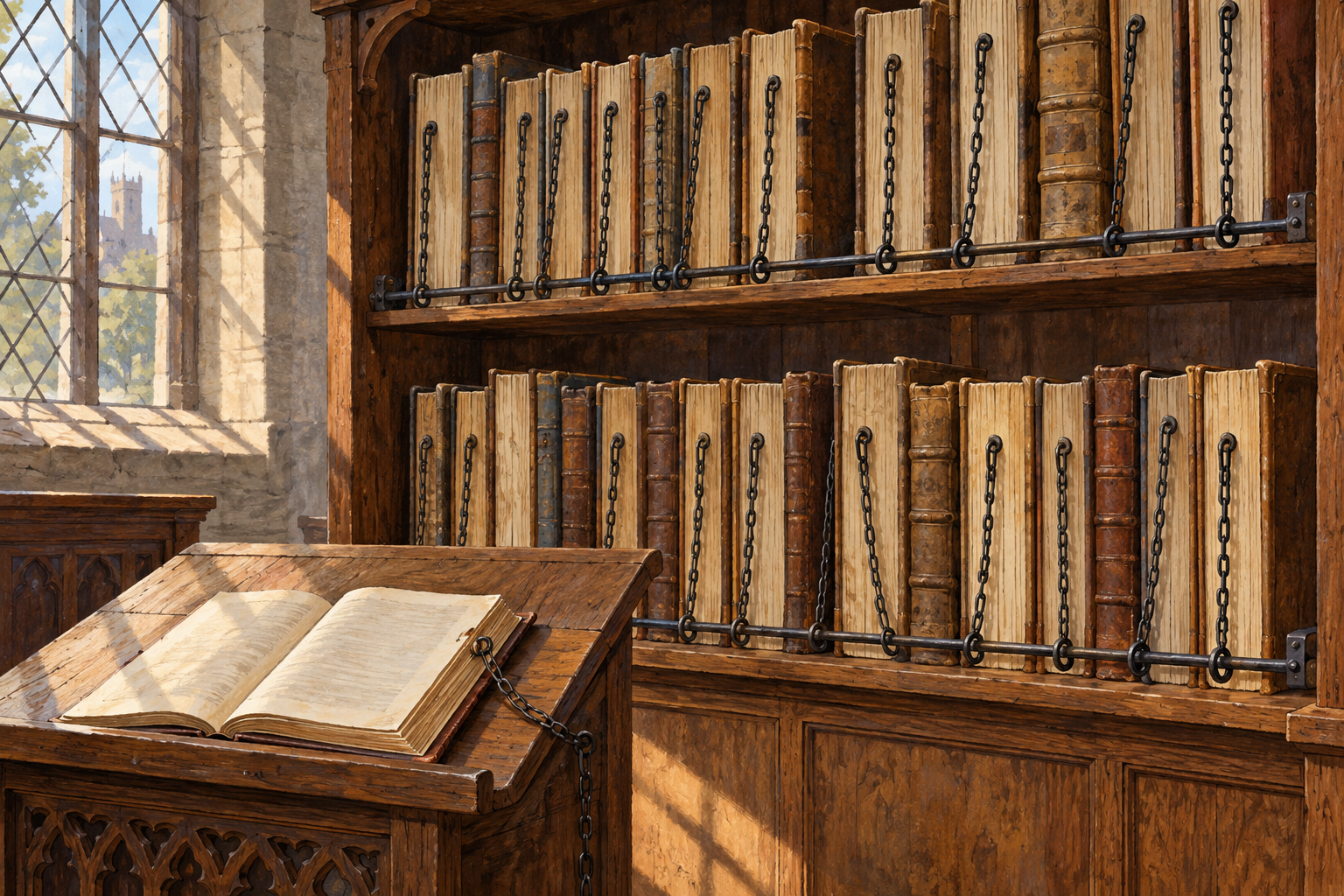
Opening image: original conceptual illustration of a chained library, not a photograph or reconstruction of a named collection.
A book could open without being free to leave
A row of books with their pale page edges facing the room can look strangely anonymous. The familiar line of labeled spines has disappeared. Then the chains come into view, and the arrangement begins to make sense: the shelf is part of a reading apparatus. A volume belongs to a particular piece of furniture, and the furniture provides a place where that volume can be used. The reader moves the book a short distance, opens it, consults it and returns it. Its contents remain accessible within a boundary that its covers cannot cross.
The surprise is that a chain need not prevent reading. Its job can be to distinguish reading from removal. That is a more interesting purpose than the image of knowledge simply being locked away. A book stored in a closed chest can be secure but unavailable until somebody opens the chest. A tethered book can be available to an admitted reader while remaining attached to the collection. The arrangement joins two requirements that otherwise seem opposed: let people handle an expensive object, and retain control of where the object goes.
Hereford Cathedral provides a particularly clear surviving example. Its institutional account, published June 8, 2016 and updated September 23, 2020, describes a chain attached to a book’s front cover and secured through a rod below the shelf. The volume can reach the desk, but cannot leave the bookcase. The same account explains the outward-facing fore-edges: this orientation lets the reader lower and open the book without turning it around and tangling the chain. That is the essential mechanism behind an arrangement that first appears to be a decorative oddity. Hereford’s explanation supplies the physical starting point.
This article treats the surviving libraries as historical evidence, rather than interchangeable picturesque rooms. A manuscript’s age, a cabinet’s date, a library’s foundation and a later restoration are different things. So are permission to enter, permission to consult and permission to borrow. Following those distinctions reveals a system of reading whose ingenuity lies in its ordinary details: the direction of a book, the position of a seat, the length of a reach and the location of a key.
The chain was only one part of the apparatus
A chain by itself explains very little. It needs an attachment strong enough to hold, an anchor that remains fixed and sufficient slack for the intended movement. It also needs a place for the book to rest. Without that final element, a security device can become an obstacle to the activity it is supposed to allow. The desk or lectern therefore belongs in the explanation from the beginning. Reading is not a secondary use improvised after a lock has been installed; it is the use around which a workable arrangement must be designed.
Consider the geometry without imagining a particular historical reader. A book on a shelf must travel downward or outward before it can lie open. Its covers separate, its leaves turn and its weight shifts. A tether that becomes taut during any of those actions would pull on the binding or force an awkward position. A tether that runs loosely across a neighboring volume could interfere with that volume instead. These are consequences of attaching a moving object to fixed furniture, not evidence that every historical library adopted the same solution.
The distinction between an anchor and a lock matters too. A fixed rod can carry several rings, while a lock controls access to the rod’s removable end or securing fixture. Ordinary consultation then occurs without releasing the whole assembly. Moving a book elsewhere is a different operation, potentially requiring access to the shared fitting. This separation makes custody visible: permission to read a volume does not automatically include permission to detach it. An attendant’s key has a role that the reader’s hands do not.
Independent historical reporting supports the importance of this furniture. In her July 17, 2017 TIME article, updated January 24, 2024, Lily Rothman explains that tethering determined where reading happened and that removing an individual volume from a shared rod could require releasing other rings. The account is useful corroboration of the mechanism, rather than a reason to treat a fictional library as a historical reconstruction.
A museum photograph that includes only dangling metal misses much of the story. The relative positions of shelf, rod and reading surface show what movements were possible. The arrangement is best understood as a small working environment: a book, a support, a tether and a person admitted to use them. Security was built into the environment, with consequences for how knowledge could be consulted.
Why the page edges faced the room
The fore-edge is the edge of the leaves opposite the spine. On an ordinary modern shelf it usually faces the back of the bookcase. Turning it outward reverses a deeply familiar visual convention. That reversal can seem inconvenient because it conceals the place where readers now expect the title. But the modern convention assumes that a book can be lifted, rotated and carried away without a tether. Once that assumption changes, the best orientation can change with it.
Imagine a closed volume whose attachment sits on its front board. If its spine faces the room, bringing it down and opening it may involve rotating the volume in relation to the fixed chain. With the opposite edge outward, a different movement becomes available. The reader can place it on the adjacent support in an orientation compatible with opening the cover. Hereford’s account makes this functional relationship explicit. It is not evidence that the keepers forgot how to display titles, or that earlier readers preferred a wall of unidentified books.
Orientation also affects contact between metal and binding. Chetham’s account of its parish libraries describes fore-edge shelving as a way to prevent chains rubbing the bindings during use. Its surviving Gorton cabinet combined enclosed storage with a sloping support, although that support was subsequently removed and the door hinges changed. Those alterations remind us that a surviving object can preserve one part of a mechanism while having lost another.
The practical lesson is about relationships rather than a universal shelving rule. Moving the chain attachment, changing the reading surface or altering the cabinet can change how the same volume behaves. A photograph cannot always establish those relationships, especially when the most important fitting is hidden behind a cover. Nor does an illustration of a generic chained book prove how a particular library was arranged. The illustrations accompanying this article visualize the concept; they are not measured reconstructions of the named collections.
The outward page edge also changes the identity of the shelf. It becomes less like a line of individual advertisements and more like a sequence of locations. A reader may need a title on an edge, a shelf designation or assistance to identify the wanted work. The small puzzle of the missing spines therefore opens a larger question: how did readers find books when the furniture fixed their positions?
A title did not always belong on the spine
Chetham’s provides a concrete answer in its description of an edition of Augustine’s works, printed in Basel in 1541–1543. The library identifies a title written on the page edge of the volume containing De Civitate Dei, or City of God. Its collection entry also records wooden boards, calf covering and later replacement spines. The identifying edge and the repaired spine tell different parts of the object’s history. Neither should be treated as proof that the book has remained untouched since printing.
A title is useful where the person selecting the book can see it. That location depends on how the object is stored. The spine is an excellent place in one shelving arrangement, the fore-edge in another. The information has not become less important because its position changes. Rather, the interface between book and reader has moved. This is a modest but revealing example of a visual habit that feels natural only because the furniture supporting it has become familiar.
An edge inscription is also different from the printed title page inside. One can identify the object before it is opened; the other belongs to the publication itself. A later owner can add a shelf mark without altering the edition’s original title page. A binder can replace a damaged spine without making a new text. These layers can coexist. They help explain why a rare book is more than a container for words that might also exist in another copy.
For a reader looking at a chained collection, this shifts attention toward working marks. A worn label, a letter on a press or an inscription across closed leaves may have been part of finding and returning the volume. Such marks need an institution’s identification before a visitor assigns them a date or purpose. But they need not be spectacular to be historically meaningful. They connect intellectual work to the repetitive task of putting an object in the place where the next reader can find it.
There is no reason to assume every shelf used precisely the same naming scheme. What matters is the requirement created by fixed positions. If a volume cannot casually travel to a new shelf, a reliable record of its location becomes especially useful. The chain limits movement; the label makes that limitation navigable. One preserves custody while the other helps turn custody into usable access.
Printed books did not immediately make chains obsolete
It is tempting to place chained libraries entirely in a distant manuscript world: books copied by hand, then printing arrives, and the metal disappears. The surviving examples resist that tidy sequence. A printed book can still be an expensive, scarce or important institutional possession. Producing multiple copies of a work does not mean a particular library can easily replace the copy it owns. Nor does it tell us whether the institution wants that copy to circulate.
Wimborne Minster’s official history places its library’s foundation in 1686. It distinguishes the first, unchained theological donation from Roger Gillingham’s later gift of 90 books in 1695, with a requirement that they be secured. The page also describes subject matter extending beyond theology, including gardening, medicine, law, etiquette and building. This was a late seventeenth-century setting, not a room whose entire rationale vanished at the first appearance of movable type.
The Augustine edition at Chetham’s supplies an individual example of the same chronological point. The printed text predates its acquisition by that library. Publication, purchase, binding, chaining and repair belong to separate moments. Treating all of them as a single date flattens the evidence. A collection can acquire older printed books for present scholarly use, while retaining a security practice that has an even longer history.
Economically, the distinction between a reproducible text and a replaceable object is decisive. A work may have been printed elsewhere without being readily available in the right edition, condition or location. A volume may contain annotations or ownership evidence that another copy lacks. These are general reasons that reproduction and custody answer different questions; they are not claims about the price or rarity of every book in these libraries. No single modern price comparison can describe the value of an entire historical collection.
The chronology also cautions against calling every chained room medieval. A medieval building can house an early modern library. A seventeenth-century cabinet can hold a much older manuscript. Later conservation can place both in a modern chamber. Their ages overlap in one view, but they do not collapse into one historical period. The result is richer than the familiar story of a single invention sweeping an old habit away overnight.
Wimborne’s public library still had a boundary
One of the strongest details in Wimborne’s account is the conjunction of security and public access. Gillingham’s gift required chaining, but also free access for a specified group of townspeople. The institution describes that group in terms of shopkeepers and social standing. It is a reminder that a historical claim to public use needs its own definition. Free admission for some people is an expansion of access, but does not establish an equal right for everyone.
A public library can be public in several senses. It may serve people outside the founding institution, charge no consultation fee or hold a collection intended for a community. Those characteristics do not necessarily imply unrestricted entry, lending, broad opening hours or a collection in languages every visitor can read. The categories are separate. Applying today’s expectation of a municipal lending library to every early example obscures the actual conditions under which readers were admitted.
The important historical question is therefore who gained an opportunity to use which books. A chain can make that opportunity more acceptable to a donor anxious about the collection’s future. The object stays where its gift is supposed to serve a community. That is a plausible institutional function of tethering, distinct from saying that every donor had the same motives or every visitor welcomed the arrangement. The record at Wimborne establishes particular conditions; it does not give access to every reader’s private experience.
Language is another boundary visible in the account. The earlier theological books were in Latin, Greek and Hebrew, which the Minster associates mainly with clerical use. A door can be open while the texts remain difficult to consult without specialist education. Conversely, books in a more widely understood language can extend the practical reach of a small collection. Neither the absence of an entrance fee nor the presence of a lock tells the whole story of intellectual access.
That makes the chained library an unusually good object for thinking about what public provision actually means. The shelf shows a permission to handle materials under rules. The donor’s conditions show whom those rules recognized. The subjects and languages show what kind of knowledge became available. The chain is visible and memorable, but it is only one of the boundaries shaping the encounter.
A small cabinet could be a library
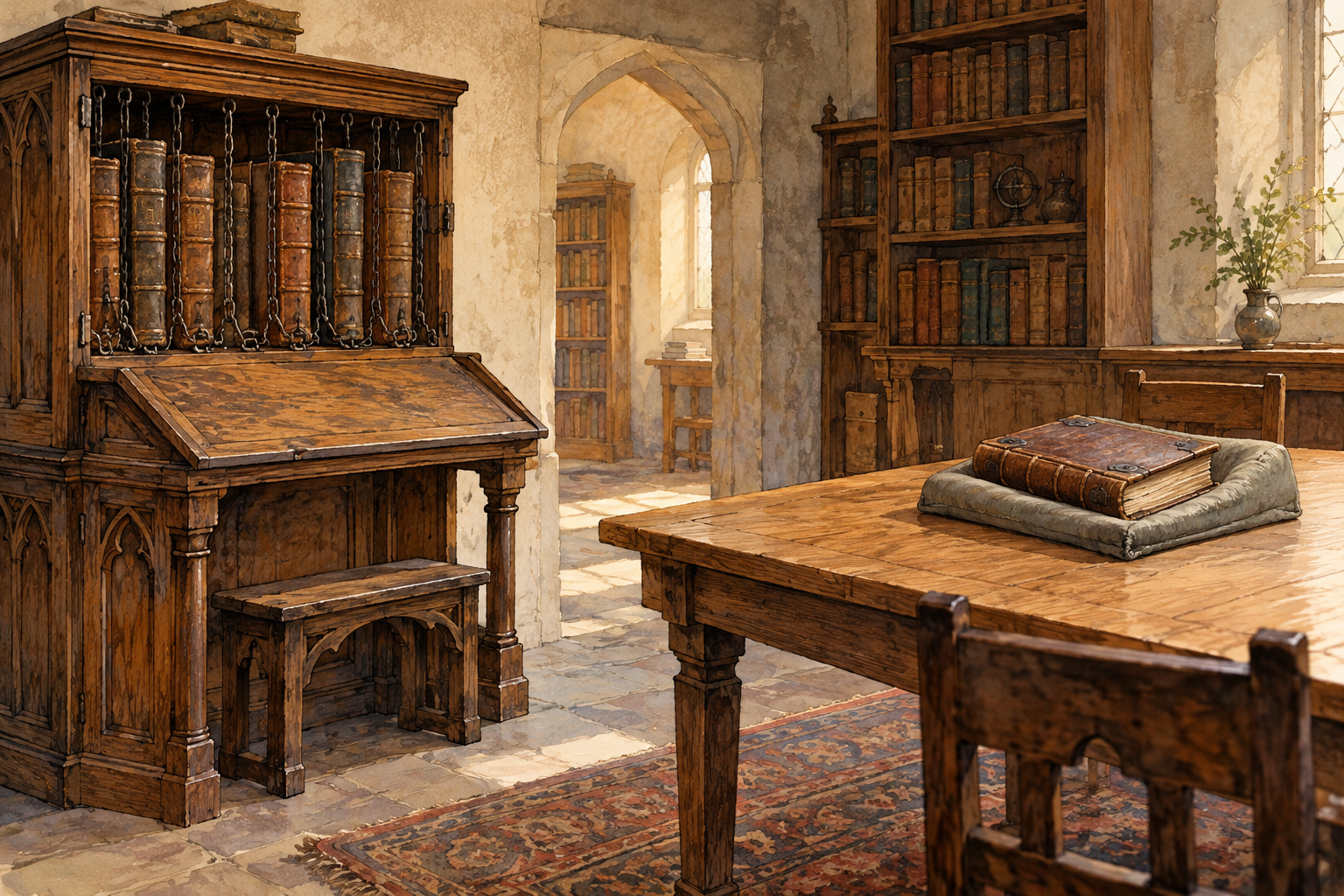
The word library now easily suggests a large building. Chetham’s parish collections demonstrate a smaller scale. The institution records a plan under Humphrey Chetham’s will for five church or chapel libraries, with books fixed in suitable places. The Gorton collection combined a cabinet with a reading support; Gorton and Turton survive intact, while the other planned collections had different outcomes. Gorton entered Chetham’s on permanent loan in 1984 and was acquired in 2001. That history is a record of movement and stewardship, not evidence of an object frozen in its first location.
A cabinet-sized library makes the relationship between storage and consultation especially clear. A large room can provide separate spaces for shelves, seating and supervision. A small unit must concentrate these functions. Doors secure the contents, shelves establish positions and a support offers a place to open a volume. The furniture becomes an institution in miniature. Its purpose is not exhausted by the number of books it can contain.
Scale changes the kinds of choice a reader can make. In a compact collection, the sequence of works is readily visible, but the range of subjects may be deliberately narrow. In a large collection, many more works can be available while finding the desired one becomes a more elaborate task. Those are different arrangements of opportunity. A small local collection need not be dismissed as insignificant simply because it cannot resemble a university library.
Chetham’s stated intention for the parish books included edification through English religious works. That intention belongs to a particular social and religious project. It should not be translated into a claim of neutral access to all knowledge. The contents were selected. Selection is part of the library’s history just as much as the chains or joinery. The cabinet offered a practical route to reading a chosen body of work in a chosen place.
Its survival also makes missing parts more meaningful. A removed sloping shelf changes the way the unit communicates its earlier purpose. A visitor seeing only doors and upright books might understand storage but miss consultation. Institutional descriptions can restore that relationship in explanation, even where the physical component no longer survives. This is why the most useful account of a chained library combines the object with records of how it was assembled and altered.

Seats and shelves shaped the act of reading
A reader who must remain within the reach of a tether needs an appropriate place to stand or sit. The location of that place is not incidental. A movable chair cannot automatically make any point in the room a reading station if the book remains attached elsewhere. The desk’s height, the shelf’s position and the support for the open volume all influence the usable space. The room’s architecture follows the available movement.
A 2013 Guardian report describes Bodleian reading stations with lecterns or fixed benches before chairs arrived in the eighteenth century.
Chetham’s institutional history adds another specific detail: readers originally had portable oak stools, and the library occupied an upper floor to avoid rising damp. These choices address different needs. The stool supports a person; the building’s level protects the collection against a form of environmental exposure. Together they demonstrate why a library’s practicality cannot be measured by its locking system alone.
A tethered volume encourages consultation close to its home position. That can suit sustained attention to one work. It can also make comparison awkward when the second desired book is attached elsewhere. That is a consequence of the layout, not a claim that every historical scholar worked in isolation or could never obtain help. An institution could provide assistance, different arrangements or exceptions. The physical constraint still defines what a reader can do without such intervention.
Modern readers often treat the ability to gather several books around a table as an unremarkable convenience. A chained shelf makes that convenience visible by limiting it. Comparing passages is an intellectual task, but it also requires arranging objects. The furniture can make that arrangement simple, inconvenient or dependent on staff. The history of reading includes these ordinary physical opportunities, alongside the history of texts and ideas.
Replacing chains changed the work of custody
Chetham’s account of its creation describes acquisitions beginning in the 1650s, shelves ordered by the size of volumes and a catalogue published in 1791. As the collection grew, the presses became taller. Eventually chaining gave way to gates, with material brought to the reading room for study. Alphabetic press labels and traces of earlier fittings remain. The library says its fixed location system still works alongside its electronic catalogue.
This is a particularly useful example because it does not equate removing chains with abandoning control. The boundary moved. Instead of attaching each book to accessible furniture, gates restricted access to the shelves while another process brought a selected volume to the reader. The reading room became the point of consultation. The collection could become easier to arrange without every item being freely available for self-service removal.
The change also redistributed tasks. A chain allows certain movements without an attendant’s immediate intervention. A system of retrieval may require someone to locate, deliver and return the volume. That does not by itself tell us which arrangement was cheaper, faster or more welcoming. It identifies where the work occurs. The labor of custody can be embedded in hardware or performed through a supervised procedure, and often combines both.
Growing shelves raise another practical issue. A fixed reading surface can serve books within a limited physical relationship to it. Expanding storage upward does not automatically expand comfortable reading positions. More volumes create demand for identification, retrieval and space as well as security. A collection’s growth can therefore place pressure on the entire arrangement, not merely on the capacity of the lock.
The chronology at Chetham’s should remain its own. It cannot establish the moment every other library unchained its books, or a universal cause for the practice’s decline. What it does establish is an institutional transition: different furniture, different boundaries and continued reference use. The surviving traces preserve evidence of an earlier workflow inside a collection that has continued to change.
There is also a difference between preventing a whole volume from leaving and protecting everything inside it. A tether does not stop a careless hand from bending a leaf, marking a page or pulling against a weak joint. Its effectiveness has to be judged against the movement it restricts. That observation does not document damage to any named book here; it explains why a chain cannot replace appropriate handling and supervision. The mechanism addresses removal, while other practices must address condition. Thinking of it as one element of care is more accurate than treating metal as a guarantee of preservation.
The catalogue and the chain answered different questions
A chain can establish where a volume must remain. It cannot tell a reader whether that volume contains the required passage. A catalogue describes and locates materials, while the physical system controls their movement. Both can be necessary, but they do different work. Confusing them leads to a narrow picture of access in which simply getting near the object becomes equivalent to understanding what is available.
Hereford’s catalogues page, published August 5, 2024 and updated May 14, 2025, distinguishes manuscript catalogues from an online catalogue of printed books. The printed catalogue includes historic and chained-library material as well as modern lending and reference books. The cathedral’s reading-room page, updated November 28, 2024, also describes a place for consulting historical collections alongside modern study facilities. A surviving chained library thus sits within a broader working institution.
That distinction prevents a common visual misunderstanding. A visitor can see a historically arranged set of shelves and assume the entire library functions that way. The institution can preserve one arrangement for its historical value while operating other collections through different procedures. The chain does not define every book, every reader or every current service associated with the cathedral.
A catalogue can also connect a physical volume with a description independent of its present position. That makes it possible to ask about an edition, author or manuscript without first recognizing a particular binding on a shelf. The description and the object complement one another. The catalogue cannot reproduce every material feature, and the physical object cannot explain every aspect of its history without interpretation.
For the curiosity at the heart of this story, the relationship is especially revealing. The shelf faces the reader with edges rather than spines because movement mattered. Finding aids compensate for what that arrangement makes less obvious. A practical reading system therefore includes information outside the book as well as the information inside it. The visible metal is only the most conspicuous part of that system.
Survival does not mean nothing has changed
Hereford identifies its present display as preserving the arrangement used from 1611 to 1841, in a specially designed chamber with controlled environmental conditions. It also identifies the eighth-century Hereford Gospels among 229 medieval manuscripts. Those facts describe several different kinds of continuity: a very old text-bearing object, a later shelving arrangement and a modern setting intended to protect them. They do not make the current chamber an eighth-century room.
Conservation introduces its own requirements. An object retained for future study may need a stable environment, support during consultation or limited handling. A historic arrangement can be valuable evidence while also presenting challenges for the materials within it. The decision to preserve the relationship between books and furniture is therefore a decision about more than a picturesque appearance.
The object at Chetham’s with replacement spines illustrates a related point at book level. Repair can allow continued survival while leaving a record of intervention. An original covering, a later spine and a historical title on the edge can all belong to the same volume. Calling it simply original or simply restored can hide the layered condition. The useful description identifies what survives and what changed.
Movement matters too. The Gorton cabinet’s transfer into another institution altered its setting without erasing its earlier purpose. Its current surroundings help protect and explain it, but cannot be assumed to reproduce every condition of its parish use. A surviving library can preserve a coherent group of objects even after the group’s location changes. Continuity of collection and continuity of room are separate claims.
This makes conservation part of the historical explanation. A well-maintained object is not necessarily an untouched object, and an altered object is not automatically unreliable. What matters is whether alterations are identified and their consequences understood. The libraries’ own accounts are valuable because they supply those distinctions. They let the present arrangement be appreciated without inventing an unbroken scene of people reading exactly the same way for centuries.
A dated photograph records another layer
Historic England’s archive includes a photograph of Wimborne’s chained library dated July 15, 1898, with reference CC78/00195. It provides a dated record separate from the foundation story and present visitor information. The date belongs to the photograph, not to every object it depicts. That seems obvious, yet it is an easy distinction to lose when an old room’s appearance is treated as timeless.
A photograph can show the relationship between furniture and space at a particular moment. It cannot establish by itself when a chain was installed, whether every volume was present or who was permitted to use the room. A catalogue record gives the image an identifiable place and date; institutional history supplies other kinds of context. The sources are complementary because their limits differ.
The image also makes it possible to think about change without assuming that every difference is damage. Objects may be moved for display, a support may be replaced or a room may be arranged for conservation. A comparison needs to establish what is being compared before drawing conclusions. Lighting, angle and framing alone can make the same fitting appear absent or different.
For contemporary illustrations, the distinction is stronger still. An original drawing can explain a general concept with clarity, but it has no evidentiary standing as a record of a named library. A caption should say so. The open book, rod and chain in an explanatory image help a reader imagine a mechanism. They do not establish the dimensions, joinery or exact attachments at Hereford, Wimborne or Gorton.
Dating the records prevents the article’s present publication date from laundering older observations into new discoveries. This is a historical curiosity researched in October 2026, not an announcement that a library has just been found or reopened. Its usefulness comes from bringing well-documented relationships into view, with the dates of the supporting material available to readers.
Access was a set of permissions, not a single switch
It helps to separate four actions: seeing a collection, entering its reading space, consulting a particular volume and taking that volume away. A chained library can permit some of these while refusing others. Its appearance is dramatic because the refusal is embodied in metal, but its access rules are still a sequence of permissions. The same distinction explains why a public display and a research service can coexist without offering identical forms of use.
For the present-day reader, a surviving library’s historical openness is not a promise of unrestricted handling today. Conservation and current institutional arrangements can govern consultation. Wimborne’s public information distinguishes access to the church from access to the upstairs library, and notes a filmed tour as an alternative where physical access is unavailable. It is better to consult the institution’s current information than turn a historical description into a travel guarantee.
The physical structure of a room can create a further boundary. A staircase, a high shelf or a narrow station may make use difficult even when a person is formally admitted. Those constraints should not disappear behind a romantic account of communal reading. Nor should modern alternatives be assumed to offer the identical experience of examining an original volume. Different forms of access can be useful while serving different needs.
The most productive interpretation holds security, selection, language, space and permission together. A donor can provide books while restricting the intended audience. A library can preserve volumes while changing how they are consulted. A cabinet can offer a local reading opportunity while containing only a selected body of material. None of these conditions can be read from the chain alone.
This is why the history matters beyond its unusual visual detail. The shelf is evidence of how an institution turned possession into a service, with limits. It shows that access had to be arranged through material objects and human decisions. The question is not merely whether a book was locked up, but what a person could actually do with it once admitted.
The modest ingenuity of a tethered book
The chained library is memorable because it makes an invisible responsibility tangible. Someone must ensure that a shared object remains available for the next person. A tether accomplishes one part of that task through a physical limit. The desk makes the permitted use workable. The outward page edge reduces the conflict between movement and attachment. A title or location mark helps the reader find the right volume. Together these details form a coherent arrangement.
It is neither necessary nor accurate to celebrate that arrangement as the perfect solution. A chain can complicate handling. A fixed station can limit comparison. A donor’s rules can exclude potential readers. A secure collection can still require environmental care, description and maintenance. Recognizing the ingenuity does not require overlooking its constraints, and recognizing its constraints does not make the design meaningless.
The examples also refuse a simple opposition between old and new. Printed books could be chained. A collection could remove chains and retain supervised consultation. A modern catalogue could describe material still associated with historic furniture. The objects survive through change, and their usefulness as evidence depends on explaining that change precisely.
Look again at the pale edges facing the room. The absence of visible spines is no longer a mistake awaiting correction. It is a clue to the movement the reader was expected to make. The chain was meant to stay out of the way of opening the book while preventing another movement entirely: carrying it off. A small adjustment to orientation helped make those two aims compatible.
That is the lasting appeal of the curiosity. The mechanism reveals a library thinking through an ordinary but difficult question: how can a valuable book be made usable without ceasing to be shared? Its answer was built in wood, paper and iron. The surviving rooms and cabinets let us see the answer as a working relationship, one whose cleverness becomes clearest when the book is imagined open on the desk rather than trapped on the shelf.