

Why Soap Bubbles Show Rainbow Colors

Why Soap Bubbles Show Rainbow Colors
CURIOSITIES · LIGHT & COLOR
A soap bubble is a clear film, yet it can flash blue, gold, violet and green. Those hues are not dyes in the soap. They are a changing pattern made when light reflects from the film’s two boundaries and the reflected waves overlap.
OnelROR Editorial Team · October 20, 2026 · Miami (America/New_York) · 3 min read
Two reflections meet in a very thin layer
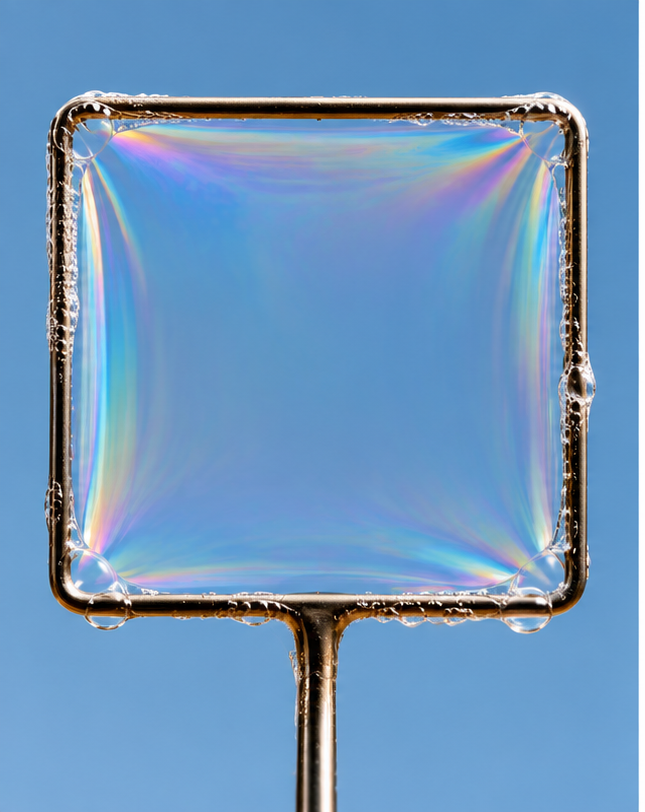
When white light hits a bubble, part reflects from the film’s outer surface. Some passes through the soap-and-water layer, reflects from the inner surface, then comes back out. The two reflected waves have traveled different distances, so they can reinforce one another or partly cancel.
That overlap is called thin-film interference. The exact result depends on the film’s thickness, the light’s wavelength and the angle at which light arrives and reaches your eye. Harvard’s lecture demonstration explains that a soap film’s front reflection undergoes a phase reversal, while the rear reflection does not. That difference matters: even when the extra distance is tiny, the waves may return out of step.
Why the rainbow keeps changing
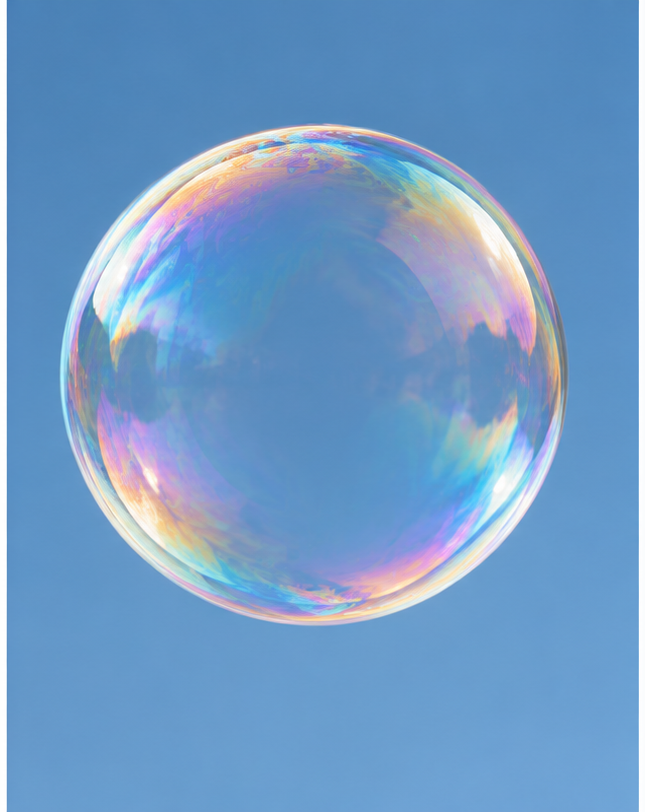
Different wavelengths correspond to different colors. At one spot, a particular thickness may strengthen some wavelengths and weaken others. A nearby spot has a slightly different thickness, so a different mix is reinforced. The result is a map of color across the bubble, not a layer of colored material.
The film is not perfectly uniform. Its liquid moves and its thickness varies, so the bright bands shift as the bubble changes. Tilting your head or changing the viewing angle can also alter the path difference between the reflections. That is why a patch that looked green a moment ago may turn pink or gold.
Why some places look nearly black
When the film becomes extremely thin, the two reflected waves can cancel strongly rather than create a bright color. Harvard notes that the very thin top of its vertical soap-film demonstration looks dark for this reason. A dark patch is therefore not a black pigment; it can mean that little reflected light of the viewed wavelengths is reaching you there.
That dark appearance is a clue about interference, not a precise thickness gauge. Real bubbles curve, lighting is rarely a single wavelength, and the observer sees a range of angles at once. Their shifting color is beautiful, but it does not let you read an exact film thickness by eye.
Color made by light, not by paint
Soap-bubble color is a useful everyday example of light behaving as a wave. The film selects which parts of white light are strengthened in reflection; pigments, by contrast, create color by absorbing some wavelengths more than others. A bubble’s color is temporary because its film and viewing geometry keep changing.
For a deeper look, see Harvard Natural Sciences Lecture Demonstrations’ Thin Film Interference demonstration and The Physics Classroom’s thin-film interference lesson.