


World Sight Day 2026: What Accessible Eye Care Looks Like in Practice
ONELROR • PUBLIC HEALTH
World Sight Day 2026: What Accessible Eye Care Looks Like in Practice
As the October 8 campaign centers lived experience and community action, this guide follows the practical steps between noticing a need and receiving useful, affordable support.
By OnelROR Editorial Team · Published October 7, 2026 · 53 min read
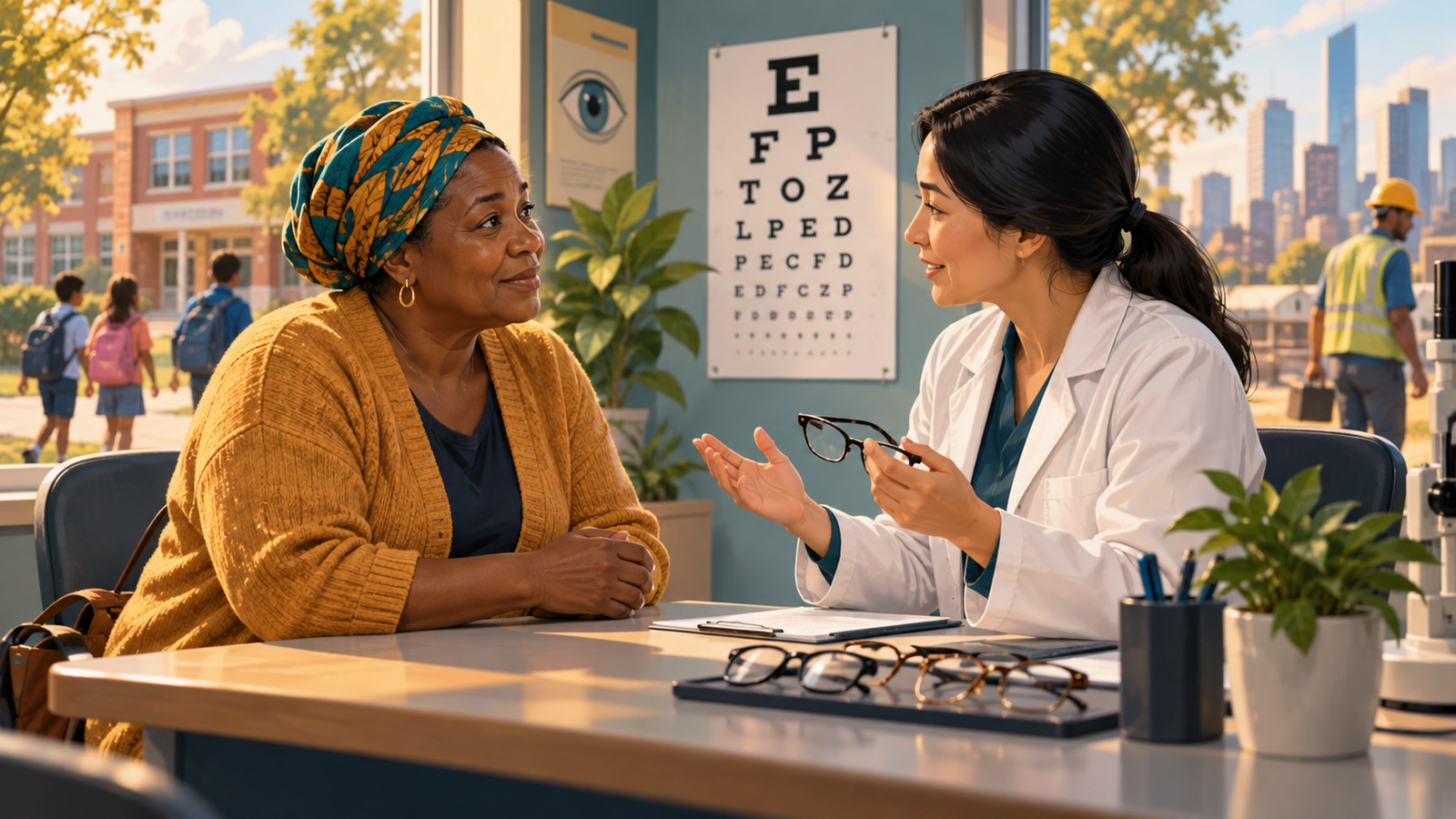
Featured image: original editorial illustration; it depicts a community-care concept, not a documented patient encounter.
World Sight Day is observed on Thursday, October 8, 2026. This year the International Agency for the Prevention of Blindness (IAPB) is asking people and institutions to focus on eye care that is accessible, available, and affordable, and to put lived experience and community action at the center of the campaign. The date is a useful prompt, but the larger question lasts all year: can a person who needs vision care recognize the need, reach an appropriate service, afford the visit and any follow-up, and use the result in daily life? That whole chain is what access means.
The World Health Organization (WHO) has opened a public consultation on a proposed global initiative for cataract-related vision impairment. Its consultation page says the World Health Assembly endorsed a 2030 target in 2021 to increase effective cataract surgical coverage by 30 percentage points. WHO says more than half of people globally who need cataract surgery do not receive it, and the consultation draft estimates 100 million adults aged 50 or older have vision impairment or blindness due to untreated cataract. The comment period closes October 8, 2026, Central European Time. These are global, model-based and policy-context figures; they do not predict an individual’s health or describe every country equally.
This guide explains what those headlines can and cannot tell us, how services fit together, and what schools, workplaces, families, public agencies, and local organizations can do to make eye care easier to reach. It is public-health information, not a way to diagnose a condition or choose treatment. A vision chart, online test, or screening can identify a reason to seek qualified assessment, but none replaces an examination by an appropriate eye-care professional. Sudden changes in sight or a painful injury call for prompt professional attention through local urgent-care or emergency pathways. Readers should use their own clinician’s advice for personal decisions.
A day for vision, and a year for access
World Sight Day falls on the second Thursday in October. IAPB leads the campaign with more than 250 member organizations, and it describes the 2026 focus as stories, lived experience, and community action. The campaign invites schools and workplaces to host activities, encourages people to share why vision matters in their lives, and asks institutions to make access visible in policy discussions. Those activities can introduce the subject to people who rarely think about eye health. Their real value depends on whether attention leads to reliable services and practical changes after the campaign day ends.
Campaigns often use a short phrase to make a complicated issue memorable. “Love Your Eyes” is an invitation, not a clinical instruction and not a promise that a personal habit can prevent every eye condition. Sight can be affected by many different causes: a refractive error that glasses can correct, a disease requiring clinical care, an injury, a developmental condition, or a disability that changes how someone accesses information. Some needs are temporary, some recur, and some are lifelong. A responsible awareness message makes room for all of them, including people who are blind or have low vision and do not expect to regain sight.
The day also sits between two policy moments. IAPB says the first Global Summit for Eye Health is scheduled in Antigua and Barbuda on November 2, 2026. WHO’s draft on cataract-related impairment is in public consultation, a stage when comments may influence the final paper. A useful public conversation therefore has a concrete direction: explain what people need, identify which parts of the service pathway are missing, and ask decision-makers to measure improvement. The campaign is not the summit, and a draft is not a final policy. Keeping those distinctions clear helps readers follow what has happened and what remains proposed.
What “vision” measures, and what it leaves out
Everyday speech can treat “vision” as one thing, but public-health measures usually describe particular abilities or conditions. Visual acuity is the ability to distinguish detail at a specified distance under a test’s conditions. A chart measures one part of function. It does not by itself describe the full visual field, contrast sensitivity, color perception, glare tolerance, depth cues, or the ability to use vision in a particular environment. Someone may read a chart well yet have another visual difficulty; someone else may read less detail but navigate and work effectively with appropriate tools and support.
CDC’s Vision and Eye Health Surveillance System (VEHSS) makes an important distinction in its modeled estimates. “Presenting visual acuity loss” describes measured acuity while a person uses their usual glasses or contact lenses. “Uncorrected refractive error” is a subset that may improve to 20/20 with appropriate refraction and eyewear. “Best corrected visual acuity loss” describes a measured deficit that remains when the best available correction is used. These categories help planners distinguish unmet need for correction from other acuity loss. They are not diagnoses, and they do not include every aspect of seeing or functioning.
The familiar 20/20 notation is a comparison under a standardized test, not a guarantee of perfect sight, eye health, or visual comfort in every setting. It also does not summarize the person’s ability to read small print for a long time, perceive obstacles in dim light, follow a moving object, or interpret a busy screen. Population statistics based on acuity answer a defined question. They should not be stretched into claims about every person’s experience or every eye condition. When a report gives a number, readers should ask: which test, which threshold, which population, and which year?
Function is shaped by context as well as by an eye measurement. A person may read a high-contrast large-print notice but struggle with a small, low-contrast form. Someone who can travel along a familiar route may need assistance in a station with changed signage. A student can understand a lesson but miss content displayed far from the board. The point is not that measurement is useless; it is that measurement and lived experience answer different questions. Strong public-health planning uses both: defined indicators for comparison and direct feedback about whether services and environments work for people.
Reading the latest U.S. estimate carefully
On August 12, 2026, CDC published modeled estimates using 2024 data. It estimated that 32.17 million people in the United States had presenting visual acuity loss, or 9.46 percent of the population covered by the estimate. Within that total, the model estimated 25.02 million people had uncorrected refractive error. It estimated 7.15 million had best-corrected acuity loss, including more than 700,000 categorized as blind under the measure used. CDC also reported more than three million children with presenting acuity loss. The figures provide a national baseline for planning; they are not a count from a single examination campaign.
The model combines information from multiple data sources and census data. That matters because no one dataset observes every person with the same examination, at the same time, using the same protocol. CDC describes its estimates as modeled, and publishes definitions and documentation alongside them. The 2024 reference year is not the same as the publication date in August 2026. This time lag is common in surveillance: agencies need to collect, combine, check, and model data before releasing estimates. Responsible reporting keeps the data year beside the release date so readers do not mistake an estimate for a real-time census.
CDC reports that presenting acuity loss was more prevalent in some groups, including people living in poverty, adults aged 15 and older with less than a high-school education, and people in nursing or correctional facilities. These differences describe modeled population patterns, not the reason for any one person’s result. They should prompt questions about service availability, affordability, mobility, communication, and measurement—not assumptions about individuals. Group-level patterns can help public agencies decide where to investigate barriers, but communities need local data and direct consultation before choosing a response.
CDC cautions that the acuity estimates do not account for other kinds of vision loss, such as visual-field or contrast-sensitivity problems. Diagnosed records also do not equal all vision impairment: a person may have an unrecognized need, may not have attended a service, or may have a diagnosis that is not coded in the data system. Conversely, a survey question about self-reported vision measures perceived function rather than acuity on a chart. Each approach has a purpose. Combining sources can give a fuller picture, but only if analysts preserve the differences instead of adding unlike numbers together.
The access chain: from need to useful support
Access is often reduced to whether a clinic exists nearby. Location matters, but it is only one link. A person must know where to go, be able to schedule a visit, travel there, communicate with staff, afford the examination and any needed device or follow-up, and receive care at a time compatible with work or caregiving. The service must also be culturally and linguistically understandable, physically accessible, and appropriate to the person’s needs. If any link fails, a nominally available benefit may not become usable care.
The pathway starts with recognition. A family might notice a child holding a book very close, a worker might find that task details are becoming harder to see, or a person may have an eye-care appointment as part of routine health planning. A screening program can bring a potential issue to attention, but a screening result is not itself a diagnosis. The next step should be clearly explained: who can perform the assessment, how to make an appointment, what the screening did not test, what records to bring, and what options exist if cost or transport is a concern.
The next link is a service able to address the need. A refraction and glasses prescription, a comprehensive eye examination, an assessment of a possible disease, surgery, rehabilitation, and low-vision support are different services. One provider may offer some but not all. A referral is useful only if it reaches a destination that accepts the person, communicates the reason for referral, and returns information to the referring service. For a patient, a phone number on a paper slip may be inadequate if it is unreadable, unavailable in their language, or impossible to call during working hours.
Continuity is the link that keeps an initial encounter from becoming an isolated event. Glasses may need fitting, repair, replacement, or an updated prescription; a referral may require follow-up; a person with permanent low vision may benefit from tools and skills that are not a medical treatment. Public-health programs can improve continuity by assigning navigation support, using reminders that respect privacy, offering several ways to respond, and checking whether the next step actually happened. A completed screening count measures activity. A closed referral loop measures whether people could move through the pathway.
Correctable refractive error and why glasses matter
Refractive error occurs when the eye’s optical system does not focus light in a way that gives the desired image at the retina. Nearsightedness, farsightedness, and astigmatism are common forms; presbyopia, the age-related difficulty focusing up close, is another familiar change. A qualified assessment can determine whether corrective lenses are appropriate and what prescription is needed. Glasses can be a relatively simple and highly useful response, but the existence of a lens prescription does not automatically ensure that the person can obtain, afford, wear, or replace eyewear.
CDC’s modeled estimate identifies uncorrected refractive error as a large component of measured presenting acuity loss in the United States. A 2024 NIH-funded analysis of 2022–23 Medicaid policies, described by the National Eye Institute, found wide state variation in adult coverage for routine eye exams and eyeglasses. The study reported that six and a half million Medicaid enrollees lived in states without coverage for routine adult eye exams and 14.6 million in states without eyeglass coverage under the policies it analyzed. Those figures refer to a specific policy period and population; they should not be presented as the current coverage status of every state or every enrollee.
For people seeking glasses, a usable service includes more than choosing frames. The prescription must correspond to a proper assessment; the eyewear needs to be made and fitted; the person needs clear information about use and care; and repair or replacement must be realistic. For a child, a pair that is lost or broken can interrupt learning if no backup or replacement process exists. For an adult, a prescription that is technically covered can remain out of reach if the nearest provider is far away or the cost-sharing amount competes with essentials. Program design should follow the whole experience, not just the appointment.
Low-cost eyewear initiatives can help address access, especially where uncorrected refractive error is common, but they still need quality safeguards and appropriate clinical assessment. A ready-made pair may suit some simple needs but is not a substitute for an individualized prescription or an eye examination when one is indicated. Programs should avoid portraying glasses as a universal solution to all visual impairment. Their strongest case is specific: where properly assessed refractive error prevents someone from seeing clearly, reliable corrective lenses can enable reading, mobility, work, and participation.
Screening, examination, referral, and diagnosis are different
Screening is a way to identify people who may need further assessment. It is designed for a target group or setting and must be interpreted within its protocol. A school screening, a workplace check, a chart on a wall, or a phone-based test may not assess every relevant condition. If the screening is normal, that does not necessarily rule out a problem outside the test’s scope. If it flags a possible issue, the person needs understandable guidance about where to go next rather than an alarming label.
An examination is a clinical encounter with a qualified eye-care professional. What it includes depends on the professional’s scope, the reason for the visit, the person’s age and history, and local standards. It can assess more than the ability to read letters at a distance. Public communications should not imply that one specific interval is appropriate for everyone; needs and professional guidance differ. A person with symptoms, a known condition, a family history, or a clinician-directed monitoring plan should follow advice tailored to them.
Diagnosis is a professional conclusion based on appropriate evaluation, not a score from a campaign booth or an online quiz. The distinction protects people from both false reassurance and unnecessary fear. It also protects the integrity of data: a screening program should report how many people were screened, how many results suggested follow-up, how many referrals were completed, and what the program is authorized to say about later outcomes. It should not count a positive screen as a diagnosed case unless a diagnostic process actually established that diagnosis.
When organizations offer screening, they can build trust by explaining the purpose and limits in plain language before the activity. Participation should be voluntary and privacy-respecting. Staff should know how to route a concerning result without giving a diagnosis outside their role. The event should have a referral destination, language support, accessible information, and a plan for people who cannot pay. Without these elements, a screening can raise concern without connecting people to care. The question to ask is not simply “How many tests did we give?” but “What useful next step could each participant take?”
Children and schools: support should continue after the chart
A child’s ability to see classroom materials can affect access to instruction, play, transportation, and peer interaction. Schools can help by knowing local screening requirements, maintaining clear communication with families, and coordinating with qualified providers and public programs. A screening can flag a concern; families need a clear explanation and a path to assessment. A child should not have to interpret a technical result alone, and a school should not treat a screening as proof of a diagnosis or as a substitute for a professional examination.
Practical school access includes consent and privacy procedures, language-appropriate notices, scheduling options for caregivers, and a named contact who can help answer questions. A referral letter should say what was observed, what the screening did and did not assess, and whom the family can contact. If the school has access to a nurse, community health worker, or family navigator, that person may help connect the family to services without taking the clinician’s role. The communication should be respectful: avoid describing children as careless, inattentive, or less capable because they may not be seeing the lesson clearly.
Learning environments can be made more usable while a family arranges care. Teachers can provide digital copies of board notes, seat a student where they can participate, use strong contrast and readable type, and say aloud information that is otherwise presented visually. These accommodations help students access material; they do not diagnose or treat an eye condition. They can benefit a wide range of learners and can be adjusted through normal school support processes. The child’s own preferences matter: some may prefer a different seat, a screen zoom setting, or a printed handout rather than being singled out.
Families can ask a provider or school contact what type of appointment is recommended, whether insurance or a public program may cover it, what records to bring, and what will happen if the screening result is uncertain. Ask how to obtain or replace glasses if the child needs them. Schools can evaluate whether referred students reach services, with appropriate privacy protections and consent. A tally of screenings is not a measure of successful access if a family receives a referral but cannot find an appointment, transportation, language assistance, or affordable eyewear.
Workplaces: protect people and remove avoidable friction
Work tasks place different demands on vision. A worker may read labels, check a display, distinguish objects at a distance, handle tools, or move through a dim or changing environment. Employers should assess task-specific hazards and follow applicable workplace-safety obligations. General eye protection can reduce exposure to particular hazards when selected for the task, but it does not replace an eye examination, correct refractive needs, or make an unsafe process safe. The right protective equipment depends on the hazard and the relevant safety standard.
IAPB’s 2026 workplace materials invite employers and workers to treat eye health as part of everyday work. An organization can start by reviewing existing safety procedures, asking workers where visual tasks are difficult, and making information accessible. It can ensure that safety glasses fit the person and are compatible with any needed prescription. It can provide clear routes for reporting near misses or equipment problems without retaliation. It can check lighting, signage, and screen readability as part of ergonomic and accessibility reviews.
Employers can also reduce the practical cost of seeking care by offering scheduling flexibility, explaining any available benefits, and making reasonable accommodations through established processes. A health fair screening should be voluntary, private, and linked to a provider pathway. Employers should not use screening results to make personnel decisions outside lawful and appropriate procedures, and should not collect more sensitive information than needed. Workplace initiatives need clear boundaries between occupational safety, personal health information, and job requirements.
A useful workplace plan measures more than participation in a campaign event. It might track whether employees can find benefit information, whether protective equipment is available in appropriate sizes, whether incident reporting is understood, and whether visual-access barriers in software or training materials were addressed. Any results should be aggregated and protected to avoid identifying workers. The aim is not to create a medical surveillance program by default; it is to make work safer and information easier to use, while allowing employees to seek personal care through proper channels.
Older adults and low-vision services
As people age, the chance of needing vision care can change, but age alone does not define a person’s ability or goals. An older adult may need updated glasses, evaluation of a new symptom, management of a chronic eye condition, low-vision devices, or help adapting an environment. Some people have more than one need at the same time. A service that focuses only on whether someone can read a chart may miss problems with glare, contrast, mobility, medication labels, or digital forms.
Low vision describes visual impairment that can affect daily tasks even with standard correction; services may include assessment, magnification, lighting strategies, accessible technology, orientation and mobility support, and instruction in techniques that fit a person’s goals. It is distinct from a promise to restore sight. A National Eye Institute summary of Medicaid policy research noted that many state adult Medicaid programs did not cover low-vision aids in the 2022–23 period studied. That finding signals a potential access gap, but current eligibility and services must be checked with the state program because benefits and rules can change.
Family members and caregivers can help by asking what tasks the person wants to do independently and what form of support they prefer. Offer assistance rather than taking over automatically. Large-print materials, good contrast, uncluttered pathways, audible options, and lighting chosen with the person can make information or movement easier. Keep medication instructions in a format the person can use and confirm questions with a clinician or pharmacist rather than making assumptions about what an unlabeled bottle contains. Accessibility should protect agency, not replace it.
Public and community services should make low-vision referrals visible alongside medical eye care. A person may need a clinician to evaluate an eye condition and a separate rehabilitation service to practice navigation or use adaptive technology. These services complement one another. A referral that says only “vision impaired” may not capture the person’s priorities. With consent, care teams can coordinate a plan that considers transportation, home safety, information access, social participation, and follow-up. Respectful communication asks the person what matters to them first.
Blindness, disability, and accessible information
Eye care for all includes people who are blind and people with low vision; it does not mean every service is organized around restoring sight. Some people need accessible formats, rehabilitation, assistive technology, mobility support, or accommodations to participate in health care and public life. A sight chart may not reflect the full experience of disability, and a person’s preferred language for their vision may differ. Organizations should ask, listen, and make participation possible without requiring people to disclose more than they choose.
Accessible communication can be planned before a campaign begins. Registration forms should work with screen readers and keyboard navigation. Images should have concise, meaningful alternative text when the image conveys information; decorative images should not create unnecessary noise. Videos can include captions and audio description where relevant. Printed material can be offered in large print, braille, accessible digital formats, or another format requested by participants. A phone number alone may be inadequate for someone who cannot use voice calls, so organizations can offer email, text, or relay-friendly options as appropriate.
In a clinic, reception, examination, and payment processes can each create barriers. Staff can introduce themselves, explain when they will touch equipment or guide a person, describe room transitions, and ask whether assistance is wanted. Forms can be offered in accessible formats before the appointment. Digital portals should not assume that every patient sees small text or can complete a timed visual puzzle. Accessibility also includes the physical route: entrances, signs, elevators, service counters, and waiting-room announcements.
People with lived experience should be involved early in service design, not brought in only to endorse a finished campaign. Paid consultation, accessible meeting formats, clear decision authority, and feedback about what changed make participation meaningful. Token representation can turn a person’s story into decoration while leaving design decisions untouched. A strong approach asks which barrier is being addressed, who has authority to change it, how participants will know the change happened, and how the organization will report back.
Rural travel and community-based services
Distance can make even a covered examination inaccessible. A rural resident may need to travel hours to see a provider, arrange time away from work, find transportation, or combine several health appointments in one trip. Mobile clinics and community outreach can reduce travel burdens for some services, while remote tools can assist with particular steps. Neither is automatically a complete replacement for local clinical capacity. Programs should identify which needs they can safely meet on site, which require referral, and how follow-up will happen after the mobile team leaves.
Community sites can help make services familiar and reachable. Libraries, schools, senior centers, community organizations, and workplaces may offer trusted venues for information and referral. A venue is not a clinic merely because a screening occurs there. Clear role boundaries and referral agreements protect participants. A mobile activity can provide information about local providers, assist with scheduling, and explain possible coverage pathways. It should also make clear what it cannot assess and where urgent concerns should be directed under local guidance.
Rural service planning benefits from mapping travel time, provider availability, public transit, broadband, language access, and referral destinations together. A map of clinic locations alone can conceal whether people can realistically reach them. Community advisory groups can identify seasonal constraints, caregiving duties, and local patterns that a statewide database may miss. The resulting plan might combine periodic outreach with dependable fixed-site services and a way to communicate between visits. A one-time event can start relationships, but cannot establish ongoing access by itself.
Evaluation should examine whether the outreach reduces missed appointments and completes referrals, while protecting privacy and avoiding blame. If few people attend, the explanation may be scheduling, trust, publicity, transportation, or eligibility rather than lack of interest. Ask participants what prevented follow-through and offer more than one way to respond. Where resources are limited, transparent criteria help explain which communities are served first and why. Equity is not achieved simply by sending the same event to every town; it requires attention to different barriers and measured results.
Primary care and eye-care coordination
People often encounter primary care, schools, pharmacies, or community health programs before reaching an eye specialist. Integrating eye-health awareness into those settings can make it easier to notice a need and arrange a referral. Integration does not mean every worker performs an eye examination or gives advice beyond their role. It means the health system knows how to ask appropriate questions, recognize when a person needs an eye-care professional, and connect them to one without losing information along the way.
The World Health Organization’s integrated people-centred eye care framework emphasizes organizing promotive, preventive, treatment, and rehabilitation services around people’s needs across the life course. In practical terms, agencies can define referral criteria, train staff for their role, and agree how records and feedback move between services with consent. A primary-care clinic might help patients understand where eye services are available; an eye-care provider might coordinate relevant information with other clinicians. The exact model depends on local resources, professional scopes, privacy rules, and the service need.
Shared systems should not create duplicate tests or confusing responsibility. Patients can be asked to repeat their story at each stop if records do not travel, yet indiscriminate sharing of health information can compromise privacy. A useful referral contains only necessary information, identifies the question to be assessed, and indicates how the patient can follow up. A secure system should record whether the referral was accepted, scheduled, completed, or declined, and make a person responsible for helping when the pathway stalls.
Coordination has a public-health dimension because eye conditions can interact with broader health and daily function, but communications must be carefully scoped. Avoid suggesting that a routine vision screen detects every systemic illness or that eye care can replace primary care. Instead, explain the purpose of each service and the limits of the test. When organizations are clear about those boundaries, they can work together without overclaiming what one encounter reveals.
Workforce: the right skills in the right places
An eye-care system relies on multiple professional roles. Depending on the country and its regulations, optometrists, ophthalmologists, opticians, nurses, community health workers, rehabilitation specialists, teachers, and public-health teams may contribute different services. Training, licensing, and permitted tasks vary. A policy designed around a single workforce model may not transfer to another place. Planners should begin with local rules, population needs, referral capacity, and the competencies available rather than assume job titles are interchangeable.
Workforce planning concerns distribution as much as headcount. A region can have qualified professionals yet still have poor access if they are concentrated in major cities, cannot accept a public insurance plan, or lack interpreters and accessible facilities. Teams can review wait times, service locations, appointment availability, and referral completion. Incentives, training placements, tele-support, and community-based pathways may help address gaps, but each option needs evaluation. A short-term campaign should not mask a chronic shortage or shift uncompensated tasks onto community workers.
Task-sharing can expand reach when roles are clearly defined and supported by training, supervision, referral protocols, and quality checks. For example, a trained worker may be able to conduct an approved screening or help navigate an appointment pathway; that does not authorize diagnosing disease or prescribing. A strong program explains what happens when a result is uncertain, who reviews it, and how the participant reaches the appropriate professional. Accountability should be visible to the worker and the public.
The workforce also needs accessible tools and sustainable working conditions. Staff may need interpreters, accessible records, enough appointment time, functioning equipment, and a safe way to manage follow-up. Burnout and turnover can interrupt continuity, especially in remote settings. Community organizations can support outreach, but a clinical service should not depend on volunteers filling a structural workforce gap indefinitely. A plan is more credible when its funding covers maintenance, supervision, data quality, and staffing beyond the launch event.
Paying for care: coverage is necessary but not sufficient
Affordability has several components: the exam, eyewear, medication or treatment when prescribed, travel, time away from work, childcare, and follow-up. Insurance can reduce direct costs but does not guarantee that a provider accepts the plan or is close enough to reach. A benefit may have a copayment, frequency limit, prior authorization, network restriction, or a narrow definition of covered equipment. Public communications should help people find official, current details instead of promising that a service is free or universally covered.
The National Eye Institute described a study of adult Medicaid vision benefits based on 2022–23 policy data. It found that coverage varied widely by state; the study noted that some states did not cover routine adult exams or glasses, and that copayments and restrictive rules could remain barriers even where coverage existed. The figures are a snapshot of the policies studied, not a current benefits lookup. People should confirm their own state and plan rules through official Medicaid channels or a qualified benefits navigator. Children’s Medicaid vision coverage operates under different requirements from adult optional benefits.
Coverage is most useful when it connects the service chain. If an exam benefit exists but glasses are unaffordable, a person may still struggle to function. If a referral is covered but the specialist has no appointments, the practical result may be delay. If low-vision aids are excluded, a person may lack tools that support independence. Policymakers can review package design by looking at the service need and patient experience, not only the number of billing codes. Public programs may also explore purchasing, repair, or transportation approaches where permitted and evidence supports them.
Financial planning should distinguish costs from savings and outcomes. An economic case for eye care may estimate productivity or educational participation, but such estimates depend on assumptions and should be identified as estimates. A health service deserves evaluation on equity, function, quality, and patient priorities, not solely on whether projected savings exceed its budget. Public spending decisions can use transparent comparisons while recognizing benefits that do not appear in a short time horizon, such as confidence, social participation, and easier access to information.
Technology and tele-eye care: useful tools with boundaries
Digital tools can make some parts of eye care easier to reach. Remote consultations can help connect a patient and professional across distance, assist with follow-up, or provide triage under appropriate protocols. Imaging and data systems can support clinical decisions when staff are trained and quality is maintained. Accessibility technology such as screen magnification, speech output, contrast settings, and text recognition can help people access information. These tools are different categories: one provides clinical service, another supports daily function, and neither should be confused with a consumer “eye test” that claims to diagnose everything.
Remote services have limits. Some examinations require equipment, physical assessment, or in-person procedures. Image quality, connectivity, privacy, and a patient’s ability to operate the platform can affect whether a remote encounter is useful. A rural clinic may need local staff to capture an image or measure a vital parameter, plus a specialist to interpret it and a pathway for an in-person review. The program must establish what happens if the image cannot be interpreted, the person cannot connect, or the result indicates a need for further care.
Digital access is not universal. Broadband, suitable devices, data plans, language, literacy, disability access, and private space all affect participation. A video-only appointment can exclude people who rely on text, need an interpreter, have limited connectivity, or cannot use a camera interface. Offer alternatives such as voice or in-person service where appropriate, and do not make digital delivery the only route to a critical service. Technology should reduce barriers without shifting all navigation work onto the patient.
Consumer applications and web-based charts can be educational or help someone describe a concern, but a result should not be treated as a diagnosis. The underlying test may not assess eye health, and the conditions of use may differ from clinical standards. Users should read what a tool measures, who developed it, whether it has been evaluated for the intended use, what data it collects, and what its limitations are. If an app handles sensitive health information, privacy policies and data practices matter. A marketing claim is not proof of clinical validity.
Trust, language, and community knowledge
People are more likely to use services when they understand what will happen and believe that the service respects them. Trust is built through clear explanations, reliable follow-through, privacy, culturally responsive communication, and accountability when something goes wrong. It is not achieved by translating a poster after all program decisions have been made. Community partners should help shape outreach, set priorities, choose venues, and determine how feedback is returned to participants.
Language access includes more than translating an invitation. A person may need interpretation during scheduling, consent, examination, billing, and follow-up. Translated information should use plain language and explain unfamiliar systems. Interpreters should be competent and should be offered without placing a child or family member in an unwanted role. Organizations can provide accessible formats in advance and ask participants what works best for them rather than make assumptions based on age, appearance, or nationality.
Stories can show how access barriers affect real life, which is one reason the 2026 campaign centers lived experience. Ethical storytelling requires consent, context, and control. A person should know where their story or image will appear, for how long, and whether it will be used in fundraising or partner materials. They should be able to decline without losing services. Avoid presenting someone’s life as a single inspirational lesson or implying that an individual must disclose disability to make a policy case. Aggregate data and lived experience can inform one another without either replacing the other.
Feedback should reach a decision-maker who can respond. A community event can collect comments about travel, cost, or scheduling, but the organizer should explain how those comments will be summarized and what action follows. If no change is possible, say why and identify another route. A feedback form that disappears into a folder can weaken trust. Co-design works when residents can see which suggestions were adopted, which were not, and how the next review will occur.
Communication without myths or blame
Eye-health messaging can accidentally create myths when it simplifies too aggressively. Avoid telling audiences that a specific food, exercise, screen setting, or supplement will prevent all sight loss. Avoid implying that people who experience vision impairment failed to take care of themselves. Some causes are preventable or treatable, some are not, and access to prevention or treatment differs. Language should describe services and choices without assigning moral responsibility for a condition.
Screen use is a common subject of concern, but broad claims about permanent harm from ordinary device use require evidence and careful definitions. Long periods of near work can be tiring for some people, and lighting, font size, breaks, posture, and workspace comfort can affect usability. These practical adjustments are not treatments for every eye condition. Families should ask qualified professionals for guidance specific to a child, adult, or workplace need. A public article should separate general ergonomics from medical claims and should not substitute a universal rule for individual assessment.
Sun protection and workplace eye protection should also be communicated specifically. Different products and hazards require different standards, and a label or fashion description may not establish that an item is suitable for a particular task. Employers should identify the hazard and follow applicable safety requirements. Public-health messaging should point to authoritative standards and qualified advice, not rely on vague advice such as “wear any glasses.” The aim is to help people make informed choices rather than market a one-size-fits-all product.
Most importantly, a person who has a sudden or severe change in vision should not be told to wait for an awareness event or rely on an online screen. Public information can direct people toward appropriate local professional or emergency care, while avoiding diagnosis in the article. Organizations should keep urgent-care routing current for the jurisdiction where an event occurs. A general educational feature cannot assess symptoms remotely or decide which service an individual needs.
A practical plan for an individual or family
World Sight Day can be a reminder to make a personal plan without turning it into a source of anxiety. If someone already has a provider and a recommended follow-up schedule, the simplest step may be to check whether the next appointment is scheduled and whether transportation, time, or cost creates a barrier. If a person has no provider, they can ask a primary-care office, health plan, local public-health department, school, or community organization where qualified eye-care services are available. Confirm that the service fits the need and ask what it costs before committing when possible.
Before an appointment, a person may find it useful to write down questions, current eyewear, medicines, prior test results, and the everyday tasks that have become difficult. Examples of functional concerns might include reading labels, seeing classroom material, navigating unfamiliar places, using a computer, or glare at work. This list helps the person explain what matters to them; it does not diagnose the cause. Bring a support person if desired, and ask for an interpreter or accessible communication format ahead of time when that would help.
During the visit, ask the provider to explain what each test is intended to measure, what the result means, and what it does not establish. If a referral is made, ask who will contact the receiving service and whether you should schedule it yourself. Clarify whether eyewear, medication, or follow-up will involve additional cost, and where to call if the appointment cannot be arranged. People can request information in writing, large print, electronic text, or another format they can use. They can also ask to pause and clarify an explanation.
Families can create a simple record of current prescriptions, provider contact details, insurance questions, and upcoming appointments, stored in a secure and accessible place. Avoid circulating identifiable health details in an open group chat or public campaign post. For a child, ask how school staff can support access to lessons while a family follows clinical advice. For an older adult, ask what support the person actually wants. The plan should be personal, minimal, and revisited when circumstances change—not a substitute for professional care.
A school or employer checklist that leads somewhere
A school can begin by reviewing its screening process, referral letters, consent procedures, accessibility of notices, and list of local providers. It can check whether families know what a result means and how to reach an assessment. A small working group might include a school nurse, teacher, family representative, accessibility specialist, and community provider. The group can map the steps from screening to completed follow-up and identify one barrier to address first. A pilot with a defined period and feedback process is more informative than launching many disconnected activities at once.
Schools should plan for children who need glasses to obtain, wear, store, and replace them. A lost or broken pair may require a rapid pathway. Teachers can provide accessible materials without waiting for a diagnosis where ordinary classroom practice permits. Student privacy matters: information should be shared only with staff who need it to support learning and care, consistent with applicable rules and family consent. Public communication should not name children or expose their results as examples without valid, specific permission.
An employer can inventory visually demanding tasks, workplace hazards, protective equipment, screen and signage accessibility, and the availability of benefit information. Ask workers whether instructions and reporting channels are usable, and offer confidential ways to raise concerns. If the organization holds a health fair, it should explain that participation is voluntary and that a screening does not replace an examination. Ensure there is a referral path and that no one is pressured to share health results with a supervisor.
Both schools and employers can adopt a simple accountability loop: decide what barrier to remove, state who owns the change, set a review date, and ask participants whether it helped. Possible measures include wait time for referral assistance, proportion of referral contacts completed, availability of accessible materials, repair time for safety equipment, and participant-reported usability. These are operational measures, not clinical outcomes. Keep data proportionate, protect privacy, and explain the limits of what the numbers show.
How communities can turn awareness into action
Community organizations can host a conversation that begins with the local service map rather than with a generic slogan. Which eye-care services exist? Who is eligible? What languages are offered? Can a person reach them without a car? Are appointment hours compatible with work? What happens after a school screening? Who can help with forms or a benefits question? The answers may be distributed across agencies. Bringing them together in one accessible directory can be a meaningful first step, as long as someone owns the task of keeping it current.
Local groups can invite people with different experiences to review the directory and the referral process. Pay or otherwise fairly compensate community expertise where resources allow; avoid asking people to provide unpaid testimony repeatedly. Offer anonymous feedback routes. If an organization holds a public screening or information table, make participation optional, explain the scope, and provide a next-step contact. An event should not collect personal data it does not need. If follow-up contact is offered, specify what information is collected and how it will be protected.
Advocacy becomes more effective when a request names a responsible institution, a defined barrier, and an observable change. “Improve eye care” is a worthy aspiration but difficult to monitor. A clearer request might ask a school district to publish its referral process in several accessible formats, a health plan to clarify eyewear benefits, or a public agency to report whether referrals from its screening program result in appointments. The examples are hypothetical; local law, authority, and resources determine what is feasible. Specific requests let communities return later and ask whether the change occurred.
Coalitions should also notice whose voices are missing. People without stable housing, people in institutions, rural residents, children in care, people with disabilities, migrants, and those who speak minority languages may face distinct barriers. Consultation should be safe and voluntary, and community groups should not promise services they cannot deliver. A coalition can separate immediate steps—like accessible referral information—from longer-term needs such as workforce funding or insurance reform. Publishing both the progress and the unresolved issues can sustain trust.
What policymakers can measure
Policy goals need indicators that reflect both service availability and whether people can complete care. Potential measures include the number and geographic distribution of providers, waiting times, benefit coverage, out-of-pocket costs, completed referrals, availability of glasses, access to low-vision rehabilitation, and patient-reported experience. No single measure tells the entire story. A policy dashboard should define each indicator, its source, population, time period, and limitations so comparisons do not create false precision.
For screening programs, the denominator matters. Reporting “10,000 people screened” is incomplete unless the report says how many people were invited or eligible, what test was used, how many results required follow-up, and whether follow-up was completed. Programs should distinguish an outreach encounter from an examination, a referral from a completed referral, and a diagnosis from a screening flag. They should also explain how records were linked and what privacy protections apply. Better documentation can reveal where participants leave the pathway.
Equity analysis should be purposeful and privacy-preserving. Aggregate data by geography, age, income proxy, disability, language, or other relevant factors can reveal unequal access, but small cells can identify individuals and categories can be misused. Community consultation can help determine which comparisons are meaningful and safe. Analysts should avoid claiming a group caused its own outcome. Data are most useful when paired with a plausible service response and a plan to check whether that response reduces the gap.
Governments can use the WHO’s global targets as a shared reference while adapting implementation to local conditions. The cataract consultation, for instance, focuses on effective coverage: not merely the number of operations, but whether services reach people who need them and provide a beneficial result. A target encourages accountability, yet an indicator can become a narrow production quota if quality and patient experience are ignored. Planners should include access, effectiveness, safety, and follow-up in the scorecard and examine who is still not being reached.
Cataract services and the WHO consultation
WHO’s September 17, 2026 notice invites public comment on a draft discussion paper about a global initiative to address cataract-related vision impairment. The notice states that the 2021 World Health Assembly endorsed a global 2030 target: a 30-percentage-point increase in effective cataract surgical coverage. WHO says the proposed initiative is designed for diverse health-system contexts and includes objectives, milestones, indicators, technical approaches, country implementation, and surveillance. The consultation draft is explicitly unedited and not intended for citation; the final paper is expected to be edited after comments are considered.
The notice reports that more than half of people who need cataract surgery globally do not have access, and that in the WHO African Region the proportion is three in four. It estimates 100 million adults aged 50 and older have vision impairment or blindness because of untreated cataract. These figures illustrate the scale described by WHO; they are not measurements of a specific hospital or a prediction for a particular person. Cataract-related impairment is not the only cause of vision loss, and a national program must account for the full range of eye-care needs.
Effective coverage asks whether services reach people and produce a useful outcome, not simply whether a procedure was performed. A surgical program needs trained teams, equipment, sterile processes, referrals, patient information, transport, postoperative follow-up, and a way to address complications. The number of operations can increase while remote or low-income populations remain excluded. Conversely, a well-run service can improve coverage through better case finding, referral, and follow-through without changing the operation itself. Measuring only the procedure count obscures those differences.
The consultation provides a rare chance for policymakers, providers, researchers, development organizations, and people with lived experience to comment before finalization. A strong response can describe a concrete implementation barrier, provide evidence where available, explain who is affected, and suggest a feasible change. It should distinguish firsthand experience from data and avoid disclosing someone’s private health details without consent. Because the draft is for consultation and may change, readers should link to the official WHO page rather than quote an unofficial summary as final policy.
A 90-day local access review
A practical local review can fit into a three-month cycle. In the first month, a small team lists services, eligibility rules, referral destinations, language options, transport resources, and official coverage information. It interviews participants and frontline workers using accessible methods, asks where appointments fail, and records only necessary information. The team should identify one population and one pathway rather than attempt to map every eye-care issue at once. A short scope protects the review from becoming an unmanageable wish list.
In the second month, the team verifies the map with providers and community members. It traces a few fictionalized or consented pathways from first concern through appointment and follow-up, marking points where a person might wait, pay, travel, or repeat paperwork. Hypothetical cases can surface process problems without exposing a real patient. If real stories are used, participants should control how their accounts are shared. The team can then choose a manageable change such as an accessible directory, a navigator contact, a translated referral letter, or a method to return referral results.
In the third month, the team tests the change and collects modest measures. Did people find the provider? Could they schedule? Did the new information answer their questions? Were referrals completed? What cost, language, or accessibility barriers remained? A simple before-and-after comparison can be useful for process learning but should not be described as proof that the intervention caused a population health improvement. Record what changed, what did not, and what the next iteration requires. Share findings in plain language with the participants who helped identify the problem.
The review should have a named owner and a follow-up date. If the intervention relies on one person’s unpaid labor or a temporary grant, sustainability should be discussed at the outset. Funding may need to cover staff time, translation, accessible communication, technology, transportation, and evaluation. A local access review cannot replace national insurance or workforce policy, but it can generate evidence that makes a larger policy request more concrete. Even a modest process change can matter when it helps a person reach an appropriate service sooner.
Common program mistakes and how to avoid them
One common mistake is equating awareness with access. A campaign may generate attention and pledges but leave service hours, cost, and referral capacity unchanged. Pair communications with clear local next steps and an honest description of what is not yet available. Another mistake is treating a screening event as the end of care. Design the referral pathway before the event, budget for navigation, and track whether participants can use it. A program that cannot offer follow-up should say so plainly and avoid implying that a test alone has solved the need.
A second mistake is choosing one-size-fits-all solutions. A chart test may work for a particular age group and purpose, yet fail to capture other impairments. A mobile unit may reduce travel but cannot provide every treatment. A telehealth option may serve some people while excluding those without broadband or accessible devices. State the intended population, scope, and limits before launch. Build alternatives for people the primary channel cannot serve and ask whether those alternatives are acceptable to them.
Programs can also overstate impact by counting outputs as outcomes. Posters distributed, screenings given, and social posts viewed are outputs. A person who understands the result, reaches an assessment, obtains needed correction, or receives rehabilitation reflects a further step. Longer-term outcomes require appropriate measures and time. A careful report separates those levels, publishes methods, and does not attribute change to the program without evidence. A modest accurate result is more useful than an impressive but ambiguous number.
Finally, avoid asking communities to tell painful stories without changing the conditions that produce barriers. Ethical participation requires consent and feedback, but also attention to coverage, provider availability, accessible buildings, communication, and funding. A person’s experience is not a substitute for a service plan. Nor should organizations assume that an individual is responsible for solving a systemic problem through personal resilience. Campaign energy is strongest when a specific institution accepts responsibility for a specific improvement.
A reader’s guide to eye-health headlines
When a report announces a prevalence number, check the year, definition, population, and whether it counts diagnosed disease, self-reported difficulty, visual acuity, or modeled estimates. A headline can be directionally useful while the underlying measurement is narrower than the word “vision” suggests. If the report uses a model, find how the model was constructed and what uncertainty or limitations are reported. The CDC VEHSS pages provide definitions and data access links; the method notes matter as much as the headline number.
When a story announces a new program, distinguish funding announced from money spent, people invited from people served, and screening completed from care completed. Ask who is eligible, where the service operates, whether follow-up is funded, and how success will be measured. A grant can create capacity, but a release does not prove that care has already been delivered. Later reporting should revisit the implementation rather than repeat the launch announcement as though it were the final result.
When a commercial product or app makes a claim, ask what it measures, whether the test is appropriate for the person, whether it has been evaluated for that use, what data it collects, and how a positive or unclear result is handled. A product page is not an independent evidence review. If the claim concerns diagnosis or treatment, look for information from qualified regulators, professional bodies, or health agencies. Personal anecdotes may explain user experience, but they cannot establish that a tool is safe or effective for everyone.
When a campaign shares a personal story, notice whether the person has consented and whether they are presented as a full individual rather than a symbol. Ask whether the story is paired with concrete information about services, accessibility, and policy. Respect a person’s own description of their disability or vision. A compelling story can bring attention to a problem, but systemic claims need evidence and decisions need accountability. Good reporting preserves both the human meaning and the technical limits of the evidence.
What meaningful progress could look like
Progress is not simply more appointments; it is appropriate care that people can reach and use. A community might see shorter referral delays, a higher share of children receiving glasses after a school referral, more accessible communication, improved rural travel options, or broader coverage for low-vision aids. Those examples require local baseline data and a fair evaluation. They should be measured over time and interpreted with the people affected. A target should motivate the work without erasing local differences or turning patients into numbers.
Quality includes respect and patient priorities. Two people with similar acuity measurements may want different things: one may prioritize reading, another independent travel, another a safer work task or access to a classroom display. A person who is blind may value rehabilitation and accessible technology rather than a clinical intervention aimed at changing sight. Programs can ask what outcome matters to each participant and still use standardized indicators for population monitoring. Personal goals and system metrics can coexist when each is used for the right purpose.
Resilience also matters. A service pathway should continue through staff changes, funding cycles, technology outages, weather, and supply disruptions. Backup referral options, maintenance budgets, updated directories, accessible paper alternatives, and cross-trained staff help prevent a single failure from shutting people out. A system that works only on campaign day is not universal access. Long-term reliability requires everyday administration and learning, much of which is less visible than an event or headline.
At a global level, commitments need financing, workforce planning, data, and accountability. A summit can help governments and partners agree on priorities, but a declaration alone does not deliver services. After a commitment is made, the public should be able to find who is responsible, when progress will be reported, how communities can participate, and how setbacks will be addressed. IAPB frames the November 2026 summit as an opportunity to turn shared vision into action. Whether it succeeds should be judged by subsequent policies and results, not the announcement itself.
Turning October 8 into an everyday practice
An individual can use World Sight Day to check whether a planned appointment or referral has a next step. A family can ask whether school materials and notices are accessible. An employer can review a task hazard or make benefit information easier to understand. A community group can map services and ask residents where the pathway breaks. A policymaker can examine whether coverage, referral capacity, and quality indicators align. These are different actions, but each begins with a concrete question and ends with a way to see whether anything changed.
Small steps become more useful when they are connected. A school screening should connect to qualified assessment; a referral should connect to an available appointment; an exam should connect to eyewear, treatment, or rehabilitation when indicated; and public reporting should connect the result to a decision. Each transition can be designed so a person does not have to discover the entire system alone. A named contact, accessible instructions, transparent costs, and a feedback loop are ordinary operational details, but they often determine whether the pathway works.
There is also a role for restraint. Not every community activity needs to become a mass screening. Not every health concern should be turned into a slogan. Not every person wants to disclose a story or join a pledge campaign. Good public-health practice offers choices, respects privacy, avoids blame, and directs people to qualified care when appropriate. A campaign is successful when people can act on accurate information, not when they feel pressured to perform concern publicly.
The 2026 World Sight Day campaign asks the public to focus on access and lived experience. WHO’s cataract consultation places a policy question in front of decision-makers at the same time. Together they create a chance to move from “vision matters” to a more demanding set of questions: who can obtain care, what service do they need, what prevents them from reaching it, and what evidence will show that the barrier has changed? Those questions are useful beyond one day because they connect awareness to accountability.
The most valuable measure of access is not whether a service exists somewhere on a map. It is whether a person can reach the right service, understand it, afford it, complete the next step, and use the support in a way that respects their goals. That standard includes examinations and glasses, but also rehabilitation, accessible information, safe work, inclusive classrooms, and public policy. World Sight Day can make those needs visible. The work after the day is to keep listening, fund the pathway, measure what happens, and make the next barrier easier to cross.
Sources and further reading
IAPB: World Sight Day 2026 · IAPB: 2026 campaign announcement · CDC VEHSS: modeled U.S. vision-loss estimates · CDC: how VEHSS works · National Eye Institute: Medicaid coverage variation · WHO: cataract initiative consultation · WHO: blindness and vision impairment · WHO: World Report on Vision
Editorial note: The campaign date and planned November summit are taken from IAPB’s current 2026 materials. CDC’s figures are modeled estimates referencing 2024 data, released August 12, 2026. Medicaid findings cited here describe coverage policies analyzed for 2022–23 and should not be treated as a current eligibility lookup. WHO’s September 2026 cataract paper is a draft for consultation, not a final recommendation. This article provides general public-health context and is not personal medical advice.